







Question: Derivations 1. Analyze the forces acting on a conical pendulum by completing the force table below. Assume the pendulum is traveling in a horizontal circle
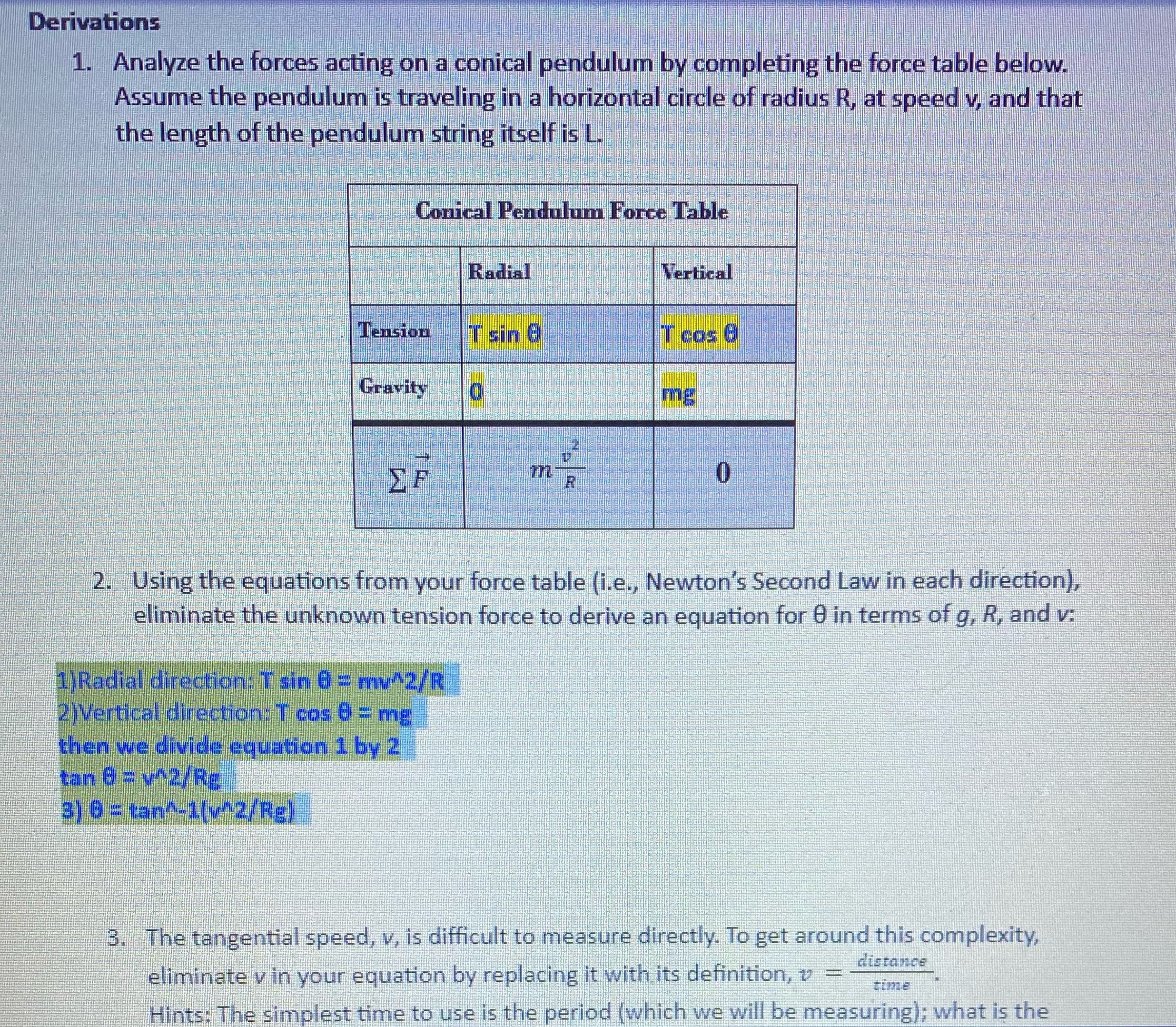
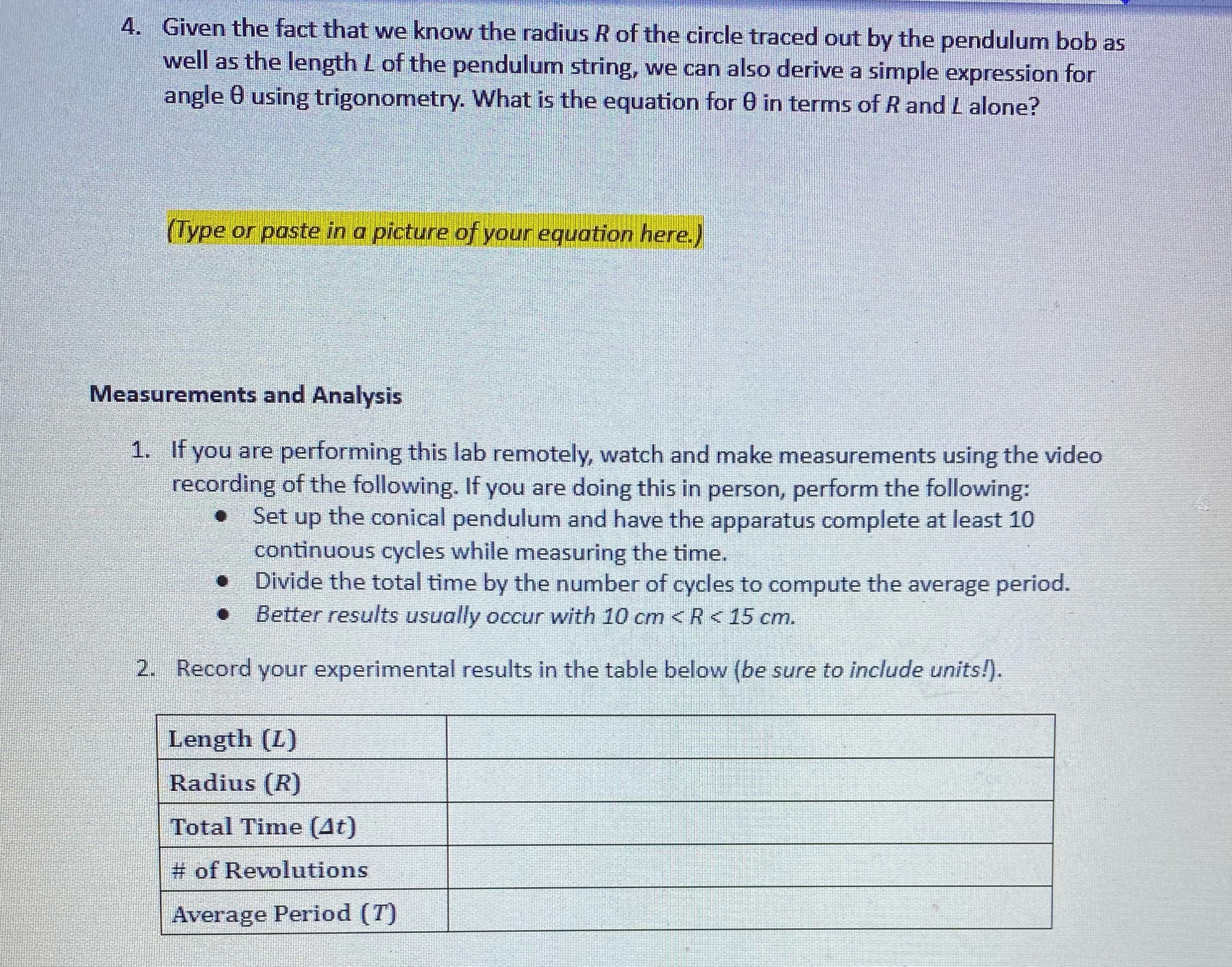
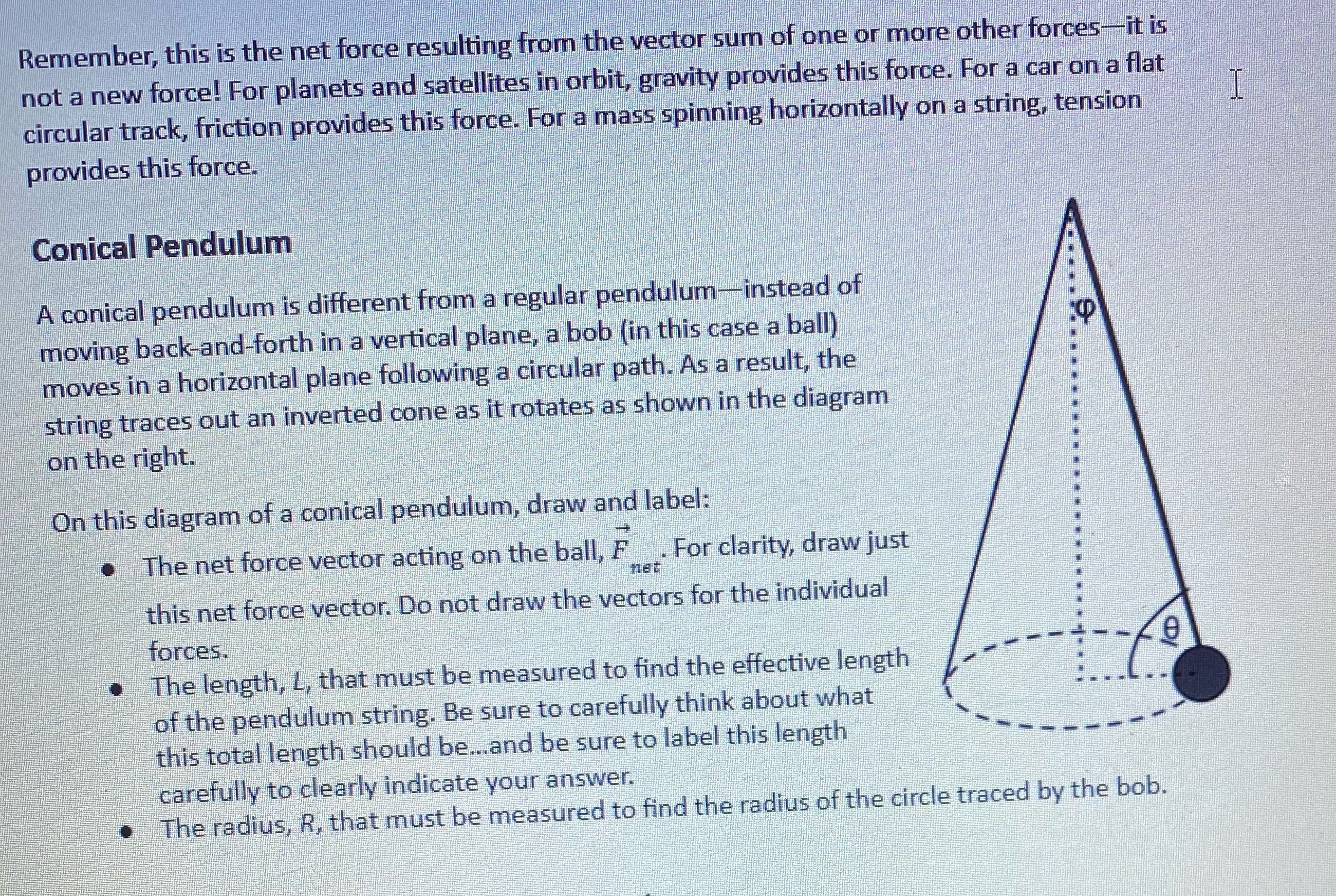
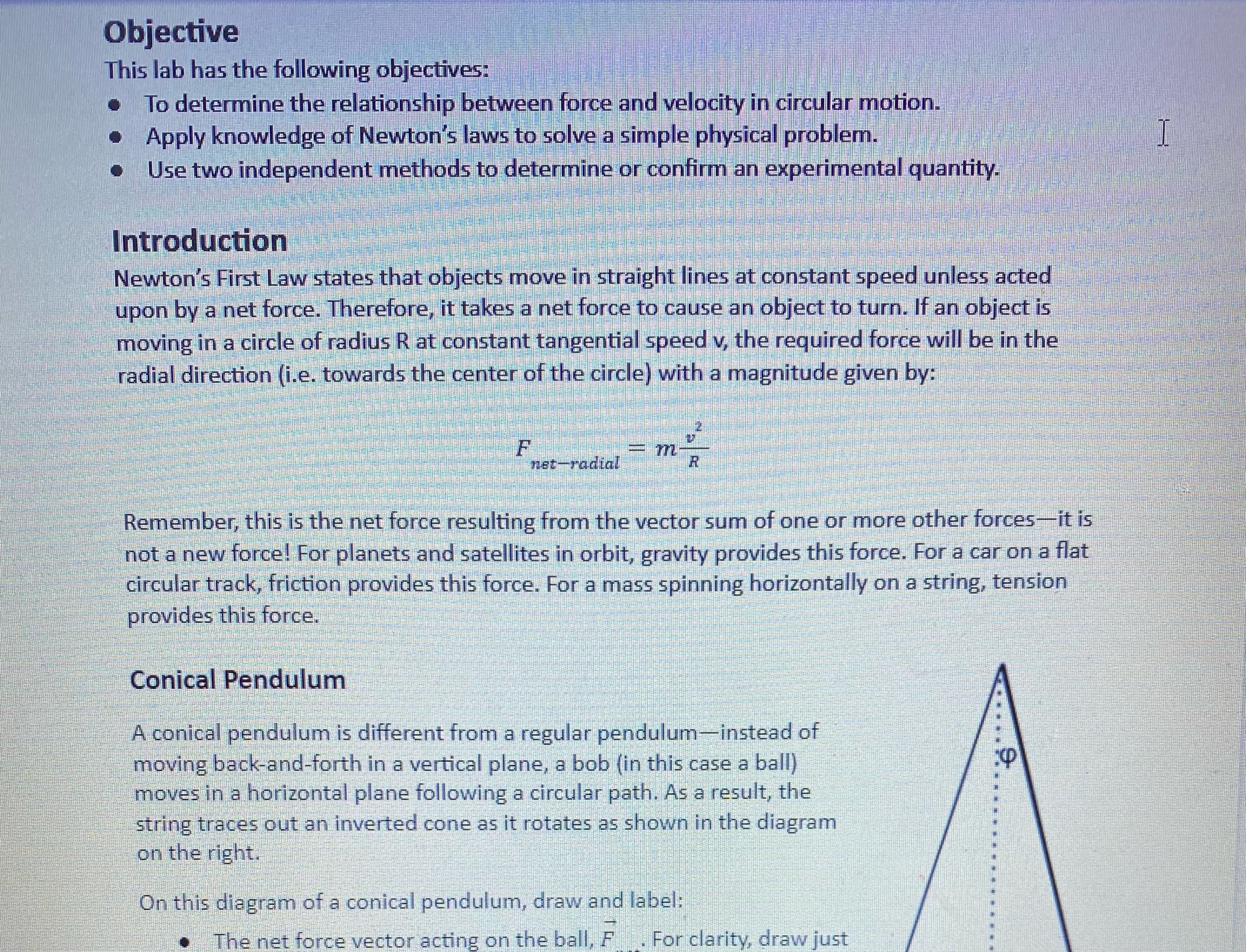
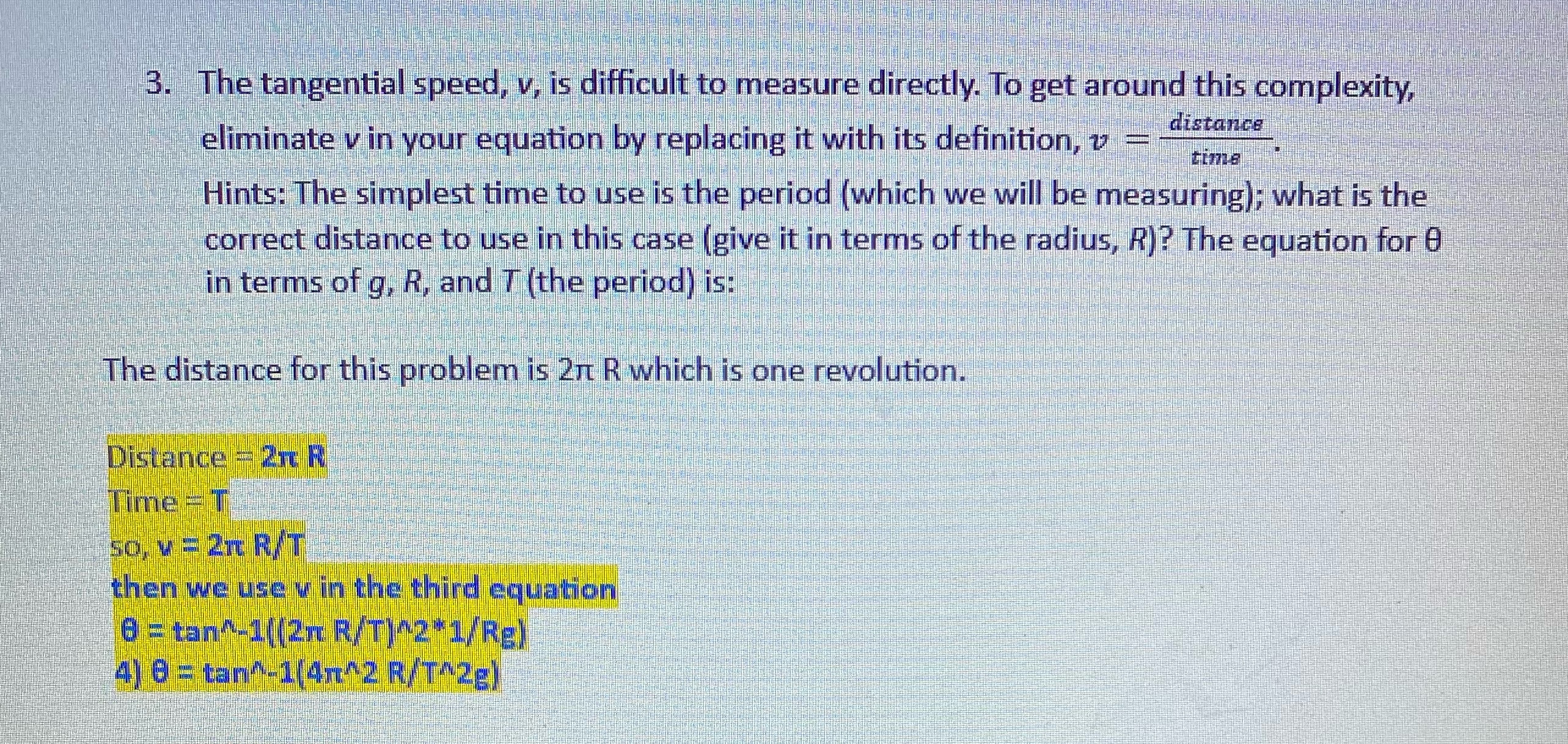
Derivations 1. Analyze the forces acting on a conical pendulum by completing the force table below. Assume the pendulum is traveling in a horizontal circle of radius R, at speed v, and that the length of the pendulum string itself is L. Conical Pendulum Force Table Radial Vertical Tension Tein E Gravity me EF MR 0 2. Using the equations from your force table (i.e., Newton's Second Law in each direction), eliminate the unknown tension force to derive an equation for 0 in terms of g, R, and v: 1)Radial direction: T sin 0 = mmv 2/R 2)Vertical direction: T then we divide equation 1 by 2 tan 8 = 442 3) 9 = tank-1[v2/Re) 3. The tangential speed, v, is difficult to measure directly. To get around this complexity, eliminate v in your equation by replacing it with its definition, v = - distance time Hints: The simplest time to use is the period (which we will be measuring); what is the4. Given the fact that we know the radius R of the circle traced out by the pendulum bob as well as the length L of the pendulum string, we can also derive a simple expression for angle 0 using trigonometry. What is the equation for 0 in terms of R and _ alone? (Type or paste in a picture of your equation here.) Measurements and Analysis 1. If you are performing this lab remotely, watch and make measurements using the video recording of the following. If you are doing this in person, perform the following: Set up the conical pendulum and have the apparatus complete at least 10 continuous cycles while measuring the time. Divide the total time by the number of cycles to compute the average period. Better results usually occur with 10 cm
Step by Step Solution
There are 3 Steps involved in it

Get step-by-step solutions from verified subject matter experts
 Study Help