







Question: b. (i) (ii) (iii) (iv) Assume that the frictional force with the atmosphere F, acting in the opposite direction to the velocity v =
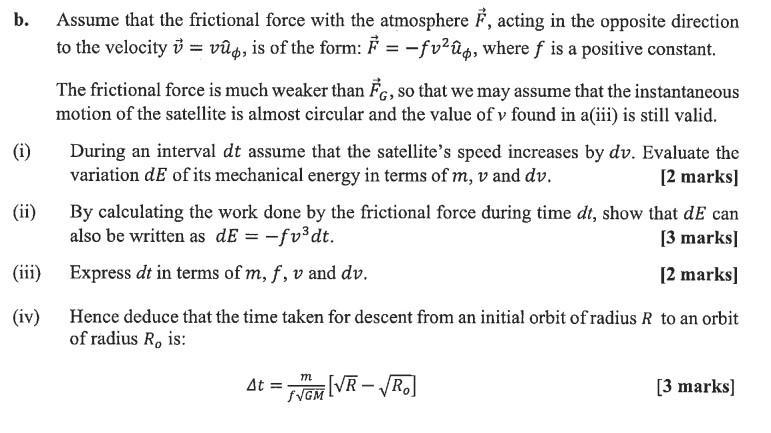
b. (i) (ii) (iii) (iv) Assume that the frictional force with the atmosphere F, acting in the opposite direction to the velocity v = v, is of the form: F = -fv, where f is a positive constant. The frictional force is much weaker than FG, so that we may assume that the instantaneous motion of the satellite is almost circular and the value of v found in a(iii) is still valid. During an interval dt assume that the satellite's speed increases by dv. Evaluate the variation dE of its mechanical energy in terms of m, v and dv. [2 marks] By calculating the work done by the frictional force during time dt, show that de can also be written as dE = -fvdt. [3 marks] Express dt in terms of m, f, v and dv. [2 marks] Hence deduce that the time taken for descent from an initial orbit of radius R to an orbit of radius R, is: 4t = m FVGM VR-RO [3 marks]
Step by Step Solution
3.54 Rating (158 Votes )
There are 3 Steps involved in it
To solve this problem lets go through each part stepbystep i Variation of Mechanical Energy The mech... View full answer

Get step-by-step solutions from verified subject matter experts
 Study Help