







Question: derive a symbolic expression for the maximum net conversion efficiency of the cycle, ncycle, the ratio of the net amount of work produced compared to
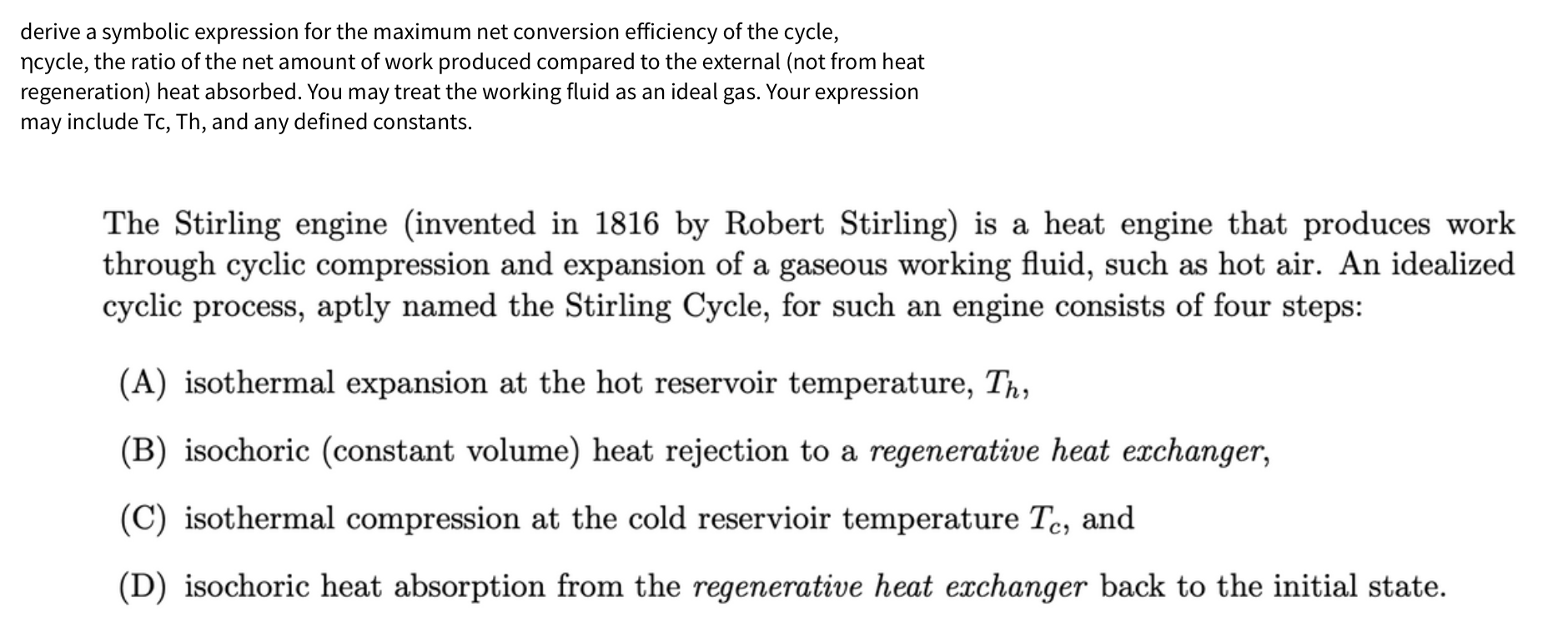
derive a symbolic expression for the maximum net conversion efficiency of the cycle, ncycle, the ratio of the net amount of work produced compared to the external (not from heat regeneration) heat absorbed. You may treat the working fluid as an ideal gas. Your expression may include Tc, Th, and any defined constants. The Stirling engine (invented in 1816 by Robert Stirling) is a heat engine that produces work through cyclic compression and expansion of a gaseous working fluid, such as hot air. An idealized cyclic process, aptly named the Stirling Cycle, for such an engine consists of four steps: (A) isothermal expansion at the hot reservoir temperature, Th, (B) isochoric (constant volume) heat rejection to a regenerative heat exchanger, (C) isothermal compression at the cold reservioir temperature Tc, and (D) isochoric heat absorption from the regenerative heat exchanger back to the initial state
Step by Step Solution
There are 3 Steps involved in it

Get step-by-step solutions from verified subject matter experts
 Study Help