







Question: Describe the strings that are represented by the regular expression R*((E|e) (+ | -)? R R*)? where, R = { 0, 1, 2,..., 9} What
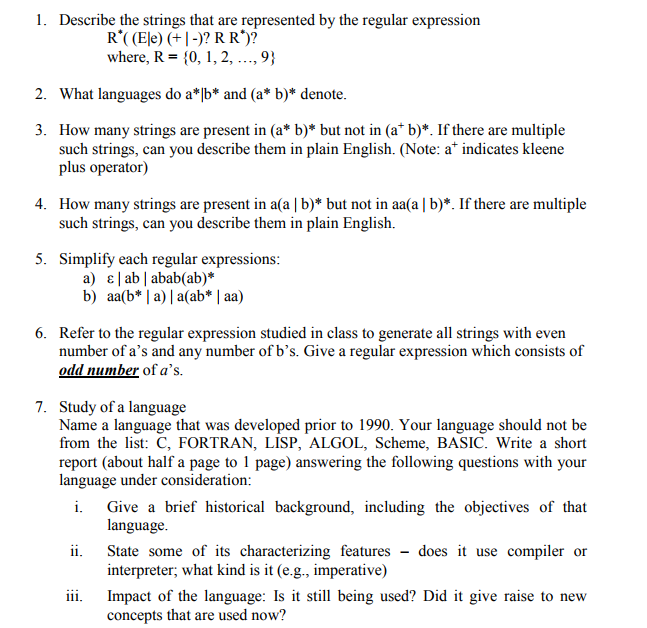
Describe the strings that are represented by the regular expression R*((E|e) (+ | -)? R R*)? where, R = { 0, 1, 2,..., 9} What languages do a*|b* and (a* b)* denote. How many strings are present in (a* b)* but not in (a^+ b)*. If there are multiple such strings, can you describe them in plain English. How many strings are present in a(a|b)* but not in aa(a|b)*. If there are multiple such strings, can you describe them in plain English. Simplify each regular expressions: a) epsilon |ab|abab(ab)* b) aa(b*|a) |a(ab*|aa) Refer to the regular expression studied in class to generate all strings with even number of a's and any number of b's. Give a regular expression which consists of odd number of a's. Study of a language Name a language that was developed prior to 1990. Your language should not be from the list: C, FORTRAN, LISP, ALGOL, Scheme, BASIC. Write a short report (about half a page to 1 page) answering the following questions with your language under consideration: i. Give a brief historical background, including the objectives of that language. ii. State some of its characterizing features - does it use compiler or interpreter, what kind is it (e.g., imperative) iii. Impact of the language: Is it still being used? Did it give raise to new concepts that are used now
Step by Step Solution
There are 3 Steps involved in it

Get step-by-step solutions from verified subject matter experts
 Study Help