







Question: Description Implement a Taylor series approximation of some mathematical functions In mathematics, the Taylor series is a way of approximating transcendental functions such as sin
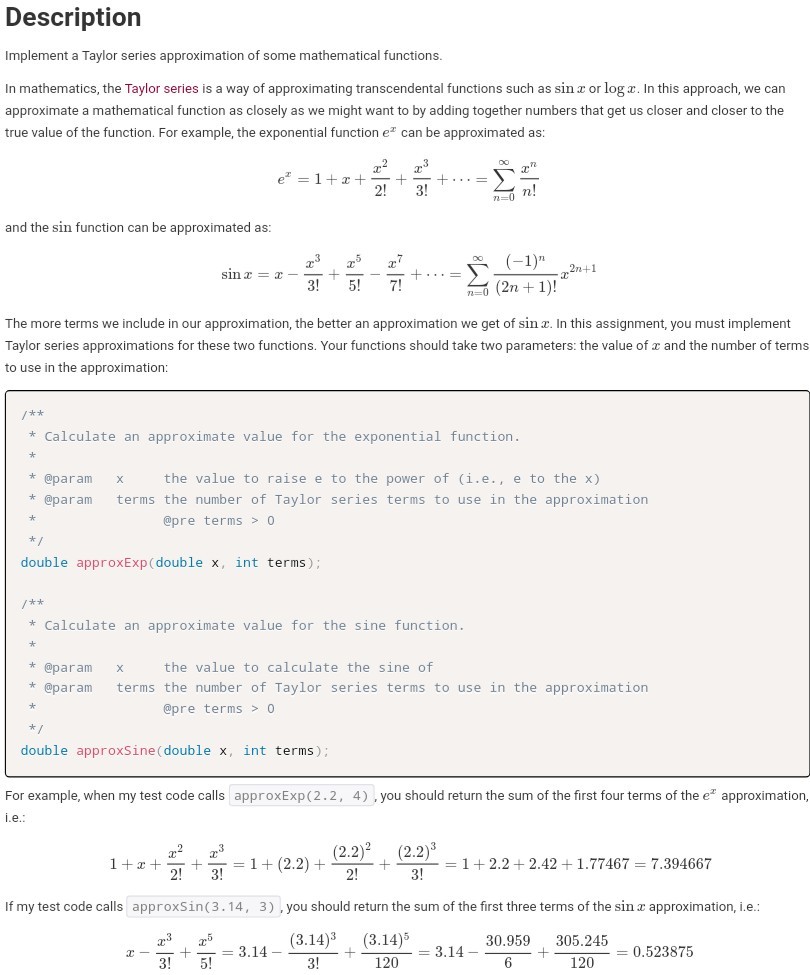
Description Implement a Taylor series approximation of some mathematical functions In mathematics, the Taylor series is a way of approximating transcendental functions such as sin or log x. In this approach, we can approximate a mathematical function as closely as we might want to by adding together numbers that get us closer and closer to the true value of the function. For example, the exponential function e can be approximated as n! and the sin function can be approximated as 2n+1 3! 5!7! (2n 1)! The more terms we include in our approximation, the better an approximation we get of sin x. In this assignment, you must implement Taylor series approximations for these two functions. Your functions should take two parameters: the value of r and the number of terms to use in the approximation * Calculate an approximate value for the exponential function the value to raise e to the power of (i.e, e to the x) @param x *@param terms the number of Taylor series terms to use in the approximation @pre terms>0 double approxExp (double x, int terms); /t * Calculate an approximate value for the sine function @param X *@param terms the number of Taylor series terms to use in the approximation the value to calculate the sine of @pre terms >0 double approxsine (double x, int terms); For example, when my test code calls approxExp(22, 4) , you should return the sum of the first four terms of the ez approximation .e (2.2) (2.2)3 2 2! 3! = 1 + 2.2 2.42 1.77467 7.394667 If my test code calls approxSin(3.14, 3) you should return the sum of the first three terms of the sin r approximation, i.e (3.14)3 (3.14)5 +3.14 120-= 3.14-30.959 120 0.523875 6
Step by Step Solution
There are 3 Steps involved in it

Get step-by-step solutions from verified subject matter experts
 Study Help