







Question: Description In three units of study, there will be application focused cases due at the beginning of the class that will be provided by the
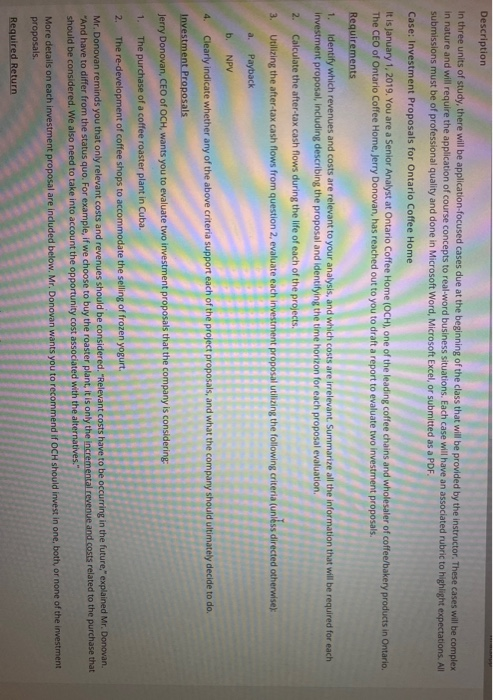
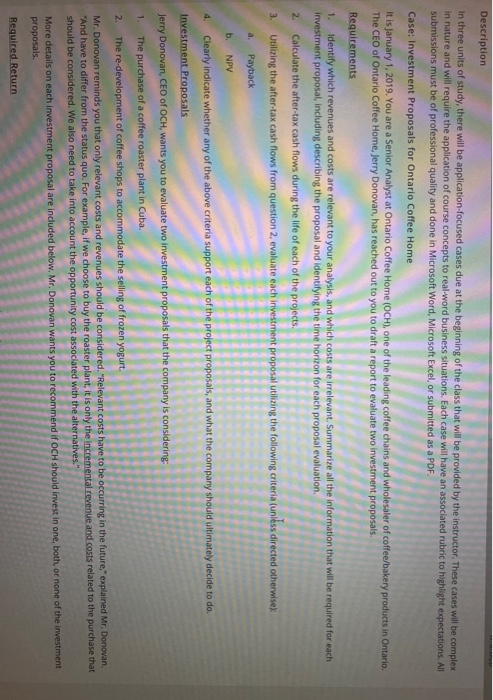
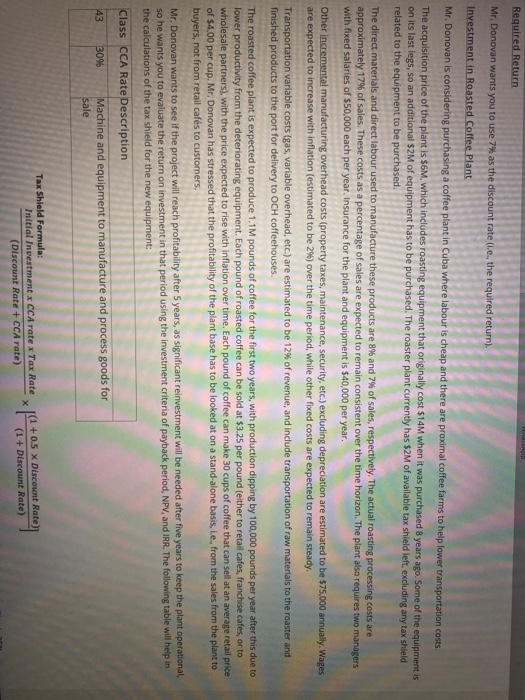
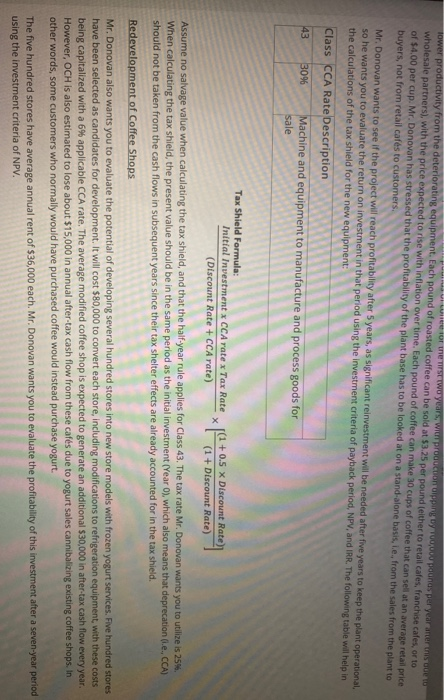
Description In three units of study, there will be application focused cases due at the beginning of the class that will be provided by the instructor. These cases will be complex in nature and will require the application of course concepts to real-word business situations. Each case will have an associated rubric to highlight expectations. All submissions must be of professional quality and done in Microsoft Word, Microsoft Excel, or submitted as a PDF Case: Investment Proposals for Ontario Coffee Home It is January 1, 2019. You are a Senior Analyst at Ontario Coffee Home (OCH), one of the leading coffee chains and wholesaler of coffee/bakery products in Ontario The CEO of Ontario Coffee Home, Jerry Donovan, has reached out to you to draft a report to evaluate two investment proposals. Requirements Identify which revenues and costs are relevant to your analysis, and which costs are irrelevant. Summarize all the information that will be required for each Investment proposal, including describing the proposal and identifying the time horizon for each proposal evaluation. Calculate the after-tax cash flows during the life of each of the projects. Utilizing the after-tax cash flows from question 2, evaluate each Investment proposal utilizing the following criteria (unless directed otherwisex 1. 2. 3. Payback b. NPV 4 Clearly indicate whether any of the above criteria support each of the project proposals, and what the company should ultimately decide to do Investment Proposals Jerry Donovan, CEO of OCH wants you to evaluate two investment proposals that the company is considering 1. The purchase of a coffee roaster plant in Cuba. 2 The re-development of coffee shops to accommodate the selling of frozen yogurt, Mr. Donovan reminds you that only relevant costs and revenues should be considered, "Relevant costs have to be occurring in the future," explained Mr. Donovan. "And have to differ from the status quo. For example, if we choose to buy the roaster plant, it is only the incremental revenue and costs related to the purchase that should be considered. We also need to take into account the opportunity cost associated with the alternatives." More details on each investment proposal are included below. Mr. Donovan wants you to recommend if OCH should invest in one, both, or none of the investment proposals. Required Return Description In three units of study, there will be application focused cases due at the beginning of the class that will be provided by the instructor. These cases will be complex in nature and will require the application of course concepts to real-word business situations. Each case will have an associated rubric to highlight expectations. All submissions must be of professional quality and done in Microsoft Word, Microsoft Excel, or submitted as a PDF Case: Investment Proposals for Ontario Coffee Home It is January 1, 2019. You are a Senior Analyst at Ontario Coffee Home (OCH), one of the leading coffee chains and wholesaler of coffee/bakery products in Ontario. The CEO of Ontario Coffee Home, Jerry Donovan, has reached out to you to draft a report to evaluate two investment proposals. Requirements 1. Identify which revenues and costs are relevant to your analysis, and which costs are irrelevant. Summarize all the information that will be required for each Investment proposal, including describing the proposal and identifying the time horizon for each proposal evaluation. Calculate the after-tax cash flows during the life of each of the projects. 3. utlizing the after-tax cash flows from question 2, evaluate each investment proposal utilizing the following criteria (unless directed otherwisex 2. a Payback b. NPV 4 Clearly indicate whether any of the above criteria support each of the project proposals, and what the company should ultimately decide to do Investment Proposals Jerry Donovan, CEO of OCH wants you to evaluate two investment proposals that the company is considering 1. The purchase of a coffee roaster plant in Cuba. 2 The re-development of coffee shops to accommodate the selling of frozen yogurt, Mr. Donovan reminds you that only relevant costs and revenues should be considered, "Relevant costs have to be occurring in the future," explained Mr. Donovan. "And have to differ from the status quo. For example, if we choose to buy the roaster plant, it is only the incremental revenue and costs related to the purchase that should be considered. We also need to take into account the opportunity cost associated with the alternatives." More details on each investment proposal are included below. Mr. Donovan wants you to recommend if OCH should invest in one, both, or none of the investment proposals. Required Return we neist two years woocoonopping by poona pery lower productivity from the deteriorating equipment. Each pound of roasted coffee can be sold at 53.25 per pound (either to retail cafes, franchise cafes, or to wholesale partners), with the price expected to rise with inflation over time. Each pound of coffee can make 30 cups of coffee that can sell at an average retail price of $4.00 per cup. Mr. Donovan has stressed that the profitability of the plant base has to be looked at on a stand-alone basis, ie, from the sales from the plant to buyers, not from retail cafs to customers. Mr. Donovan wants to see if the project will reach profitability after 5 years, as significant reinvestment will be needed after five years to keep the plant operational, so he wants you to evaluate the return on investment in that period using the investment criteria of payback period, NPV, and IRR. The following table will help in the calculations of the tax shield for the new equipment: Class CCA Rate Description 43 3096 Machine and equipment to manufacture and process goods for sale Tax Shield Formula: Initial Investment x CCA rate x Tax Rate X (Discount Rate + CCA rate) (141 ) (1 + Discount Rate) Assume no salvage value when calculating the tax shield, and that the half-year rule applies for Class 43. The tax rate Mr. Donovan wants you to utilize is 25% When calculating the tax shield, the present value should be in the same period as the initial investment (Year O), which also means that deprecation (... CCA) should not be taken from the cash flows in subsequent years since their tax shelter effects are already accounted for in the tax shield. Redevelopment of Coffee Shops Mr. Donovan also wants you to evaluate the potential of developing several hundred stores into new store models with frozen yogurt services. Five hundred stores have been selected as candidates for development. It will cost $80,000 to convert each store, including modifications to refrigeration equipment, with these costs being capitalized with a 6% applicable CCA rate. The average modified coffee shop is expected to generate an additional $30,000 in after-tax cash flow every year, However, OCH is also estimated to lose about $15,000 in annual after-tax cash flow from these cafs due to yogurt sales cannibalizing existing coffee shops. In other words, some customers who normally would have purchased coffee would instead purchase yogurt. The five hundred stores have average annual rent of $36,000 each. Mr. Donovan wants you to evaluate the profitability of this investment after a seven-year period using the investment criteria of NPV. Description In three units of study, there will be application focused cases due at the beginning of the class that will be provided by the instructor. These cases will be complex in nature and will require the application of course concepts to real-word business situations. Each case will have an associated rubric to highlight expectations. All submissions must be of professional quality and done in Microsoft Word, Microsoft Excel, or submitted as a PDF Case: Investment Proposals for Ontario Coffee Home It is January 1, 2019. You are a Senior Analyst at Ontario Coffee Home (OCH), one of the leading coffee chains and wholesaler of coffee/bakery products in Ontario The CEO of Ontario Coffee Home, Jerry Donovan, has reached out to you to draft a report to evaluate two investment proposals. Requirements Identify which revenues and costs are relevant to your analysis, and which costs are irrelevant. Summarize all the information that will be required for each Investment proposal, including describing the proposal and identifying the time horizon for each proposal evaluation. Calculate the after-tax cash flows during the life of each of the projects. Utilizing the after-tax cash flows from question 2, evaluate each Investment proposal utilizing the following criteria (unless directed otherwisex 1. 2. 3. Payback b. NPV 4 Clearly indicate whether any of the above criteria support each of the project proposals, and what the company should ultimately decide to do Investment Proposals Jerry Donovan, CEO of OCH wants you to evaluate two investment proposals that the company is considering 1. The purchase of a coffee roaster plant in Cuba. 2 The re-development of coffee shops to accommodate the selling of frozen yogurt, Mr. Donovan reminds you that only relevant costs and revenues should be considered, "Relevant costs have to be occurring in the future," explained Mr. Donovan. "And have to differ from the status quo. For example, if we choose to buy the roaster plant, it is only the incremental revenue and costs related to the purchase that should be considered. We also need to take into account the opportunity cost associated with the alternatives." More details on each investment proposal are included below. Mr. Donovan wants you to recommend if OCH should invest in one, both, or none of the investment proposals. Required Return Description In three units of study, there will be application focused cases due at the beginning of the class that will be provided by the instructor. These cases will be complex in nature and will require the application of course concepts to real-word business situations. Each case will have an associated rubric to highlight expectations. All submissions must be of professional quality and done in Microsoft Word, Microsoft Excel, or submitted as a PDF Case: Investment Proposals for Ontario Coffee Home It is January 1, 2019. You are a Senior Analyst at Ontario Coffee Home (OCH), one of the leading coffee chains and wholesaler of coffee/bakery products in Ontario. The CEO of Ontario Coffee Home, Jerry Donovan, has reached out to you to draft a report to evaluate two investment proposals. Requirements 1. Identify which revenues and costs are relevant to your analysis, and which costs are irrelevant. Summarize all the information that will be required for each Investment proposal, including describing the proposal and identifying the time horizon for each proposal evaluation. Calculate the after-tax cash flows during the life of each of the projects. 3. utlizing the after-tax cash flows from question 2, evaluate each investment proposal utilizing the following criteria (unless directed otherwisex 2. a Payback b. NPV 4 Clearly indicate whether any of the above criteria support each of the project proposals, and what the company should ultimately decide to do Investment Proposals Jerry Donovan, CEO of OCH wants you to evaluate two investment proposals that the company is considering 1. The purchase of a coffee roaster plant in Cuba. 2 The re-development of coffee shops to accommodate the selling of frozen yogurt, Mr. Donovan reminds you that only relevant costs and revenues should be considered, "Relevant costs have to be occurring in the future," explained Mr. Donovan. "And have to differ from the status quo. For example, if we choose to buy the roaster plant, it is only the incremental revenue and costs related to the purchase that should be considered. We also need to take into account the opportunity cost associated with the alternatives." More details on each investment proposal are included below. Mr. Donovan wants you to recommend if OCH should invest in one, both, or none of the investment proposals. Required Return we neist two years woocoonopping by poona pery lower productivity from the deteriorating equipment. Each pound of roasted coffee can be sold at 53.25 per pound (either to retail cafes, franchise cafes, or to wholesale partners), with the price expected to rise with inflation over time. Each pound of coffee can make 30 cups of coffee that can sell at an average retail price of $4.00 per cup. Mr. Donovan has stressed that the profitability of the plant base has to be looked at on a stand-alone basis, ie, from the sales from the plant to buyers, not from retail cafs to customers. Mr. Donovan wants to see if the project will reach profitability after 5 years, as significant reinvestment will be needed after five years to keep the plant operational, so he wants you to evaluate the return on investment in that period using the investment criteria of payback period, NPV, and IRR. The following table will help in the calculations of the tax shield for the new equipment: Class CCA Rate Description 43 3096 Machine and equipment to manufacture and process goods for sale Tax Shield Formula: Initial Investment x CCA rate x Tax Rate X (Discount Rate + CCA rate) (141 ) (1 + Discount Rate) Assume no salvage value when calculating the tax shield, and that the half-year rule applies for Class 43. The tax rate Mr. Donovan wants you to utilize is 25% When calculating the tax shield, the present value should be in the same period as the initial investment (Year O), which also means that deprecation (... CCA) should not be taken from the cash flows in subsequent years since their tax shelter effects are already accounted for in the tax shield. Redevelopment of Coffee Shops Mr. Donovan also wants you to evaluate the potential of developing several hundred stores into new store models with frozen yogurt services. Five hundred stores have been selected as candidates for development. It will cost $80,000 to convert each store, including modifications to refrigeration equipment, with these costs being capitalized with a 6% applicable CCA rate. The average modified coffee shop is expected to generate an additional $30,000 in after-tax cash flow every year, However, OCH is also estimated to lose about $15,000 in annual after-tax cash flow from these cafs due to yogurt sales cannibalizing existing coffee shops. In other words, some customers who normally would have purchased coffee would instead purchase yogurt. The five hundred stores have average annual rent of $36,000 each. Mr. Donovan wants you to evaluate the profitability of this investment after a seven-year period using the investment criteria of NPV
Step by Step Solution
There are 3 Steps involved in it

Get step-by-step solutions from verified subject matter experts
 Study Help