







Question: Description It is often necessary that we understand the surrounding environment using sensors. To design sensors and their associated circuitry, and to obtain and processor
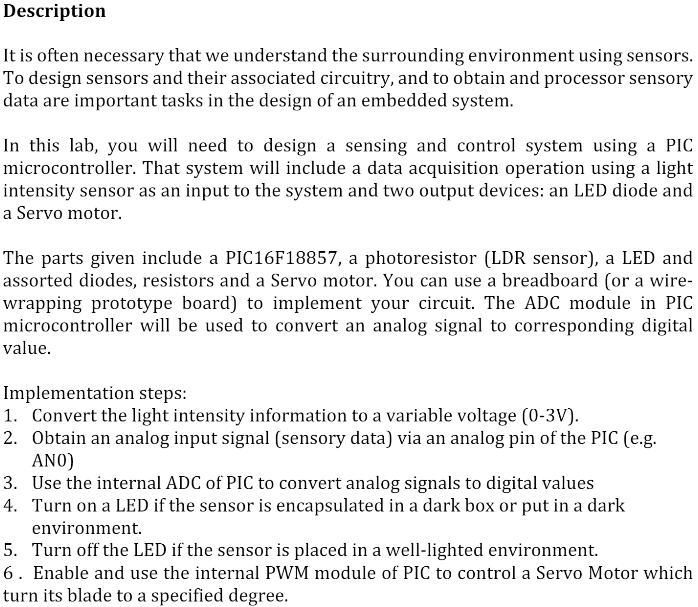
Description It is often necessary that we understand the surrounding environment using sensors. To design sensors and their associated circuitry, and to obtain and processor sensory data are important tasks in the design of an embedded system. In this lab, you will need to design a sensing and control system using a PIC microcontroller. That system will include a data acquisition operation using a light intensity sensor as an input to the system and two output devices: an LED diode and a Servo motor The parts given include a PIC16F18857, a photoresistor (LDR sensor), a LED and assorted diodes, resistors and a Servo motor. You can use a breadboard (or a wire- wrapping prototype board) to implement your circuit. The ADC module in PIC microcontroller will be used to convert an analog signal to corresponding digital value. Implementation steps: 1. Convert the light intensity information to a variable voltage (0-3V). 2. Obtain an analog input signal (sensory data) via an analog pin of the PIC (e.g. ANO) 3. Use the internal ADC of PIC to convert analog signals to digital values 4. Turn on a LED if the sensor is encapsulated in a dark box or put in a dark environment. 5. Turn off the LED if the sensor is placed in a well-lighted environment. 6. Enable and use the internal PWM module of PIC to control a Servo Motor which turn its blade to a specified degree. Description It is often necessary that we understand the surrounding environment using sensors. To design sensors and their associated circuitry, and to obtain and processor sensory data are important tasks in the design of an embedded system. In this lab, you will need to design a sensing and control system using a PIC microcontroller. That system will include a data acquisition operation using a light intensity sensor as an input to the system and two output devices: an LED diode and a Servo motor The parts given include a PIC16F18857, a photoresistor (LDR sensor), a LED and assorted diodes, resistors and a Servo motor. You can use a breadboard (or a wire- wrapping prototype board) to implement your circuit. The ADC module in PIC microcontroller will be used to convert an analog signal to corresponding digital value. Implementation steps: 1. Convert the light intensity information to a variable voltage (0-3V). 2. Obtain an analog input signal (sensory data) via an analog pin of the PIC (e.g. ANO) 3. Use the internal ADC of PIC to convert analog signals to digital values 4. Turn on a LED if the sensor is encapsulated in a dark box or put in a dark environment. 5. Turn off the LED if the sensor is placed in a well-lighted environment. 6. Enable and use the internal PWM module of PIC to control a Servo Motor which turn its blade to a specified degree
Step by Step Solution
There are 3 Steps involved in it

Get step-by-step solutions from verified subject matter experts
 Study Help