







Question: # Description Worker / Supervisor Managerial staff category staff Highly engaged employees 13% 18% 23% Highly disengaged employees 15% 5% 2% High Loyalty employees 85%
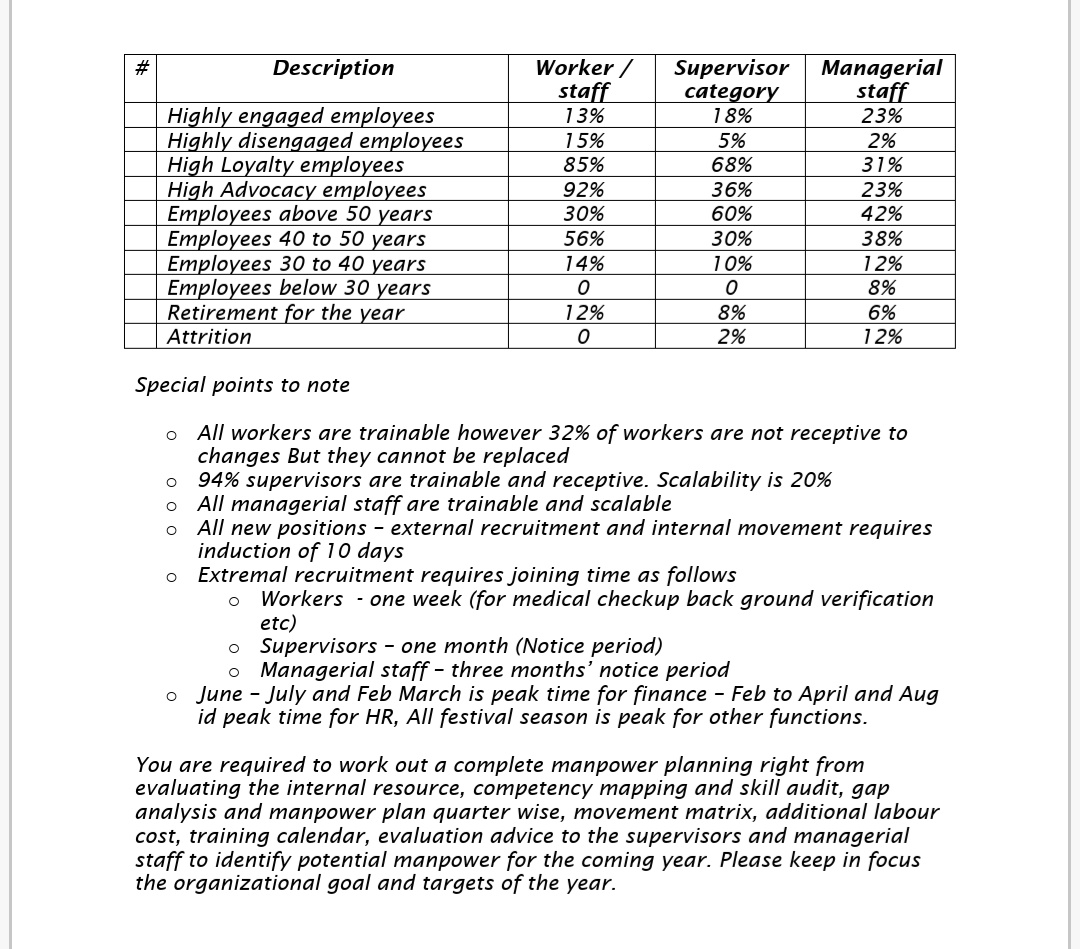
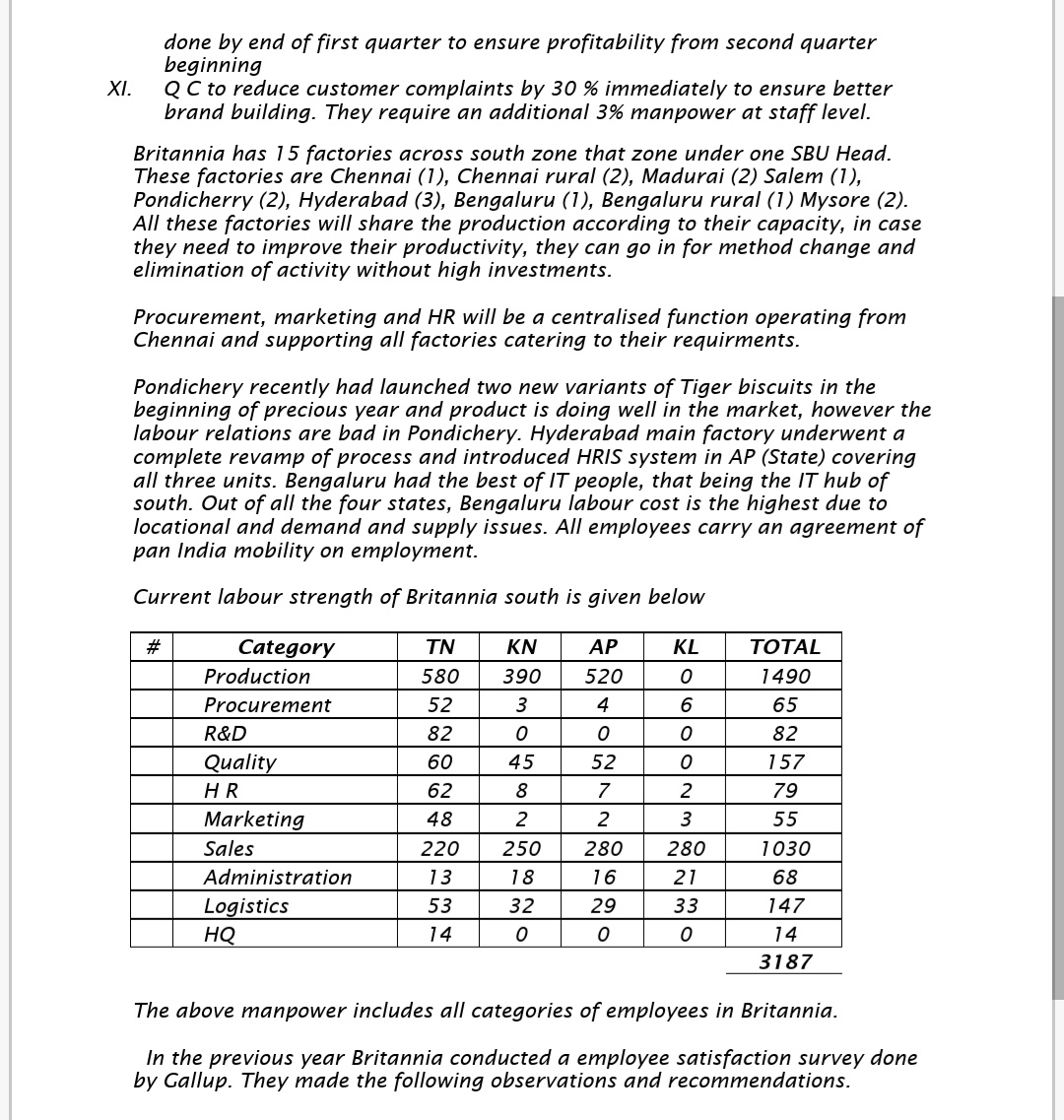
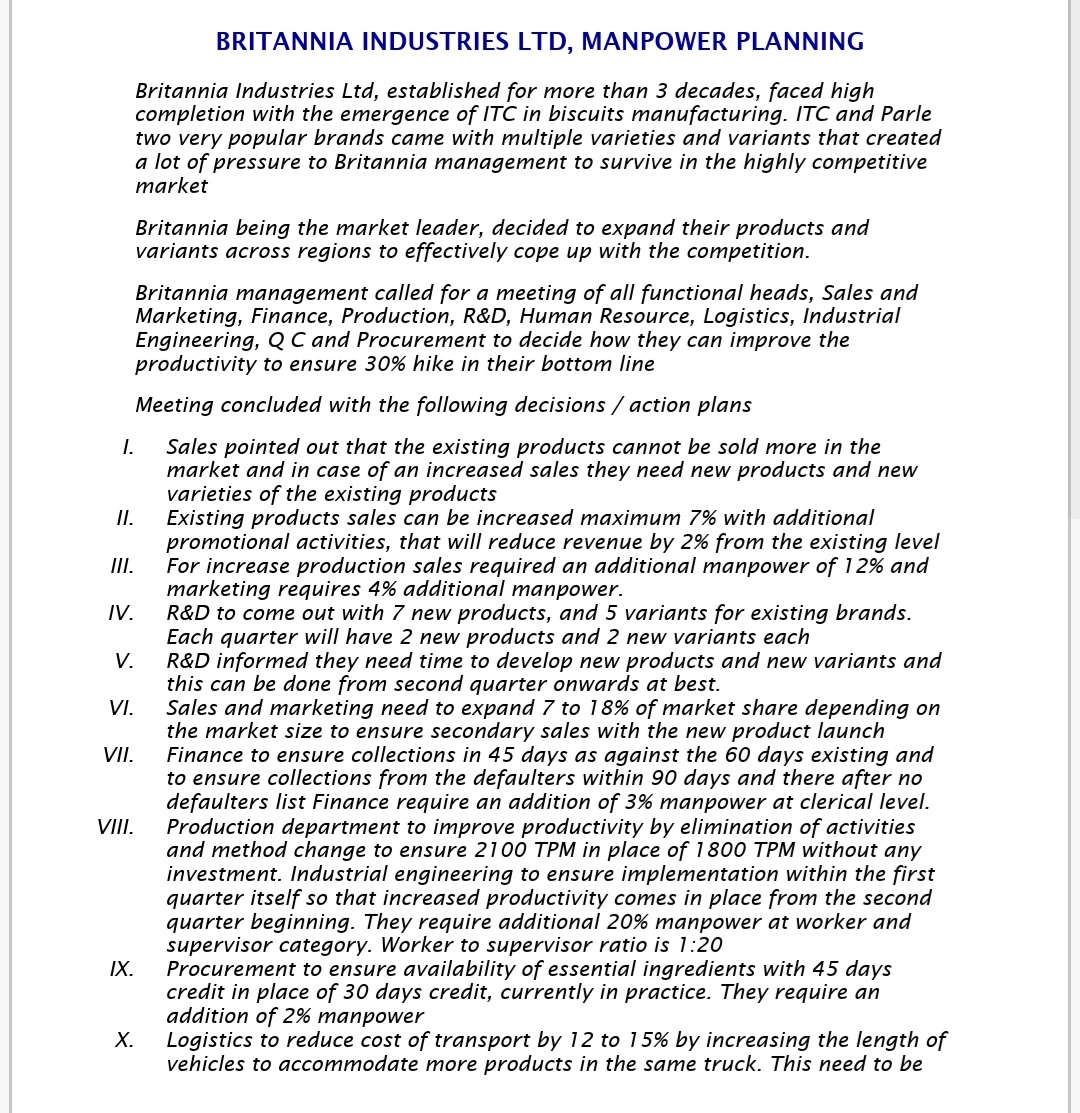
# Description Worker / Supervisor Managerial staff category staff Highly engaged employees 13% 18% 23% Highly disengaged employees 15% 5% 2% High Loyalty employees 85% 68% 31% High Advocacy employees 92% 36% 23% Employees above 50 years 30% 60% 42% Employees 40 to 50 years 56% 30% 38% Employees 30 to 40 years 14% 10% 12% Employees below 30 years 0 O 8% Retirement for the year 12% 8% 6% Attrition 0 2% 12% Special points to note O All workers are trainable however 32% of workers are not receptive to changes But they cannot be replaced O 94% supervisors are trainable and receptive. Scalability is 20% o All managerial staff are trainable and scalable o All new positions - external recruitment and internal movement requires induction of 10 days O Extremal recruitment requires joining time as follows Workers - one week (for medical checkup back ground verification etc) o Supervisors - one month (Notice period) o Managerial staff - three months notice period o June - July and Feb March is peak time for finance - Feb to April and Aug id peak time for HR, All festival season is peak for other functions. You are required to work out a complete manpower planning right from evaluating the internal resource, competency mapping and skill audit, gap analysis and manpower plan quarter wise, movement matrix, additional labour cost, training calendar, evaluation advice to the supervisors and managerial staff to identify potential manpower for the coming year. Please keep in focus the organizational goal and targets of the year.done by end of first quarter to ensure profitability from second quarter beginning XI. Q C to reduce customer complaints by 30 % immediately to ensure better brand building. They require an additional 3% manpower at staff level. Britannia has 15 factories across south zone that zone under one SBU Head. These factories are Chennai (1), Chennai rural (2), Madurai (2) Salem (1), Pondicherry (2), Hyderabad (3), Bengaluru (1), Bengaluru rural (1) Mysore (2). All these factories will share the production according to their capacity, in case they need to improve their productivity, they can go in for method change and elimination of activity without high investments. Procurement, marketing and HR will be a centralised function operating from Chennai and supporting all factories catering to their requirments. Pondichery recently had launched two new variants of Tiger biscuits in the beginning of precious year and product is doing well in the market, however the labour relations are bad in Pondichery. Hyderabad main factory underwent a complete revamp of process and introduced HRIS system in AP (State) covering all three units. Bengaluru had the best of IT people, that being the IT hub of south. Out of all the four states, Bengaluru labour cost is the highest due to locational and demand and supply issues. All employees carry an agreement of pan India mobility on employment. Current labour strength of Britannia south is given below # Category TN KN AP KL TOTAL Production 580 390 520 0 1490 Procurement 52 3 4 6 65 R&D 82 0 0 0 32 Quality 60 45 52 0 157 H R 62 8 7 2 79 Marketing 18 2 2 3 55 Sales 220 250 280 280 1030 Administration 13 18 16 21 68 Logistics 53 32 29 33 147 HQ 14 0 0 0 14 3187 The above manpower includes all categories of employees in Britannia. In the previous year Britannia conducted a employee satisfaction survey done by Gallup. They made the following observations and recommendations.l. ll. ill. 1 V. Vi. Vll. Vill. lX. BRITANNIA INDUSTRIES LTD, MANPOWER PLANNING Britannia Industries Ltd, established for more than 3 decades, faced high completion with the emergence of lTC in biscuits manufacturing. lTC and Parle two very popular brands came with multiple varieties and variants that created a lot of pressure to Britannia management to survive in the highly competitive market Britannia being the market leader, decided to expand their products and variants across regions to effectively cope up with the competition. Britannia management called for a meeting of all functional heads, Sales and Marketing, Finance, Production, R&D, Human Resource, Logistics, industrial Engineering, Q C and Procurement to decide how they can improve the productivity to ensure 30% hike in their bottom line Meeting concluded with the following decisions / action plans Sales pointed out that the existing products cannot be sold more in the market and in case of an increased sales they need new products and new varieties of the existing products Existing products sales can be increased maximum 7% with additional promotional activities, that will reduce revenue by 2% from the existing level For increase production sales required an additional manpower of 12% and marketing requires 4% additional manpower. R&D to come out with 7 new products, and 5 variants for existing brands. Each quarter will have 2 new products and 2 new variants each R&D informed they need time to develop new products and new variants and this can be done from second quarter onwards at best. Sales and marketing need to expand 7 to 18% of market share depending on the market size to ensure secondary sales with the new product launch Finance to ensure collections in 45 days as against the 60 days existing and to ensure collections from the defaulters within 90 days and there after no defaulters list Finance require an addition of 3% manpower at clerical level. Production department to improve productivity by elimination of activities and method change to ensure 2100 TPM in place of 1800 TPM without any investment. industrial engineering to ensure implementation within the rst quarter itself so that increased productivity comes in place from the second quarter beginning. They require additional 20% manpower at worker and supervisor category. Worker to supervisor ratio is 1:20 Procurement to ensure availability of essential ingredients with 45 days credit in place of 30 days credit, currently in practice. They require an addition of 2% manpower Logistics to reduce cost of transport by 12 to 15% by increasing the length of vehicles to accommodate more products in the same truck. This need to be
Step by Step Solution
There are 3 Steps involved in it

Get step-by-step solutions from verified subject matter experts
 Study Help