







Question: Design an algorithm to find all the non-common elements in two sorted lists of numbers . For example, for the lists 1, 1, 2, 3,
Design an algorithm to find all the non-common elements in two sorted lists of numbers. For example, for the lists 1, 1, 2, 3, 5, 5 and 2, 2, 3, 4, 5, 7, the output should be 1, 4, 7. What is the maximum number of comparisons your algorithm makes if the lengths of the two given lists are m and n, respectively?
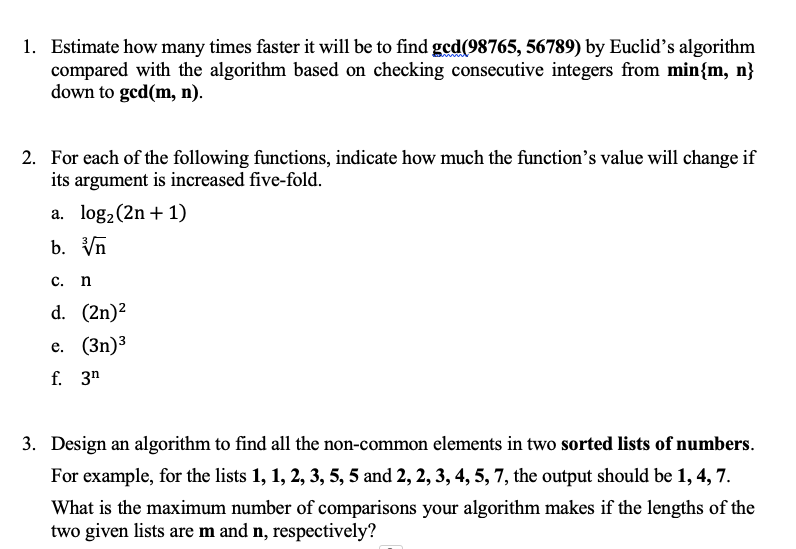
1. Estimate how many times faster it will be to find gcd(98765, 56789) by Euclid's algorithm compared with the algorithm based on checking consecutive integers from min{m, n} down to gcd(m, n). 2. For each of the following functions, indicate how much the function's value will change if its argument is increased five-fold. a. log2 (2n +1) b. Vn c. n d. (2n) e. (3n)3 f. 3n 3. Design an algorithm to find all the non-common elements in two sorted lists of numbers. For example, for the lists 1, 1, 2, 3, 5, 5 and 2, 2, 3, 4, 5, 7, the output should be 1, 4, 7. What is the maximum number of comparisons your algorithm makes if the lengths of the two given lists are m and n, respectively
Step by Step Solution
There are 3 Steps involved in it

Get step-by-step solutions from verified subject matter experts
 Study Help