







Question: Design an efficient algorithm (pseudo code) that track the k shortest strings (not sorted) seen so far, assuming a string length function that takes unit
Design an efficient algorithm (pseudo code) that track the k shortest strings (not sorted) seen so far, assuming a string length function that takes unit time. The strings are presented in streaming fashion and cannot be revisited if not saved. For example, if we want to keep 3 shortest strings (k = 3) from the following input stream: fiu, scis, cop5407, spring, 2023; the output result is fiu, scis, 2023. Analyze the complexity of your algorithm in terms the required number k of shortest strings, and the input stream size n 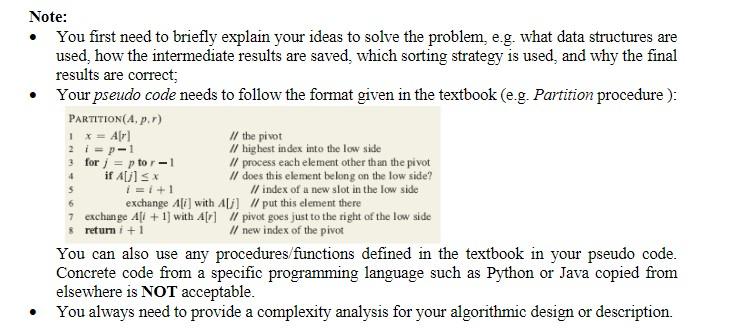
Note: - You first need to briefly explain your ideas to solve the problem, e.g. what data structures are used, how the intermediate results are saved, which sorting strategy is used, and why the final results are correct; - Your pseudo code needs to follow the format given in the textbook (e.g. Partition procedure ): PARTITION (A,p,r) You can also use any procedures/functions defined in the textbook in your pseudo code. Concrete code from a specific programming language such as Python or Java copied from elsewhere is NOT acceptable. - You always need to provide a complexity analysis for your algorithmic design or description
Step by Step Solution
There are 3 Steps involved in it

Get step-by-step solutions from verified subject matter experts
 Study Help