







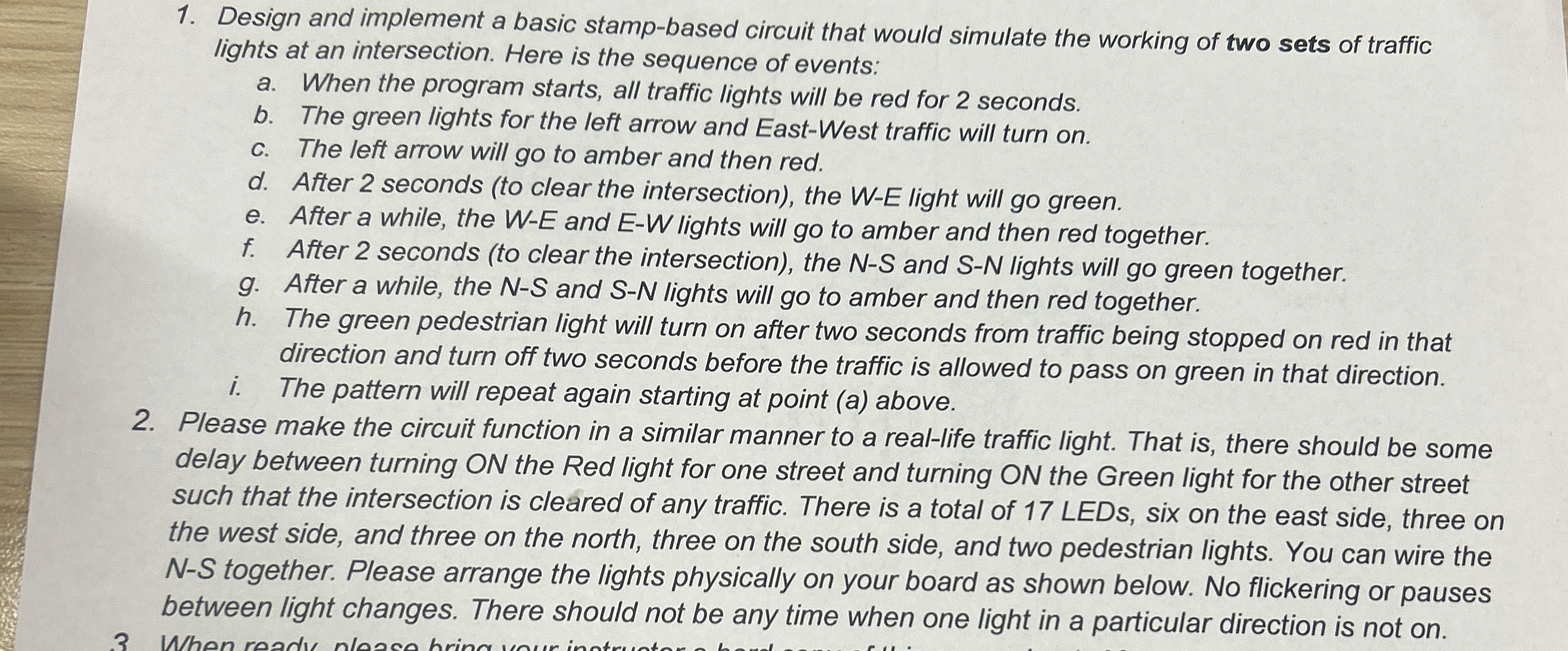
Question: Design and implement a basic stamp - based circuit that would simulate the working of two sets of traffic lights at an intersection. Here is
Design and implement a basic stampbased circuit that would simulate the working of two sets of traffic
lights at an intersection. Here is the sequence of events:
a When the program starts, all traffic lights will be red for seconds.
b The green lights for the left arrow and EastWest traffic will turn on
c The left arrow will go to amber and then red.
d After seconds to clear the intersection the WE light will go green.
e After a while, the and W lights will go to amber and then red together.
f After seconds to clear the intersection the NS and SN lights will go green together.
g After a while, the and lights will go to amber and then red together.
h The green pedestrian light will turn on after two seconds from traffic being stopped on red in that
direction and turn off two seconds before the traffic is allowed to pass on green in that direction.
i The pattern will repeat again starting at point a above.
Please make the circuit function in a similar manner to a reallife traffic light. That is there should be some
delay between turning ON the Red light for one street and turning ON the Green light for the other street
such that the intersection is cleared of any traffic. There is a total of LEDs, six on the east side, three on
the west side, and three on the north, three on the south side, and two pedestrian lights. You can wire the
NS together. Please arrange the lights physically on your board as shown below. No flickering or pauses
between light changes. There should not be any time when one light in a particular direction is not on
Step by Step Solution
There are 3 Steps involved in it
1 Expert Approved Answer
Step: 1 Unlock

Question Has Been Solved by an Expert!
Get step-by-step solutions from verified subject matter experts
Step: 2 Unlock
Step: 3 Unlock
 Study Help