







Question: Design and implement the multiplication and addition funcitons... Design and implement the multiplication and addition functions between two double precision operands. The return values from
Design and implement the multiplication and addition funcitons...
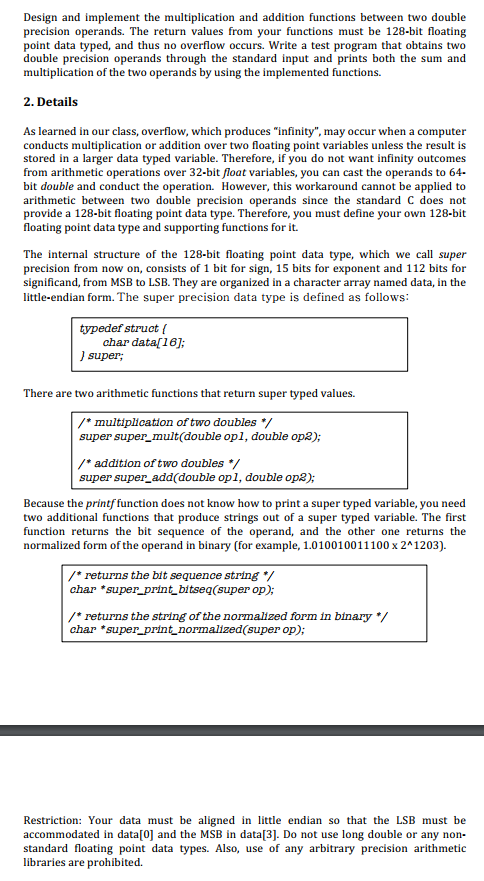
Design and implement the multiplication and addition functions between two double precision operands. The return values from your functions must be 128-bit floating point data typed, and thus no overflow occurs. Write a test program that obtains two double precision operands through the standard input and prints both the sum and multiplication of the two operands by using the implemented functions. 2. Details As learned in our class, overflow, which produces "infinity", may occur when a computer conducts multiplication or addition over two floating point variables unless the result is stored in a larger data typed variable. Therefore, if you do not want infinity outcomes from arithmetic operations over 32-bit float variables, you can cast the operands to 64- bit double and conduct the operation. However, this workaround cannot be applied to arithmetic between two double precision operands since the standard C does not provide a 128-bit floating point data type. Therefore, you must define your own 128-bit floating point data type and supporting functions for it. The internal structure of the 128-bit floating point data type, which we call super precision from now on, consists of 1 bit for sign, 15 bits for exponent and 112 bits for significand, from MS to LSB. They are organized in a character array named data, in the little-endian form. The super precision data type is defined as follows typedef struct ! char data 16]; super There are two arithmetic functions that return super typed values. multiplication of two doubles * super super_mult(double opl, doble op3); /addition of two doubles * super super add(double opl, double op3); Because the printffunction does not know how to print a super typed variable, you need two additional functions that produce strings out of a super typed variable. The first function returns the bit sequence of the operand, and the other one returns the normalized form of the operand in binary (for example, 1.010010011100 x 241203). returns the bit sequence string* char *super print bitseq(super op); /* returns the string of the normalized form in binary char *super print_normalized(super op); Restriction: Your data must be aligned in little endian so that the LSB must be accommodated in data 0] and the MSB in data[3]. Do not use long double or any non- standard floating point data types. Also, use of any arbitrary precision arithmetic libraries are prohibited. Design and implement the multiplication and addition functions between two double precision operands. The return values from your functions must be 128-bit floating point data typed, and thus no overflow occurs. Write a test program that obtains two double precision operands through the standard input and prints both the sum and multiplication of the two operands by using the implemented functions. 2. Details As learned in our class, overflow, which produces "infinity", may occur when a computer conducts multiplication or addition over two floating point variables unless the result is stored in a larger data typed variable. Therefore, if you do not want infinity outcomes from arithmetic operations over 32-bit float variables, you can cast the operands to 64- bit double and conduct the operation. However, this workaround cannot be applied to arithmetic between two double precision operands since the standard C does not provide a 128-bit floating point data type. Therefore, you must define your own 128-bit floating point data type and supporting functions for it. The internal structure of the 128-bit floating point data type, which we call super precision from now on, consists of 1 bit for sign, 15 bits for exponent and 112 bits for significand, from MS to LSB. They are organized in a character array named data, in the little-endian form. The super precision data type is defined as follows typedef struct ! char data 16]; super There are two arithmetic functions that return super typed values. multiplication of two doubles * super super_mult(double opl, doble op3); /addition of two doubles * super super add(double opl, double op3); Because the printffunction does not know how to print a super typed variable, you need two additional functions that produce strings out of a super typed variable. The first function returns the bit sequence of the operand, and the other one returns the normalized form of the operand in binary (for example, 1.010010011100 x 241203). returns the bit sequence string* char *super print bitseq(super op); /* returns the string of the normalized form in binary char *super print_normalized(super op); Restriction: Your data must be aligned in little endian so that the LSB must be accommodated in data 0] and the MSB in data[3]. Do not use long double or any non- standard floating point data types. Also, use of any arbitrary precision arithmetic libraries are prohibited
Step by Step Solution
There are 3 Steps involved in it

Get step-by-step solutions from verified subject matter experts
 Study Help