Question: DESIGN PROTOTYPES INC. PROJECT MANAGEMENT (B): PLANNING THE ALPHA C306 PROJECT Patricia A. Lapoint, McMurry University Carrol R. Haggard, Fort Hays State University CASE DESCRIPTION
DESIGN PROTOTYPES INC. PROJECT MANAGEMENT (B): PLANNING THE ALPHA C306 PROJECT Patricia A. Lapoint, McMurry University Carrol R. Haggard, Fort Hays State University CASE DESCRIPTION The primary subject matter of this case concerns project management. This case can be used in Project Management, Operations Management, or Quality Management courses. The case has a difficulty level of four. The case is designed to be taught in two class hours and is expected to require four to six hours of outside preparation by students. CASE SYNOPSIS After 9 years at Design Prototypes Inc., Raef Conley is leading his first major project. While Raef had worked on several small projects, he has never taken on the leadership of a major project. The Alpha C306 project is a significant opportunity for him, one that could advance his career in many ways. Although excited about the opportunity, Raef is also somewhat anxious, as while there is the potential for career advancement, he is also well aware that failure could mean the end of his career at Design Prototypes. Raefs first task was to assemble a project team. Although he has selected his team, he still needs to get time commitments from the supervisors so that he can finalize the team. The case starts with Raef completing the team selection process where he encountered an unexpected complication which had to be resolved. The next step is to complete the project planning process. In order to do this, the team developed a Work Breakdown Schedule (WBS). However a Critical Path Analysis (CPA) revealed that the initial WBS did not meet the 18 month timeline established by management, therefore the team developed a revised WBS. The case revolves around the question of whether the revised WBS is feasible. DESIGN PROTOTYPES INC. PROJECT MANAGEMENT (B): PLANNING THE ALPHA C306 PROJECT Last year was an interesting, but challenging year for Raef Conley. Currently in his tenth year with the company, Raef felt blessed to have been on several project teams; but the most important opportunity was his being identified as the project manager for the Alpha C306 project. The last few months of the previous year were spent in the identification, interviewing, Page 74 Journal of the International Academy for Case Studies, Volume 20, Number 3, 2014 and the selection of the project team members. Eleven employees were pared down from a list of 16; all eleven were strong candidates for the Alpha C306 project, but only seven members could be selected. After considerable and careful thought, Raef made his decisions. The team members chosen are: Alison Whitley, Philip Lowery, Rae Beth Merson, Elroy Bennett, Pierce Kennedy, Billy Brown, and Robert Brandon (for information on the team members see Design Prototypes Inc. Project Management (A): Selecting the Team, 2012, authors withheld). Just before the holidays, Raef personally met with the seven candidates chosen for the project team to congratulate them for their commitment, and to reinforce the strong qualifications each of them would bring to the project task. The team members were eager to begin. Raef shared with them the tentative 18 month timeline and scheduled the first meeting for January 9th. Raef also knew that the four who were not chosen would have to be notified of his decision; he was not looking forward to this part of the process. He decided to tell each one in person of his decision. Due to a family emergency, Daniel Swenson was unavailable, so Raef was unable to contact Daniel before his Christmas break. What follows are the interviews with Margaret Sobel, Michael Matson, and Simon Wright. INTERVIEW WITH MARGARET SOBEL Raef: Hi Margaret, do you have a minute? Margaret: Sure, come on in and have a seat. Raef: I wanted to visit with you about the Alpha C306 project. Margaret: I figured as much. Raef: First, I would like to thank you for your interest in joining the Alpha C306 project team. Margaret: It was easy to show interest, as it sounds like such an exciting project. Raef: Hopefully, it will be. After taking a deep breath, Raef continues: There is no easy way to say this, Margaret but I am sorry to tell you that you were not selected as part of the team. Margaret: Can I ask why? Raef: It was a difficult choice, one not made any easier by the fact that all 11 of you as potential team members would bring unique qualifications to the team. You are obviously a valued member of the company, since in your 18 years here you have worked on a number of small projects, offering leadership on several of them. You have demonstrated that you can work well with a team. However, for this particular project I felt that the team needed more technical expertise, thus engineers comprise most of the team. While it may not be much solace, you were one of the 11 finalists and that says much about how well you are perceived within the company. Margaret: While I am disappointed, I can certainly understand, as being in Project Administration, I assumed that my selection would be an outside shot. Page 75 Journal of the International Academy for Case Studies, Volume 20, Number 3, 2014 Raef nodded in agreement. Margaret: Can I say that it is clear that you are familiar with my record with the company and I appreciate your thoughtful consideration. I also would like to thank you for personally coming to tell me of your decision. I know that this could not be easy and I appreciate your integrity in personally informing me. It is so much better than a highly impersonal memo or just an email. Raef: You are welcome. I hope that we can work together on some future project. Have a good day. Feeling a sense of relief that that meeting had gone so well, Raef, headed to the Civil Engineering department to visit with Michael Matson. Raef found Michael in the library looking over some blueprints. INTERVIEW WITH MICHAEL MATSON Raef: Hi Michael, do you have a minute? Michael: Sure, have a seat. Raef: First, I would like to thank you for your interest in joining the Alpha C306 project team. Interrupting, Michael says: It sounds like there is a but coming. Raef: Very perceptive and I am afraid you are right, I am sorry to tell you that you were not selected as part of the team. Michael: This is very disappointing, as an engineer, I think that I have much to offer the team, and I am eager to demonstrate what I can do. Raef: While you are an engineer, and the team consists mostly of engineers, they are electrical engineers. As a civil engineer, your skills are perceived to be in the area of building things and since this project involves the development of an electronic component, electrical engineers are perceived as being able to add more to the team. Michael: You know, civil engineers know about more than just steel and concrete. Your electronic component is going to have to fit into something, and who is going to design the casing? Huh? Component design is more than just shoving some electronics into a box, the shape and design of the housing can affect whether and how the electronics work. Did you think about that? Raef: You make a good point. The size of the team was limited and I had to select those individuals whose skills sets I thought would add most to the team. This is not personal and does not reflect on you or the nature of civil engineering. Michael, sarcastically: Nothing personal, I just think that you made a bad decision. Raef: I am sorry you feel that way. Goodbye. While the Matson interview hadnt gone as well as the one with Margaret Sobel, Raef was relieved in that he had only one more interview to go. Raefs last interview is with Simon Page 76 Journal of the International Academy for Case Studies, Volume 20, Number 3, 2014 Wright. Raef found Simon in the break room of the main administration building, where Simon was regaling several others about his playing golf on Saturday at the country club with the company president and 2 VPs. As Raef entered the others returned to work. INTERVIEW WITH SIMON WRIGHT Raef: Hi Simon, mind if I join you for a cup of coffee? Simon: Sure, have a seat. Raef: I came to see you to discuss the Alpha C306 project. Simon: I am really going to enjoy working on that project, it should be a huge boost to my career. Raef: Well, Simon, while I appreciate your enthusiasm in joining the Alpha C306 project team, I am sorry to tell you that you were not selected as part of the team. Simon, in disbelief: What? Raef: The team is limited to 7 members and including yourself, there were 11 outstanding potential team members. Those who were selected were those whose backgrounds would add the most to the team. Your 2 years with the company was the least of anyone being considered. Also, your expertise in public relations, while very useful after the project is completed, wasnt perceived as being as valuable as the expertise of the engineers who will actually be creating the Alpha C306. Simon: Listen, while I have only been employed here for 2 years, I grew up in this company. In case you werent aware, my father is the VP of Engineering, so I have spent my whole life here. And public relations is more than just writing press releases about new products, it is all about connections, and I have connections. When senior management has meetings on budget, selecting products for development, or the future of the company, who do you think is present at those meetings? Ill tell you, I am! Not only am I there so that I will know what is going on, but most importantly for you, I get to insert my opinion as to the appropriate decision to be made. My background in economics and my ability to provide economic analysis is viewed very favorably by senior management. Thus, not only do I have connections, more importantly, I have influence. Raef, somewhat defensively: I understand all of that, and those are some of the reasons why you were considered for the team. However, at this point, the budget and timeline have already been established, thus technical expertise was perceived as being more critical to completing the project. I had to select those individuals who could add most to the creation of Alpha C306. Simon: You are making a HUGE mistake by not including me on the team. We will see how the budget and timeline work out for you. Raef: I am sure that you dont mean that as a threat. I am confident that we have the support we need. Goodbye. Page 77 Journal of the International Academy for Case Studies, Volume 20, Number 3, 2014 Feeling a sense of relief that the interviews were completed, both with those who had been selected and those who werent, Raef could look forward to his holiday skiing trip where he could relax and put the Alpha project behind him for a few days. Since he didnt foresee any difficulties, he would wait until the New Year to contact the 7 supervisors to confirm the availability of the team members. According to the model for project management (see figure 1), planning the project is the third stage of project management. Planning the project involves the identification of the activities/tasks required for the project, an estimation of the each activitys task time, any precedence relationships between activities, and the cost estimates for both normal and crash conditions. Raef determined that it would likely take several meetings with the team to complete the planning phase of the project. However, before the team could actually get started, Raef had to confirm the availability of the selected team members. Figure 1 Project Management Process Model Selection Initiation Planning Delivery Closure Brown & Hyer, 2010, p. 13. As Raef prepared for his meeting with Lon Gray, Elroy Bennetts manager, he was not certain how Mr. Gray would respond now. After all, it had been several months since the initial conversation with Mr. Gray to release Elroy from the department to work on the Alpha C306 Project. In any event, he would find out shortly upon his arrival to Mr. Grays office. INTERVIEW WITH LON GRAY, ELROY BENNETTS MANAGER Raef: Good morning, Mr. Gray. I am so glad that you could speak with me on such short notice. Mr. Gray: Call me Lon.
Instructions
Refer case study for details of case and respond to the case question below:
- What is the result of the Critical Paths Analysis on the revised Work Breakdown Structure?
- Based on the results of the revised Critical Path Analysis, is the project feasible within the 18-month timeline established by, management? How long will it take to complete the project? What is the Critical Path?
- What information should Raef include in his presentation to management?
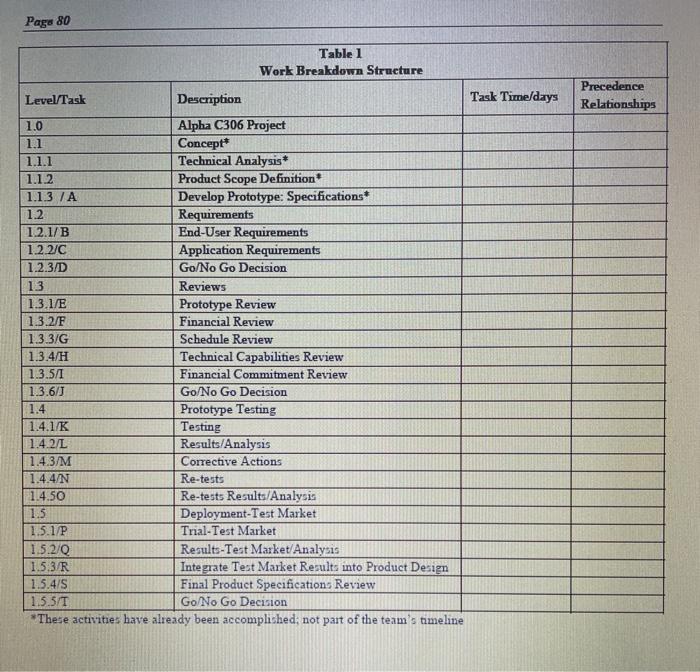
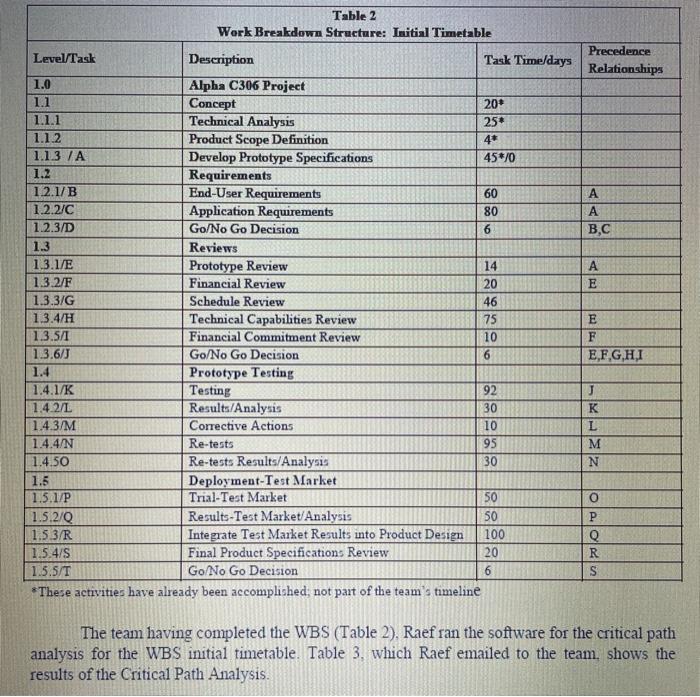
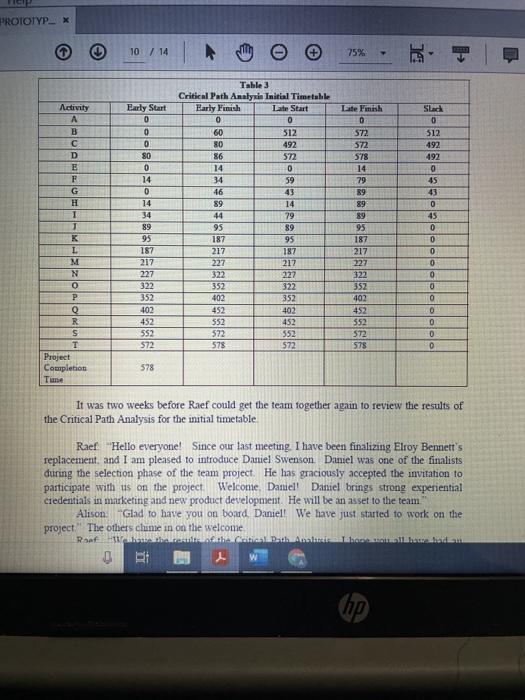
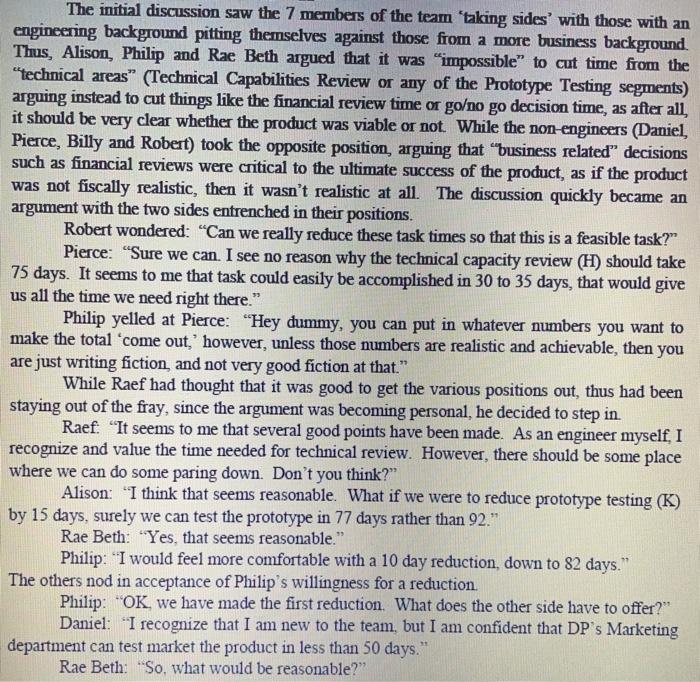
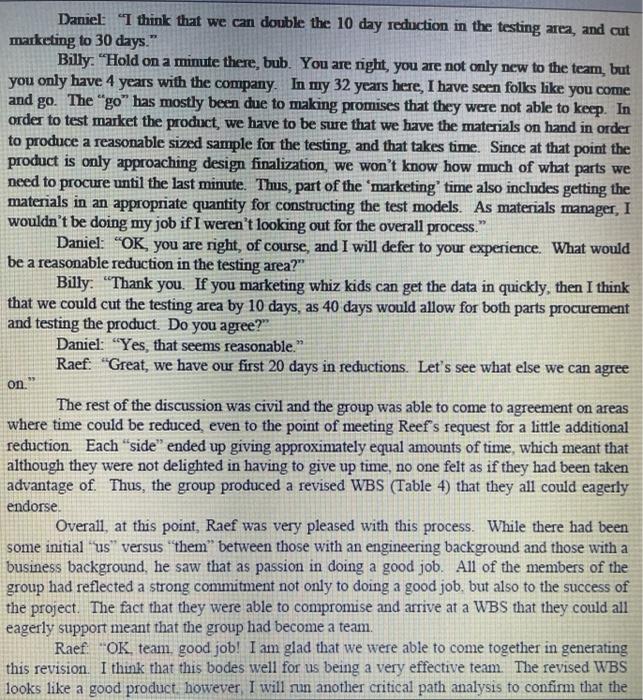
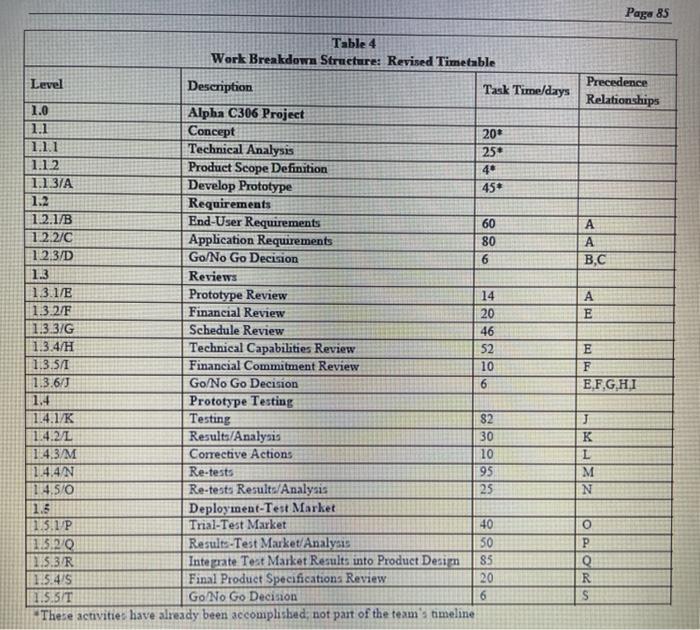
INTERVIEW WITH LON GRAY, ELROY BENNETT'S MANAGER Raef: "Good morning, Mr. Gray. I am so glad that you could speak with me on such short notice." Mr. Gray: "Call me Lon." Raef "OK. As you know from our earlier discussion last year, the Project Alpha C306 is now in the planning phase. We selected Elroy Bennett, one of your senior engineers to participate on the project team and he has agreed. However, as you also know, he is somewhat reluctant because of the time demands between the project and his responsibilities in the department. I am here today to see if we can work out a mutually beneficial schedule for the project, the department, and for Elroy." Lon: "Since we spoke last year, the workload in the department has dramatically increased. Quite honestly, there was no way that I could have anticipated that the demands on the department would increase so much. We acquired 2 new design projects from the product development group, which leaves us stretched to the limit. I am afraid that I cannot spare Elroy at all at the present time. Perhaps, at some later date, after the extra projects have been completed, he can make time beyond his departmental duties to join your project team." Raef. "Oh, I am sorry to hear this. Elroy's qualifications and experiences are just what we need for the Alpha C306 project. I am very disappointed. Is there any way I can persuade you to reconsider"? Lon: "I am afraid not... unless you can convince upper management to give us 3 more employees." Raef. "Well, thank you for your time, Lon. Goodbye." As Raef left Lon Gray's office, he had not anticipated such a drastic outcome. He was now left with another decisionwho to replace Elroy Bennett on the team INTERVIEW WITH PERRY HUDSPETH, ALISON WHITLEY'S MANAGER Perry Hudspeth: "Raef I was in the neighborhood and thought I would stop by. Just to let you know. Alison is on top of the world in joining the Alpha C306 project team. She has been floating since you informed her of your selections. I wanted to say thank you for giving her this opportunity so early in her career. Alison is rapidly becoming one of the shining stars in the EE department." Raef: "As part of Alison's recruitment team, I knew she would be a valuable asset to the department and the company. Now that you are here Perry can we chat about Alison's time for the project?" Perry: "Certainly. How much time are you looking for?" Raef. "Well, of course, I would like to have her 100% of the time, but I expect that is not realistic. Do you think you could spare her at least 65-70 percent of the time?" Perry: "Wow, that is a lot! How long would she be committed to this amount of time?" Raef. "As it stands currently, I can see her participation at that level for the first 12 months after that her participation can be reduced to 40 or 50 percent." Is that feasible for you?" Peny: "I think we can manage 60% for 12 months; let's discuss this again later for the remainder of the project." Raef "I think we can make that work, thank you, Perry, for your support. I will keep you posted on our progress and Alison's schedule. Thanks for stopping by." Despite feeling discouraged following his meeting with Lon Gray, the impromptu meeting with Peny had certainly lifted Raef's spirits. Raef's meetings with the other department heads went very well as all of department managers were able to commit to the tentative time allocations they had made last year. Journal of the International Academy for Case Studies, Volume 20, Number 3, 2014 Page 79 Raef certainly enjoyed the Christmas and New Year's holidays as he was able to get some much welcomed R and R The last several months had been very stressful in assembling the project team, but now with all team members in place except for Elroy Bennett's replacement, he could resume work on the project with renewed energy. The first team meeting was just around the comer and he was eagerly anticipating a good start. JANUARY 9 MEETING Raef "Good morning everyone!" It has taken us awhile to get to this day, but it is finally here. I trust that your Christmas and New Year's holidays were good. I had a chance to get away to the Rockies for a ski vacation; a strong snow storm hit the area just 3 days before I arrived so the skiing was great. How about the rest of you? Did you get a chance to get away for some well-deserved R and R?" Alison: I had a chance to visit my mother in western Massachusetts, the Berkshires are beautiful in the winter time. It was cold, but invigorating. I am glad to be back and eager to get started on the project." Raef. Well, in that spirit, let's get started then." Some of you may know one another, but let's go around the table and introduce yourselves. I spoke with Elroy Bennett's supervisor, and given the increased demands of the Existing Product Development Department, Elroy will not be able to participate on the team. I am in the process of finding his replacement." After the round of introductions, Raef re-explains the purpose, the goals, and the expected 18 month timeline of the team. Raef "As you are aware, management expects the product to be ready for launch to the marketplace within 18 months. Our first course of action is to determine the task times and the precedence relationships for this project to determine if the timeline is feasible. We can work out the cost estimates and crash conditions later on after we have determined that the timeline is feasible. I am handing out a Work Breakdown Structure for the Alpha C306 prototype product" (See Table 1). Raef. As you can see, a team of product development engineers were assigned the task of developing the specifications for the electronic component product, this has been completed. Activity "A" is our reference point for starting the project. Let me suggest that we take each task one at a time, determine the task time for the task and identify all precedence relationships for the task After a series of meetings the team completed the initial Work Breakdown Structure (WBS). Table 2 identifies the initial WBS. Page 80 Table 1 Work Breakdown Structure Level/Task Description Task Time/days Precedence Relationships 1.0 Alpha C306 Project 1.1 Concept 1.1.1 Technical Analysis 1.1.2 Product Scope Definition 1.1.3 /A Develop Prototype: Specifications 1.2 Requirements 12.1/B End-User Requirements 1.2.2/C Application Requirements 1.2.3/D Go/No Go Decision 13 Reviews 1.3.1/E Prototype Review 1.3.2/F Financial Review 1.3.3/G Schedule Review 1.3.4/H Technical Capabilities Review 1.3.5/1 Financial Commitment Review 1.3.6/J Go No Go Decision 1.4 Prototype Testing 1.4.1/K Testing 11.4.2/L Results/Analysis 1.4.3/M Corrective Actions 1.4.4N Re-tests 1.4.50 Re-tests Results/Analysis 1.5 Deployment-Test Market 1.5.1/P Trial-Test Market 1.5.2/Q Results-Test Market Analysis 1.5.3/R Integrate Test Market Results into Product Design 1.5.4/S Final Product Specifications Review 1.5.5/1 Go No Go Decision *These activities have already been accomplished: not part of the team's timeline Precedence Relationships A B,C A E Table 2 Work Breakdown Structure: Initial Timetable Level Task Description Task Time/days 1.0 Alpha C306 Project 1.1 Concept 20 1.1.1 Technical Analysis 25 1.1.2 Product Scope Definition 4* 1.1.3 A Develop Prototype Specifications 45*/0 1.2 Requirements 1.2.1/B End-User Requirements 60 1.2.2/C Application Requirements 80 1.2.3/D Go/No Go Decision 6 1.3 Reviews 1.3.1/E Prototype Review 14 1.3.2/F Financial Review 20 1.3.3/G Schedule Review 46 1.3.4/H Technical Capabilities Review 75 1.3.5/1 Financial Commitment Review 10 1.3.6/J Go/No Go Decision 6 1.4 Prototype Testing 1.4.1/K Testing 92 1.4.2/L Results/Analysis 30 1.4.3/M Corrective Actions 10 1.4.4/N Re-tests 95 1.4.50 Re-tests Results/Analysis 30 Deployment-Test Market 1.5.1/P Trial Test Market 50 1.5.2/Q Results-Test Market Analysis 50 1.5.3/R Integrate Test Market Results into Product Design 100 1.5.4/S Final Product Specifications Review 20 1.5.5/T Go No Go Decision 6 *These activities have already been accomplished, not part of the team's timeline E F E,F,G,H,I ZKENS 1.5 OPO4 S The team having completed the WBS (Table 2). Raef ran the software for the critical path analysis for the WBS initial timetable. Table 3. which Raef emailed to the team, shows the results of the Critical Path Analysis. PROTOTYP_* 10 / 14 75% Activity A B Slack 0 C D 512 492 492 Table 3 Critical Path Analysis Initial Timetable Early Finish Late Start 0 0 60 512 80 492 86 572 14 0 34 59 46 43 89 14 44 79 95 89 187 95 217 187 227 217 Early Start 0 0 0 80 0 14 0 14 34 89 95 187 217 227 322 352 402 F G H 1 1 K L M N Lite Finish 0 572 572 578 14 79 89 89 89 95 187 217 227 322 352 45 43 0 45 0 0 0 0 0 0 o 0 0 0 0 222 322 402 352 402 402 452 452 P Q R S Project Completion 452 552 552 572 578 452 552 372 578 552 572 572 578 It was two weeks before Raef could get the team together again to review the results of the Critical Path Analysis for the initial timetable Raef "Hello everyone! Since our last meeting. I have been finalizing Elroy Bennett's replacement and I am pleased to introduce Daniel Swenson Daniel was one of the finalists during the selection phase of the team project. He has graciously accepted the invitation to participate with us on the project Welcome, Daniel Daniel brings strong experiential credentials in marketing and new product development. He will be an asset to the team Alison. "Glad to have you on board Daniel! We have just started to work on the project The others clume in on the welcome Roef Hub the Catholeheadlam hp credentials m marketing and new product development. He will be an asset to the team Alison "Glad to have you on board, Daniel! We have just started to work on the project." The others chime in on the welcome. Raef. We have the results of the Critical Path Analysis. I hope you all have had an opportunity to review them. Daniel, we will get you up-to-speed on the initial WBS and the Critical Path Analysis. As you can see, our initial timetable is not feasible. According to the initial WBS (Table 3), we cannot meet the 18-month window set by management. As you can see, we are just 30 days over the timeline. Therefore we need to make some very minor Journal of the International Academy for Case Studies, Volume 20, Number 3, 2014 Page 83 adjustments to the WBS. Given the quality of this team. I am sure that we can make the necessary adjustments in no time. So, we need to take a closer look at the activities/tasks and their respective task times to see if these times can be reduced or activities/tasks can be consolidated. While we are in the process of making reductions, what do you say that we cut a little extra so that we can give ourselves a little wiggle room. The rest of the meeting is devoted to a lively discussion to reduce the task times and consolidation of activities Refleclansane hate any conections The initial discussion saw the 7 members of the team 'taking sides' with those with an engineering background pitting themselves against those from a more business background Thus, Alison, Philip and Rae Beth argued that it was "impossible" to cut time from the "technical areas" (Technical Capabilities Review or any of the Prototype Testing segments) arguing instead to cut things like the financial review time or goo go decision time, as after all, it should be very clear whether the product was viable or not. While the non-engineers (Daniel, Pierce, Billy and Robert) took the opposite position, arguing that "business related" decisions such as financial reviews were critical to the ultimate success of the product, as if the product was not fiscally realistic, then it wasn't realistic at all. The discussion quickly became an argument with the two sides entrenched in their positions. Robert wondered: "Can we really reduce these task times so that this is a feasible task?" Pierce: "Sure we can. I see no reason why the technical capacity review (H) should take 75 days. It seems to me that task could easily be accomplished in 30 to 35 days, that would give us all the time we need right there." Philip yelled at Pierce: "Hey dummy, you can put in whatever numbers you want to make the total come out, however, unless those numbers are realistic and achievable, then you are just writing fiction, and not very good fiction at that." While Raef had thought that it was good to get the various positions out, thus had been staying out of the fray, since the argument was becoming personal, he decided to step in. Raef. "It seems to me that several good points have been made. As an engineer myself. I recognize and value the time needed for technical review. However, there should be some place where we can do some paring down. Don't you think?" Alison: "I think that seems reasonable. What if we were to reduce prototype testing (K) by 15 days, surely we can test the prototype in 77 days rather than 92." Rae Beth: "Yes, that seems reasonable." Philip: "I would feel more comfortable with a 10 day reduction, down to 82 days." The others nod in acceptance of Philip's willingness for a reduction Philip: "OK, we have made the first reduction. What does the other side have to offer? Daniel: "I recognize that I am new to the team, but I am confident that DP's Marketing department can test market the product in less than 50 days." Rae Beth: "So, what would be reasonable?" Daniel: "I think that we can double the 10 day reduction in the testing area, and cut marketing to 30 days." Billy: "Hold on a minute there, bub. You are right, you are not only new to the team, but you only have 4 years with the company. In my 32 years here, I have seen folks like you come and go. The "go has mostly been due to making promises that they were not able to keep. In order to test market the product, we have to be sure that we have the materials on hand in order to produce a reasonable sized sample for the testing, and that takes time. Since at that point the product is only approaching design finalization, we won't know how much of what parts we need to procure until the last minute. Thus, part of the marketing time also includes getting the materials in an appropriate quantity for constructing the test models. As materials manager, I wouldn't be doing my job if I weren't looking out for the overall process." Daniel: "OK, you are right, of course, and I will defer to your experience. What would be a reasonable reduction in the testing area?" Billy: Thank you. If you marketing whiz kids can get the data in quickly, then I think that we could cut the testing area by 10 days, as 40 days would allow for both parts procurement and testing the product. Do you agree?" Daniel: "Yes, that seems reasonable." Raef: "Great, we have our first 20 days in reductions. Let's see what else we can agree on." The rest of the discussion was civil and the group was able to come to agreement on areas where time could be reduced, even to the point of meeting Reef's request for a little additional reduction. Each "side" ended up giving approximately equal amounts of time, which meant that although they were not delighted in having to give up time, no one felt as if they had been taken advantage of. Thus, the group produced a revised WBS (Table 4) that they all could eagerly endorse Overall, at this point, Raef was very pleased with this process. While there had been some initial "us" versus "them" between those with an engineering background and those with a business background, he saw that as passion in doing a good job. All of the members of the group had reflected a strong commitment not only to doing a good job, but also to the success of the project. The fact that they were able to compromise and arrive at a WBS that they could all eagerly support meant that the group had become a team. Raef: "OK, team, good job! I am glad that we were able to come together in generating this revision. I think that this bodes well for us being a very effective team. The revised WBS looks like a good product. however, I will run another critical path analysis to confirm that the Page 85 Precedence Relationships A A B,C A E Table 4 Work Breakdown Structure: Revised Timetable Level Description Task Time/days 1.0 Alpha C306 Project 1.1 Concept 20 1.1.1 Technical Analysis 25 1.1.2 Product Scope Definition 40 1.1.3/A Develop Prototype 45* 1.2 Requirements 1.2.1/B End-User Requirements 60 1.2.2/C Application Requirements 80 1.2.3/D Go/No Go Decision 6 1.3 Reviews 13.1/E Prototype Review 14 1.3.2/F Financial Review 20 1.3.3/G Schedule Review 46 1.3.4/H Technical Capabilities Review 52 1.3.54 Financial Commitment Review 10 1.3.6/J Go/No Go Decision 6 1.4 Prototype Testing 1.4.1K Testing 82 1.4.2/L Results/Analysis 30 1.4.3/M Corrective Actions 10 1.4.4N Re-tests 95 1.4.5/0 Re-testo Results/Analysis 25 Deployment-Test Market 1.5.1P Trial-Test Market 40 1:32/0 Resulto-Test Market Analysis 50 1.5.3 R Integrate Text Market Results into Product Desim 85 1.5.4/5 Final Product Specifications Review 20 1.5.5/T Go No Go Decision 6 These activities have already been accomplished, not part of the team's timeline E F E,F,G,HI J K I M N 1.5 Q R S









 Study Help