







Question: CHEMICAL BONDING 13. Which has a giant covalent structure 1) PhO, 4) AICI, 3) NaCi 2) Sio, 14. 0, is 1oclectronic with 1) H,
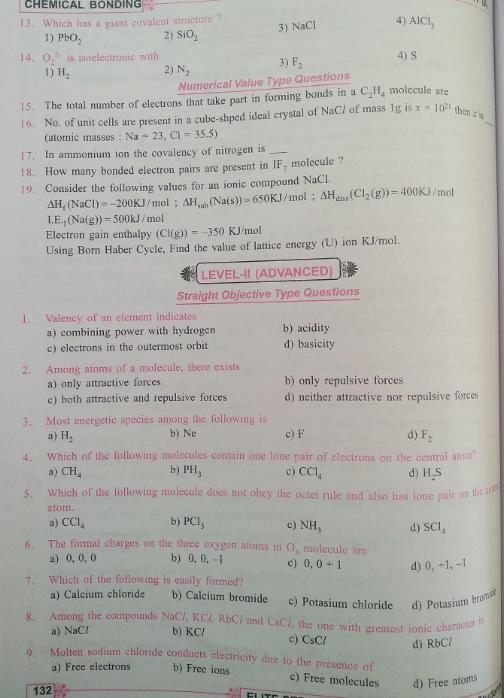
CHEMICAL BONDING 13. Which has a giant covalent structure 1) PhO, 4) AICI, 3) NaCi 2) Sio, 14. 0, is 1oclectronic with 1) H, 4) S 3) F; 2) N. Numerical Value Type Questions 15. The total number of electrons that take part in forming bonds in a CH, molecule ate 16. No. of unit cells are present in a cube-shped ideal crystal of NaCl of mass lg is xx 10 then (atomic masses : Na - 23, CI = 35.5) 17. In ammonium ion the covalency of nitrogen is 18. How many bonded electron pairs are present in IF, molecule ? 19. Consider the following values for an ionic compound NaCI. AH, (NaCl) =-200KJ/mol ; AH Na(s) - 650KJ/mol ; AHas, (Cl,(g)= 400KJ /mol LE (Na(g) = 500kJ / mol Electron gain enthalpy (Cl(g) - -350 KJ'mol Using Bon Haber Cycle, Find the value of lattice energy (U) ion KJ/mol. diss LEVELI (ADVANCED) Straight Objective Type Questions Valency of an element indieates a) combining power with hydrogen c) electrons in the outermost orbit 1. b) acidity d) basicity Among atoms of a molecule, there exists a) only attractive forces c) both attractive and repulsive forces b) only repulsive forces d) neither attractive nor repulsive forces Most energetic species among the following is a) H. 3. b) Ne c) F d) F, Which of the following molecules contain one lone pair of clectrons on the central aton? a) CH, 4. b) PH, c) CCI, d) HS Which of the following molecule does not obey ihe octet rule and also has lone pair 0 the 5. atom. b) PCI, a) CCI, The formal charges on the three oxygen atoms in O, molecule are a) 0, 0, 0 c) NH, d) SCI, 6. b) 0, 0. -1 c) 0, 0 +1 d) 0, +1, -1 Which of the following is easily formed a) Calcium chloride 7. b) Calcium bromide c) Potasium chloride d) Potasium brom 8. Among the compounds NaCl, KC RbC/ and CsC/, the one with greatest ionic chancter a) NaC! b) KC! c) CSCI 9. a) Free electrons Molten sodium chloride conducts electricity due to the presence of d) RbC/ b) Free ions c) Free molecules d) Free atoms 132
Step by Step Solution
3.36 Rating (152 Votes )
There are 3 Steps involved in it
I can see the image with question... View full answer

Get step-by-step solutions from verified subject matter experts
 Study Help