







Question: Details: Answer the following questions. Read the case study Aggregate Planning at Frito-Lay and answer the following questions. Like other organizations throughout the world, Frito-Lay
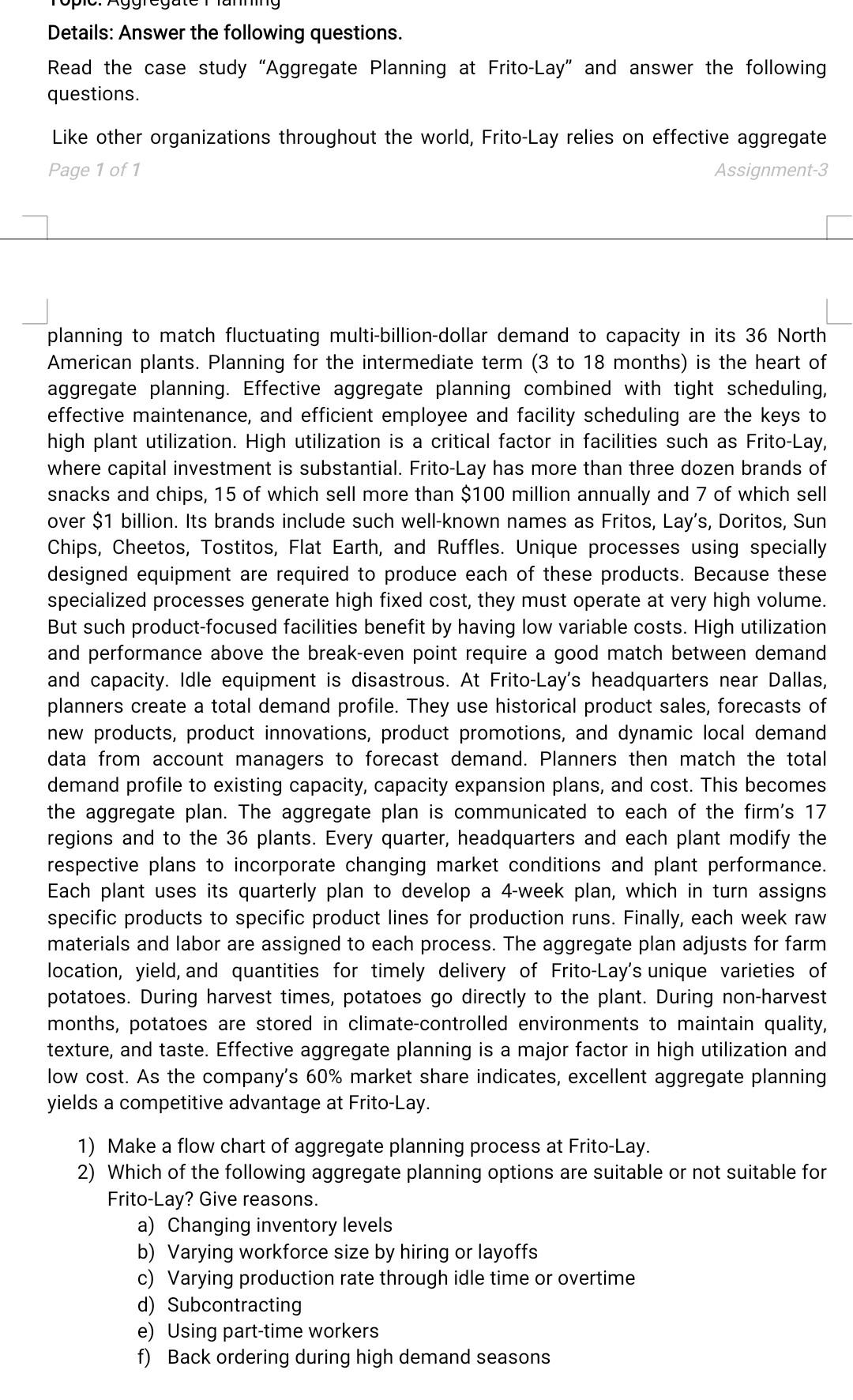
Details: Answer the following questions. Read the case study "Aggregate Planning at Frito-Lay" and answer the following questions. Like other organizations throughout the world, Frito-Lay relies on effective aggregate Page 1 of 1 Assignment-3 planning to match fluctuating multi-billion-dollar demand to capacity in its 36 North American plants. Planning for the intermediate term (3 to 18 months) is the heart of aggregate planning. Effective aggregate planning combined with tight scheduling, effective maintenance, and efficient employee and facility scheduling are the keys to high plant utilization. High utilization is a critical factor in facilities such as Frito-Lay, where capital investment is substantial. Frito-Lay has more than three dozen brands of snacks and chips, 15 of which sell more than $100 million annually and 7 of which sell over $1 billion. Its brands include such well-known names as Fritos, Lay's, Doritos, Sun Chips, Cheetos, Tostitos, Flat Earth, and Ruffles. Unique processes using specially designed equipment are required to produce each of these products. Because these specialized processes generate high fixed cost, they must operate at very high volume. But such product-focused facilities benefit by having low variable costs. High utilization and performance above the break-even point require a good match between demand and capacity. Idle equipment is disastrous. At Frito-Lay's headquarters near Dallas, planners create a total demand profile. They use historical product sales, forecasts of new products, product innovations, product promotions, and dynamic local demand data from account managers to forecast demand. Planners then match the total demand profile to existing capacity, capacity expansion plans, and cost. This becomes the aggregate plan. The aggregate plan is communicated to each of the firm's 17 regions and to the 36 plants. Every quarter, headquarters and each plant modify the respective plans to incorporate changing market conditions and plant performance. Each plant uses its quarterly plan to develop a 4-week plan, which in turn assigns specific products to specific product lines for production runs. Finally, each week raw materials and labor are assigned to each process. The aggregate plan adjusts for farm location, yield, and quantities for timely delivery of Frito-Lay's unique varieties of potatoes. During harvest times, potatoes go directly to the plant. During non-harvest months, potatoes are stored in climate-controlled environments to maintain quality, texture, and taste. Effective aggregate planning is a major factor in high utilization and low cost. As the company's 60% market share indicates, excellent aggregate planning yields a competitive advantage at Frito-Lay. 1) Make a flow chart of aggregate planning process at Frito-Lay. 2) Which of the following aggregate planning options are suitable or not suitable for Frito-Lay? Give reasons. a) Changing inventory levels b) Varying workforce size by hiring or layoffs c) Varying production rate through idle time or overtime d) Subcontracting e) Using part-time workers f) Back ordering during high demand seasons
Step by Step Solution
There are 3 Steps involved in it
1 Expert Approved Answer
Step: 1 Unlock

Question Has Been Solved by an Expert!
Get step-by-step solutions from verified subject matter experts
Step: 2 Unlock
Step: 3 Unlock
 Study Help