





Question: Determine the probability of error for this encoding/decoding scheme. Reduce your calculations to a single numerical value. (b) In an effort to reduce the probability
Determine the probability of error for this

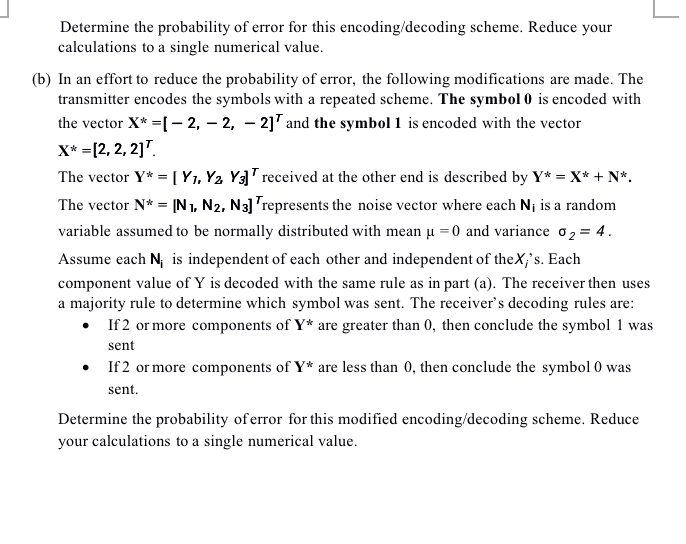
Determine the probability of error for this encoding/decoding scheme. Reduce your calculations to a single numerical value. (b) In an effort to reduce the probability of error, the following modifications are made. The transmitter encodes the symbols with a repeated scheme. The symbol 0 is encoded with the vector X* = [ 2. 2. 2]" and the symbol 1 is encoded with the vector X* =[2, 2, 2]" The vector Y* = [Y, Y2Y3] received at the other end is described by Y* = X* +N*. The vector N* = [N1, N2, N3] "represents the noise vector where each N; is a random variable assumed to be normally distributed with mean u = 0 and variance O2 = 4. Assume each N; is independent of each other and independent of theX;'s. Each component value of Y is decoded with the same rule as in part (a). The receiver then uses a majority rule to determine which symbol was sent. The receiver's decoding rules are: If 2 or more components of Y* are greater than 0, then conclude the symbol 1 was sent If 2 or more components of Y* are less than 0, then conclude the symbol o was sent. Determine the probability of error for this modified encoding/decoding scheme. Reduce your calculations to a single numerical value. Determine the probability of error for this encoding/decoding scheme. Reduce your calculations to a single numerical value. (b) In an effort to reduce the probability of error, the following modifications are made. The transmitter encodes the symbols with a repeated scheme. The symbol 0 is encoded with the vector X* = [ 2. 2. 2]" and the symbol 1 is encoded with the vector X* =[2, 2, 2]" The vector Y* = [Y, Y2Y3] received at the other end is described by Y* = X* +N*. The vector N* = [N1, N2, N3] "represents the noise vector where each N; is a random variable assumed to be normally distributed with mean u = 0 and variance O2 = 4. Assume each N; is independent of each other and independent of theX;'s. Each component value of Y is decoded with the same rule as in part (a). The receiver then uses a majority rule to determine which symbol was sent. The receiver's decoding rules are: If 2 or more components of Y* are greater than 0, then conclude the symbol 1 was sent If 2 or more components of Y* are less than 0, then conclude the symbol o was sent. Determine the probability of error for this modified encoding/decoding scheme. Reduce your calculations to a single numerical value

Step by Step Solution

There are 3 Steps involved in it

1 Expert Approved Answer
Step: 1 Unlock blur-text-image

Question Has Been Solved by an Expert!

Get step-by-step solutions from verified subject matter experts

Step: 2 Unlock
Step: 3 Unlock

Students Have Also Explored These Related General Management Questions!