







Question: Determine the sample deviation rate, the computed upper deviation rate, and the auditors conclusion (i.e., testing results do or do not support operating effectiveness of
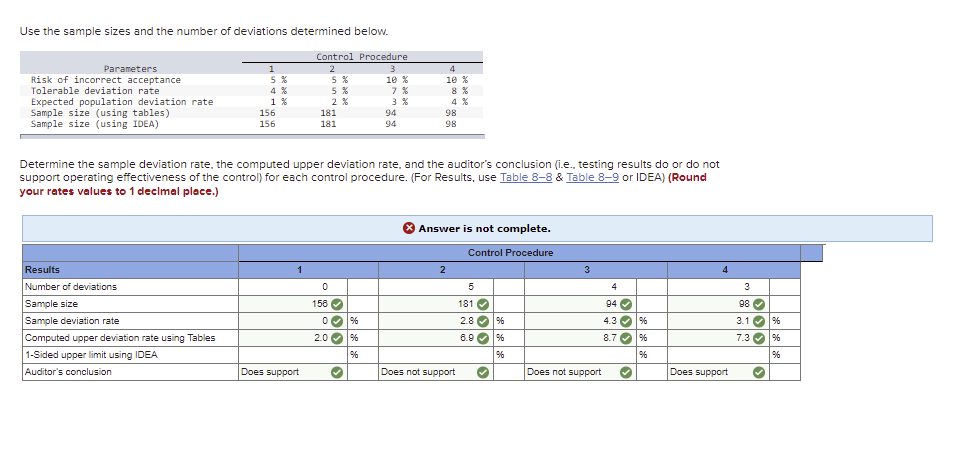
Determine the sample deviation rate, the computed upper deviation rate, and the auditors conclusion (i.e., testing results do or do not support operating effectiveness of the control) for each control procedure. (For Results, use Table 88 & Table 89 or IDEA) (Round your rates values to 1 decimal place.)
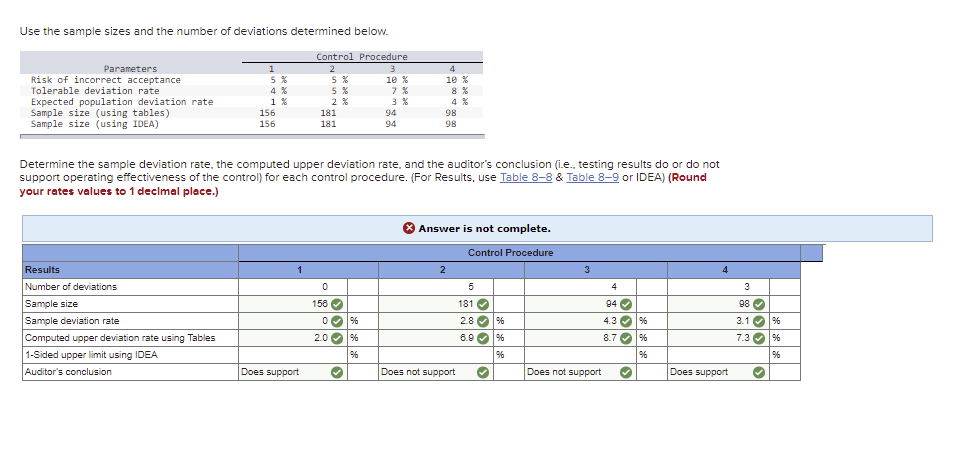
Use the sample sizes and the number of deviations determined below. 4 10 % Parameters Risk of incorrect acceptance Tolerable deviation rate Expected population deviation rate Sample size (using tables) Sample size (using IDEA) 1 5 % 4 % 1 % 156 156 Control Procedure 2 3 le % 5 % 2 % 3 % 181 94 181 94 98 98 Determine the sample deviation rate, the computed upper deviation rate, and the auditor's conclusion (i.e., testing results do or do not support operating effectiveness of the control) for each control procedure. (For Results, use Table 8-8 & Table 8-9 or IDEA) (Round your rates values to 1 decimal place.) Answer is not complete. Control Procedure Results 1 2 3 4 5 4 150 94 Number of deviations Sample size Sample deviation rate Computed upper deviation rate using Tables 1-Sided upper limit using IDEA Auditor's conclusion 0 96 20% 181 2.8% 8.096 % 4.3 % 96 8.7% 96 3 98 3.1 % 7.3% 96 96 Does support Does not support Does not support Does support
Step by Step Solution
There are 3 Steps involved in it

Get step-by-step solutions from verified subject matter experts
 Study Help