



Question: Determine the total area under the standard normal curve for parts (a) through (c) below. For each, be sure to draw a standard normal curve
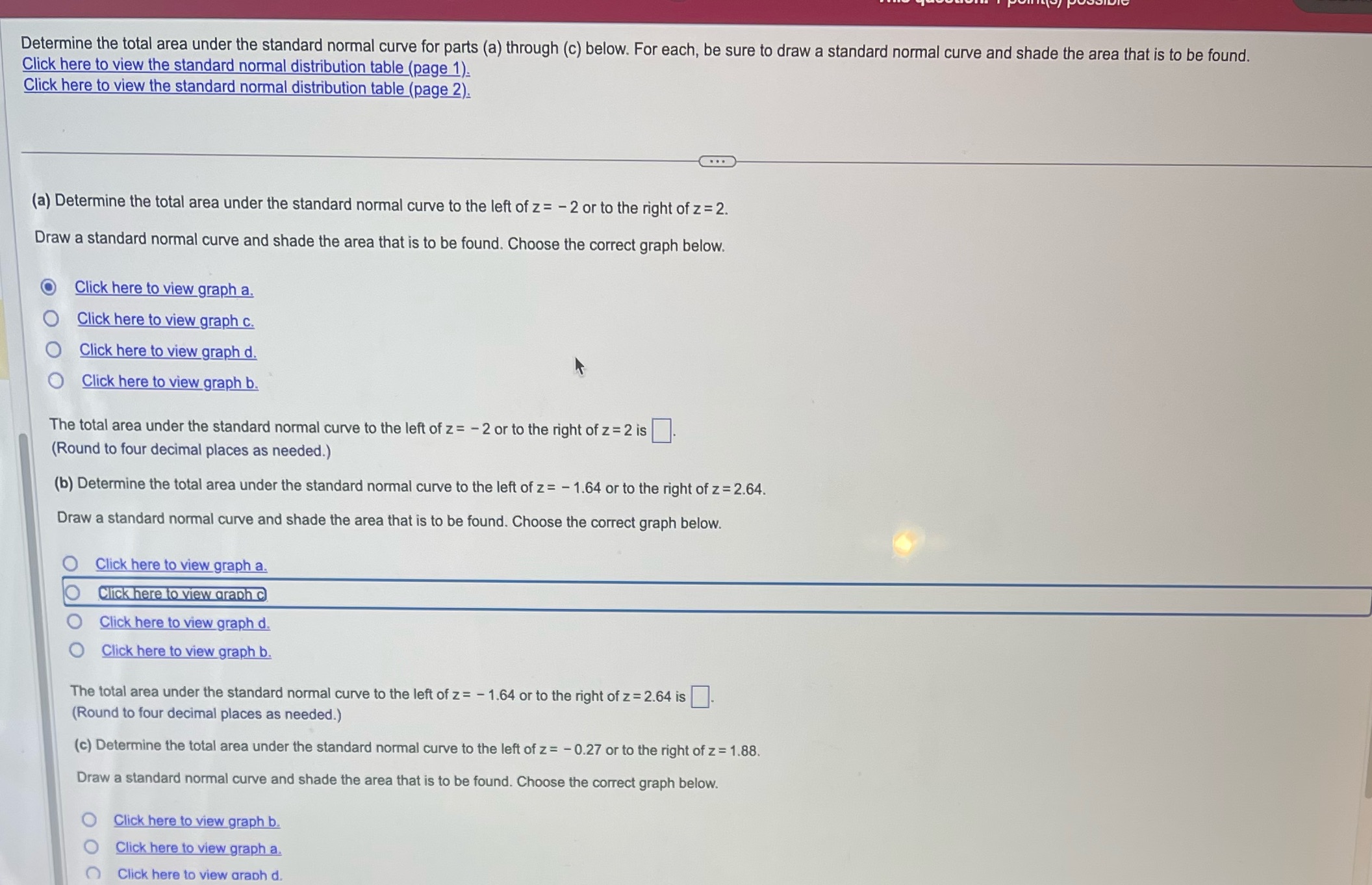
Determine the total area under the standard normal curve for parts (a) through (c) below. For each, be sure to draw a standard normal curve and shade the area that is to be found. Click here to view the standard normal distribution table (page 1). Click here to view the standard normal distribution table (page 2). (a) Determine the total area under the standard normal curve to the left of z = - 2 or to the right of z = 2. Draw a standard normal curve and shade the area that is to be found. Choose the correct graph below. Click here to view graph a. O Click here to view graph c. O Click here to view graph d. Click here to view graph b. The total area under the standard normal curve to the left of z = - 2 or to the right of z = 2 is|. (Round to four decimal places as needed.) (b) Determine the total area under the standard normal curve to the left of z = - 1.64 or to the right of z = 2.64. Draw a standard normal curve and shade the area that is to be found. Choose the correct graph below. O Click here to view graph a. click here to view graph c O Click here to view graph d. O Click here to view graph b. The total area under the standard normal curve to the left of z = - 1.64 or to the right of z = 2.64 is (Round to four decimal places as needed.) (c) Determine the total area under the standard normal curve to the left of z = - 0.27 or to the right of z = 1.88. Draw a standard normal curve and shade the area that is to be found. Choose the correct graph below. Click here to view graph b. O Click here to view graph a. Click here to view araph d
Step by Step Solution
There are 3 Steps involved in it

Get step-by-step solutions from verified subject matter experts