



Question: Determine whether the following statements are always true, always false, or sometimes true. In the statements, n is positive and both f(n) and g(n)
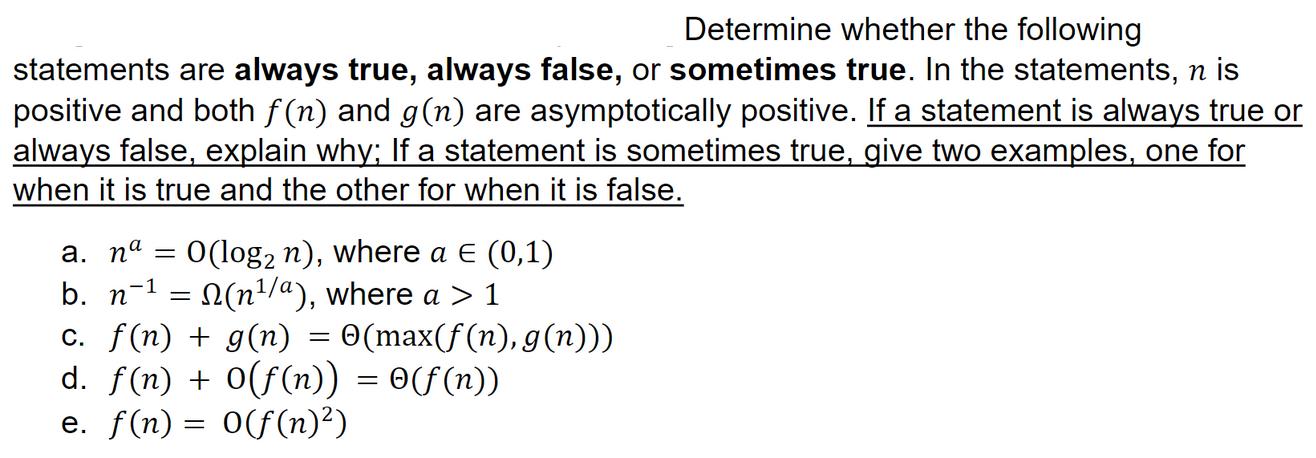
Determine whether the following statements are always true, always false, or sometimes true. In the statements, n is positive and both f(n) and g(n) are asymptotically positive. If a statement is always true or always false, explain why; If a statement is sometimes true, give two examples, one for when it is true and the other for when it is false. a. na O(logn), where a (0,1) -1 b. n = N(n/a), where a > 1 c. f(n) + g(n) = (max(f(n),g(n))) d. f(n) + O(f(n)) = (f(n)) e. f(n) 0(f(n))
Step by Step Solution
There are 3 Steps involved in it
a na Olog2 n where a 01 This statement is sometimes true Example 1 Lets consider a 05 If we take n 4 ... View full answer

Get step-by-step solutions from verified subject matter experts