







Question: Determine whether the following values are continuous random variable Determine whether the value is a discrete random variable, continuous random variable, or not a random
Determine whether the following values are continuous random variable
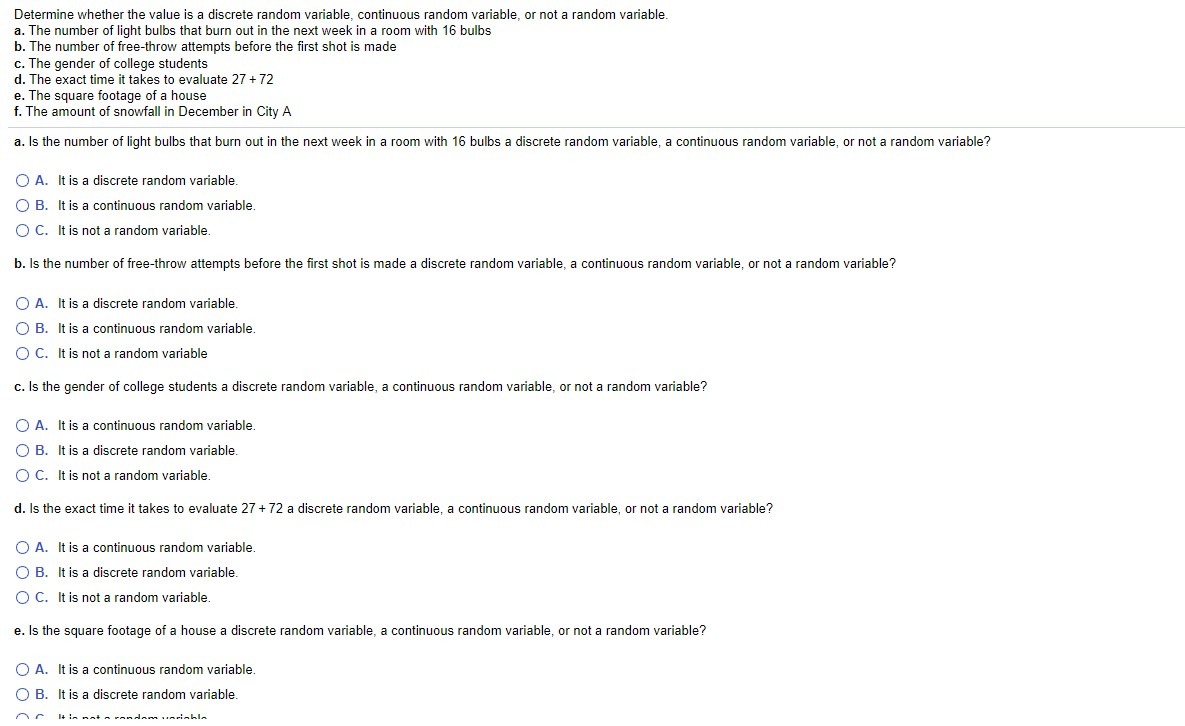
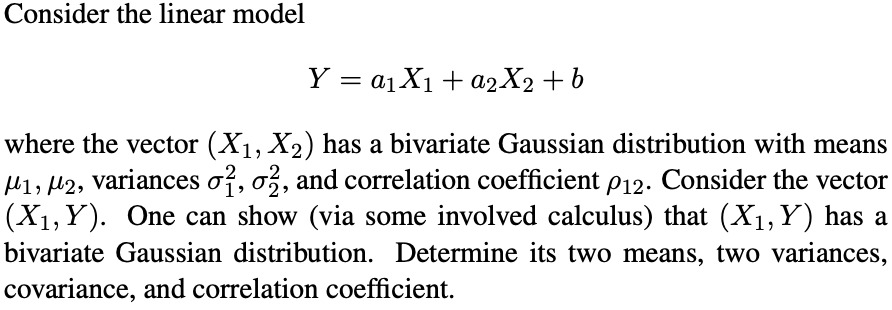
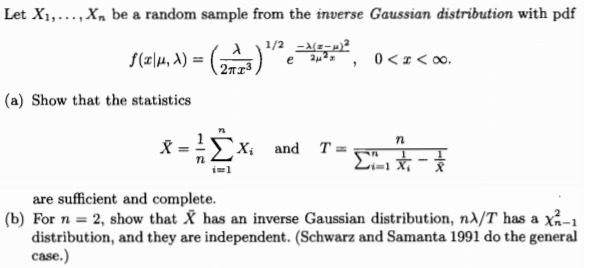
Determine whether the value is a discrete random variable, continuous random variable, or not a random variable. a. The number of light bulbs that burn out in the next week in a room with 16 bulbs b. The number of freethrow attempts before the rst shot is made c. The gender of college students d. The exad time it takes to evaluate 2?+ T2 e. The square footage of a house f. The amount of snowfall in December in City A a. Is the number of light bulbs that burn out in the next week in a room with 16 bulbs a discrete random variable, a continuous random variable, or not a random variable? 0 A. It is a discrete random variable. 0 B. It is a continuous random variable. 0 C. It is not a random variable. b. Is the number of freethrowI attempts before the rst shot is made a discrete random variable, a continuous random variable, or not a random variable? 0 A. It is a discrete random variable. 0 B. It is a continuous random variable. 0 C. It is not a random variable c. Is the gender of college students a discrete random variable, a continuous random variable, or not a random variable? 0 A. It is a continuous random variable. 0 B. It is a d'mcrete random variable. 0 C. It is not a random variable. d. Is the exact time it takes to evaluate 2? +?2 a discrete random variable. a continuous random variable. or not a random variable? 0 A. It is a continuous random variable. 0 B. It is a discrete random variable. 0 C. It is not a random variable. e. Is the square footage of a house a discrete random variable, a continuous random variable. or note random variable? 0 A. It is a continuous random variable 0 B. It is a discrete random variable. H r I| :. .mo .. "ml...\" .....:..L.I.. Consider the linear model Y = alX1 + a2X2 +b where the vector (X1, X2 ) has a bivariate Gaussian distribution with means U1, M2, variances of, 0?, and correlation coefficient p12. Consider the vector (X1, Y). One can show (via some involved calculus) that (X1, Y ) has a bivariate Gaussian distribution. Determine its two means, two variances, covariance, and correlation coefficient.Let X1, ...,Xn be a random sample from the inverse Gaussian distribution with pdf A 1/2 -Me-)2 f(z| 4, A ) = e 0
Step by Step Solution
There are 3 Steps involved in it

Get step-by-step solutions from verified subject matter experts
 Study Help