







Question: Determine whether the statement is true or false. If it is true, explain why. If it is false, explain why or give an example that
Determine whether the statement is true or false. If it is true,
explain why. If it is false, explain why or give an example that dis
proves the statement.
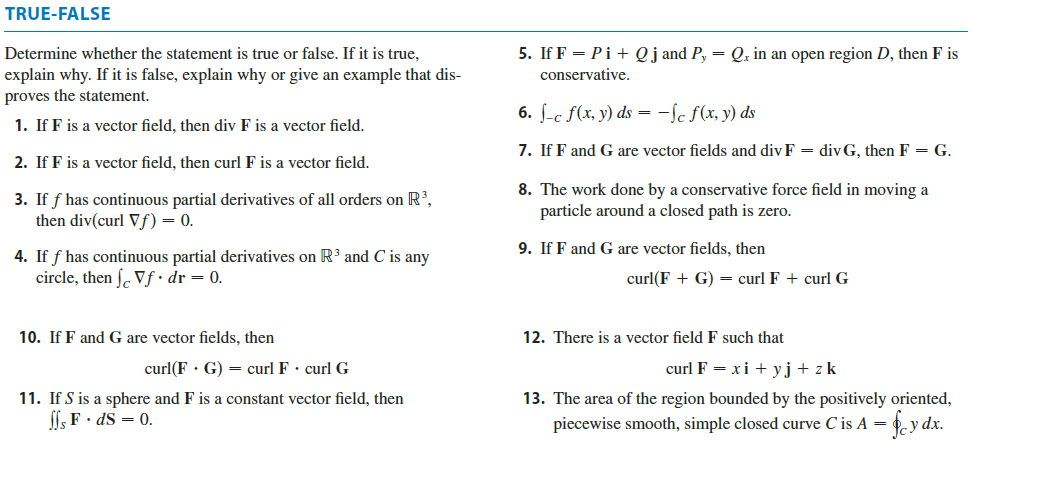
If F is a vector field, then divF is a vector field.
If F is a vector field, then curl F is a vector field.
If f has continuous partial derivatives of all orders on R
then divcurlgradf
If f has continuous partial derivatives on R and C is any
circle, then intC gradfdr
If F and G are vector fields, then
curlFGcurlFcurlG
If S is a sphere and F is a constant vector field, then
SFdS
If FPi Qj and PyQx in an open region D then F is
conservative.
intC fxydsintC fxyds
If F and G are vector fields and divFdivG, then FG
The work done by a conservative force field in moving a
particle around a closed path is zero.
If F and G are vector fields, then
curlFGcurlFcurlG
There is a vector field F such that
curlFxi yjzk
The area of the region bounded by the positively oriented,
piecewise smooth, simple closed curve C is AointC ydx
Step by Step Solution
There are 3 Steps involved in it
1 Expert Approved Answer
Step: 1 Unlock

Question Has Been Solved by an Expert!
Get step-by-step solutions from verified subject matter experts
Step: 2 Unlock
Step: 3 Unlock
 Study Help