







Question: Students will be counting cells using an automated cell counter called the Countess. However, determining total cell number and cell viability has traditionally been
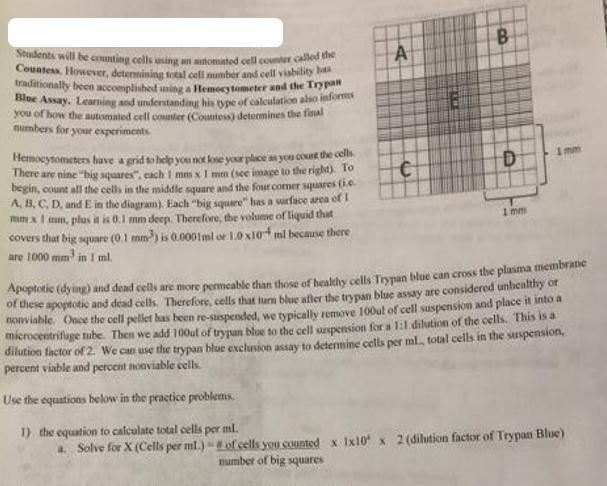
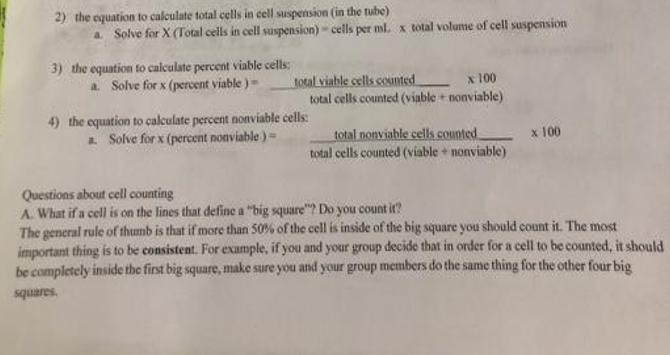
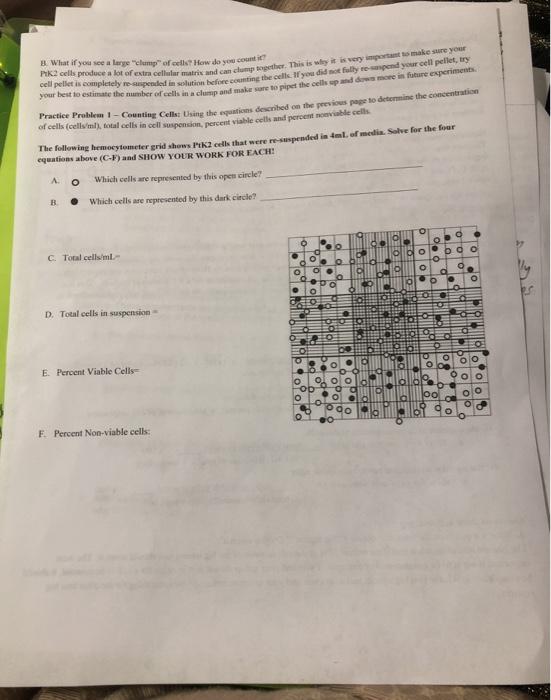
Students will be counting cells using an automated cell counter called the Countess. However, determining total cell number and cell viability has traditionally been accomplished using a Hemocytometer and the Trypan Blue Assay. Learning and understanding his type of calculation also informs you of how the automated cell counter (Countess) determines the final numbers for your experiments. Hemocytometers have a grid to help you not lose your place as you count the cells There are tine "big squares", each 1 mm x 1 mm (see image to the right). To begin, count all the cells in the middle square and the four corner squares (ie. A. B, C, D, and E in the diagram). Each "big square" has a surface area of I mm x 1 mm, plus it is 0.1 mm deep. Therefore, the volume of liquid that covers that big square (0.1 mm) is 0.0001 ml oe 1.0 x10 ml because there are 1000 mm in 1 ml. A C B D 1 mm 1mm Apoptotic (dying) and dead cells are more permeable than those of healthy cells Trypan blue can cross the plasma membrane of these apoptotic and dead cells. Therefore, cells that turn blue after the trypan blue assay are considered unhealthy or nonviable. Once the cell pellet has been re-suspended, we typically remove 100ul of cell suspension and place it into a microcentrifuge tube. Then we add 100ut of trypan blue to the cell suspension for a 1:1. dilution of the cells. This is a dilution factor of 2. We can use the trypan blue exclusion assay to determine cells per ml., total cells in the suspension, percent viable and percent nonviable cells. Use the equations below in the practice problems. 1) the equation to calculate total cells per ml. & Solve for X (Cells per ml.)-# of cells you counted x 1x10 x 2 (dilution factor of Trypan Blue) number of big squares 2) the equation to calculate total cells in cell suspension (in the tube) a. Solve for X (Total cells in cell suspension) - cells per ml. x total volume of cell suspension 3) the equation to calculate percent viable cells: a. Solve for x (percent viable)- total viable cells counted x 100 total cells counted (viable +nonviable) 4) the equation to calculate percent nonviable cells: a. Solve for x (percent nonviable) = total nonviable cells counted total cells counted (viable + nonviable) x 100 Questions about cell counting A. What if a cell is on the lines that define a "big square"? Do you count it? The general rule of thumb is that if more than 50% of the cell is inside of the big square you should count it. The most important thing is to be consistent. For example, if you and your group decide that in order for a cell to be counted, it should be completely inside the first big square, make sure you and your group members do the same thing for the other four big squares. B. What if you see a large "clump" of cells? How do you count it? PIK2 cells produce a lot of extra cellular matrix and can clump together. This is why it is very important to make sure your cell pellet is completely re-sampended in solution before counting the cells. If you did not fully re-sampend your cell pellet, try your best to estimate the number of cells in a clump and make sure to pipet the cells up and down more in future experiments Practice Problem 1-Counting Cells: Using the equations described on the previous page to determine the concentration of cells (cells/ml), total cells in cell suspension, percent viable cells and percent nonviable cells. The following hemocytometer grid shows PK2 cells that were re-suspended in 4mL of media. Solve for the four equations above (C-F) and SHOW YOUR WORK FOR EACH! A O Which cells are represented by this open circle? B Which cells are represented by this dark circle? C. Total cells/mL- D. Total cells in suspension E. Percent Viable Cells- F. Percent Non-viable cells: boo Poooo 19 91000 to poo My Bab po do ooooo b odo o tot 000 d OO 000 95 o 1988 0989 00 O boo Oo oo 00
Step by Step Solution
3.37 Rating (153 Votes )
There are 3 Steps involved in it
ANSWER A 1 The query is summarized as whether the cells lying on the ru... View full answer

Get step-by-step solutions from verified subject matter experts
 Study Help