







Question: Develop a project schedule Background You previously came up with a list of tasks and their durations based on several factors. It's now time to
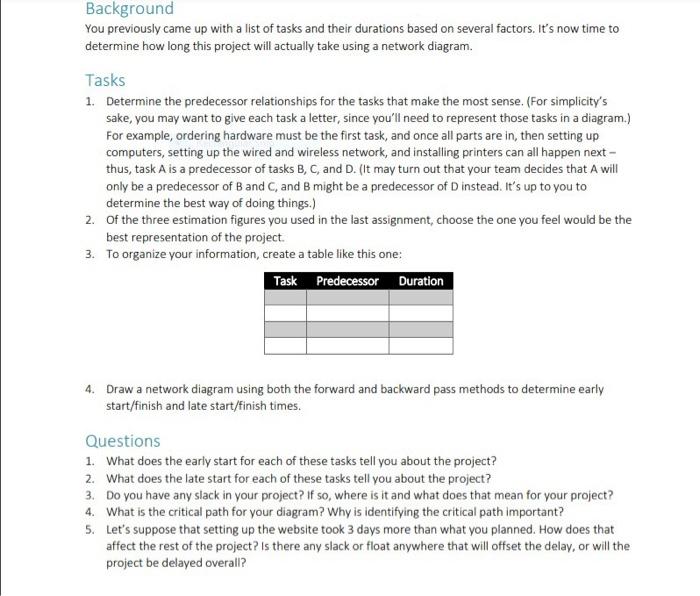
Background You previously came up with a list of tasks and their durations based on several factors. It's now time to determine how long this project will actually take using a network diagram. Tasks 1. Determine the predecessor relationships for the tasks that make the most sense. (For simplicity's sake, you may want to give each task a letter, since you'll need to represent those tasks in a diagram.) For example, ordering hardware must be the first task, and once all parts are in, then setting up computers, setting up the wired and wireless network, and installing printers can all happen next thus, task A is a predecessor of tasks B, C, and D. (It may turn out that your team decides that A will only be a predecessor of B and C, and B might be a predecessor of D instead. It's up to you to determine the best way of doing things.) 2. Of the three estimation figures you used in the last assignment, choose the one you feel would be the best representation of the project. 3. To organize your information, create a table like this one: 4. Draw a network diagram using both the forward and backward pass methods to determine early start/finish and late start/finish times. Questions 1. What does the early start for each of these tasks tell you about the project? 2. What does the late start for each of these tasks tell you about the project? 3. Do you have any slack in your project? If so, where is it and what does that mean for your project? 4. What is the critical path for your diagram? Why is identifying the critical path important? 5. Let's suppose that setting up the website took 3 days more than what you planned. How does that affect the rest of the project? Is there any slack or float anywhere that will offset the delay, or will the project be delayed overall
Step by Step Solution
There are 3 Steps involved in it

Get step-by-step solutions from verified subject matter experts
 Study Help