







Question: Develop an action plan for Dell to improve upon its culture and change implementation strategy? Effectively weighs and assesses a variety of alternative actions that
Develop an action plan for Dell to improve upon its culture and change implementation strategy?
Effectively weighs and assesses a variety of alternative actions that address the multiple issues central to the case; proposes detailed plans of action; action plans are realistic and contain thorough and well-reasoned justifications.
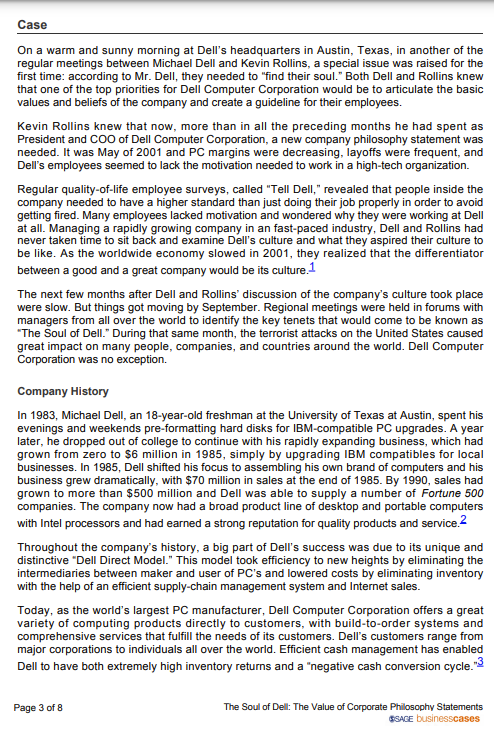
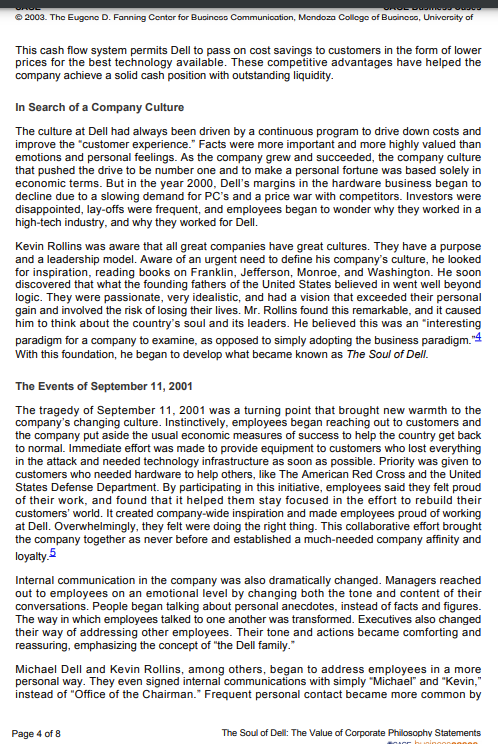
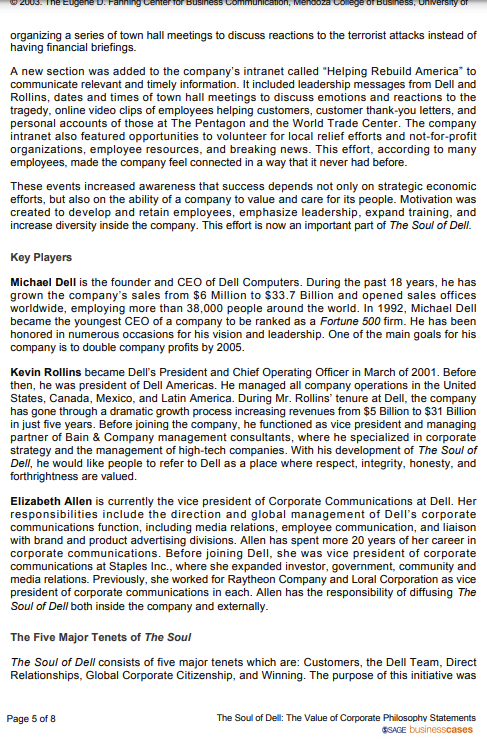
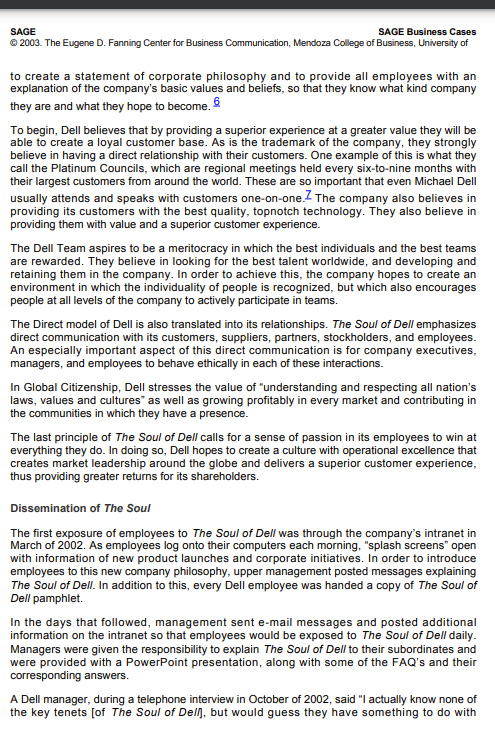
Case On a warm and sunny morning at Dell's headquarters in Austin, Texas, in another of the regular meetings between Michael Dell and Kevin Rollins, a special issue was raised for the first time: according to Mr. Dell, they needed to "find their soul." Both Dell and Rollins knew that one of the top priorities for Dell Computer Corporation would be to articulate the basic values and beliefs of the company and create a guideline for their employees. Kevin Rollins knew that now, more than in all the preceding months he had spent as President and COO of Dell Computer Corporation, a new company philosophy statement was needed. It was May of 2001 and PC margins were decreasing, layoffs were frequent, and Dell's employees seemed to lack the motivation needed to work in a high-tech organization. Regular quality-of-life employee surveys, called "Tell Dell," revealed that people inside the company needed to have a higher standard than just doing their job properly in order to avoid getting fired. Many employees lacked motivation and wondered why they were working at Dell at all. Managing a rapidly growing company in an fast-paced industry, Dell and Rollins had never taken time to sit back and examine Dell's culture and what they aspired their culture to be like. As the worldwide economy slowed in 2001, they realized that the differentiator between a good and a great company would be its culture.1 The next few months after Dell and Rollins' discussion of the company's culture took place were slow. But things got moving by September. Regional meetings were held in forums with managers from all over the world to identify the key tenets that would come to be known as "The Soul of Dell." During that same month, the terrorist attacks on the United States caused great impact on many people, companies, and countries around the world. Dell Computer Corporation was no exception. Company History In 1983, Michael Dell, an 18-year-old freshman at the University of Texas at Austin, spent his evenings and weekends pre-formatting hard disks for IBM-compatible PC upgrades. A year later, he dropped out of college to continue with his rapidly expanding business, which had grown from zero to $6 million in 1985, simply by upgrading IBM compatibles for local businesses. In 1985, Dell shifted his focus to assembling his own brand of computers and his business grew dramatically, with $70 million in sales at the end of 1985. By 1990, sales had grown to more than $500 million and Dell was able to supply a number of Fortune 500 companies. The company now had a broad product line of desktop and portable computers with Intel processors and had earned a strong reputation for quality products and service. 2 Throughout the company's history, a big part of Dell's success was due to its unique and distinctive "Dell Direct Model." This model took efficiency to new heights by eliminating the intermediaries between maker and user of PC's and lowered costs by eliminating inventory with the help of an efficient supply-chain management system and Internet sales. Today, as the world's largest PC manufacturer, Dell Computer Corporation offers a great variety of computing products directly to customers, with build-to-order systems and comprehensive services that fulfill the needs of its customers. Dell's customers range from major corporations to individuals all over the world. Efficient cash management has enabled Dell to have both extremely high inventory returns and a "negative cash conversion cycle." 3 Page 3 of 8 The Soul of Dell: The Value of Corporate Philosophy Statements gSACE businesscases Q 2003. The Eugene D. Fanning Center for Busincos Communioation, Mendoza Colloge of Buainesa, University of This cash flow system permits Dell to pass on cost savings to customers in the form of lower prices for the best technology available. These competitive advantages have helped the company achieve a solid cash position with outstanding liquidity. In Search of a Company Culture The culture at Dell had always been driven by a continuous program to drive down costs and improve the "customer experience." Facts were more important and more highly valued than emotions and personal feelings. As the company grew and succeeded, the company culture that pushed the drive to be number one and to make a personal fortune was based solely in economic terms. But in the year 2000 , Dell's margins in the hardware business began to decline due to a slowing demand for PC's and a price war with competitors. Investors were disappointed, lay-offs were frequent, and employees began to wonder why they worked in a high-tech industry, and why they worked for Dell. Kevin Rollins was aware that all great companies have great cultures. They have a purpose and a leadership model. Aware of an urgent need to define his company's culture, he looked for inspiration, reading books on Franklin, Jefferson, Monroe, and Washington. He soon discovered that what the founding fathers of the United States believed in went well beyond logic. They were passionate, very idealistic, and had a vision that exceeded their personal gain and involved the risk of losing their lives. Mr. Rollins found this remarkable, and it caused him to think about the country's soul and its leaders. He believed this was an "interesting paradigm for a company to examine, as opposed to simply adopting the business paradigm. . 4 With this foundation, he began to develop what became known as The Soul of Dell. The Events of September 11, 2001 The tragedy of September 11, 2001 was a turning point that brought new warmth to the company's changing culture. Instinctively, employees began reaching out to customers and the company put aside the usual economic measures of success to help the country get back to normal. Immediate effort was made to provide equipment to customers who lost everything in the attack and needed technology infrastructure as soon as possible. Priority was given to customers who needed hardware to help others, like The American Red Cross and the United States Defense Department. By participating in this initiative, employees said they felt proud of their work, and found that it helped them stay focused in the effort to rebuild their customers' world. It created company-wide inspiration and made employees proud of working at Dell. Overwhelmingly, they felt were doing the right thing. This collaborative effort brought the company together as never before and established a much-needed company affinity and loyalty. 5 Internal communication in the company was also dramatically changed. Managers reached out to employees on an emotional level by changing both the tone and content of their conversations. People began talking about personal anecdotes, instead of facts and figures. The way in which employees talked to one another was transformed. Executives also changed their way of addressing other employees. Their tone and actions became comforting and reassuring, emphasizing the concept of "the Dell family." Michael Dell and Kevin Rollins, among others, began to address employees in a more personal way. They even signed internal communications with simply "Michael" and "Kevin," instead of "Office of the Chairman." Frequent personal contact became more common by Page 4 of 8 The Soul of Dell: The Value of Corporate Philosophy Statements organizing a series of town hall meetings to discuss reactions to the terrorist attacks instead of having financial briefings. A new section was added to the company's intranet called "Helping Rebuild America" to communicate relevant and timely information. It included leadership messages from Dell and Rollins, dates and times of town hall meetings to discuss emotions and reactions to the tragedy, online video clips of employees helping customers, customer thank-you letters, and personal accounts of those at The Pentagon and the World Trade Center. The company intranet also featured opportunities to volunteer for local relief efforts and not-for-profit organizations, employee resources, and breaking news. This effort, according to many employees, made the company feel connected in a way that it never had before. These events increased awareness that success depends not only on strategic economic efforts, but also on the ability of a company to value and care for its people. Motivation was created to develop and retain employees, emphasize leadership, expand training, and increase diversity inside the company. This effort is now an important part of The Soul of Dell. Key Players Michael Dell is the founder and CEO of Dell Computers. During the past 18 years, he has grown the company's sales from \$6 Million to $33.7 Billion and opened sales offices worldwide, employing more than 38,000 people around the world. In 1992, Michael Dell became the youngest CEO of a company to be ranked as a Fortune 500 firm. He has been honored in numerous occasions for his vision and leadership. One of the main goals for his company is to double company profits by 2005. Kevin Rollins became Dell's President and Chief Operating Officer in March of 2001. Before then, he was president of Dell Americas. He managed all company operations in the United States, Canada, Mexico, and Latin America. During Mr. Rollins' tenure at Dell, the company has gone through a dramatic growth process increasing revenues from $5 Billion to $31 Billion in just five years. Before joining the company, he functioned as vice president and managing partner of Bain \& Company management consultants, where he specialized in corporate strategy and the management of high-tech companies. With his development of The Soul of Dell, he would like people to refer to Dell as a place where respect, integrity, honesty, and forthrightness are valued. Elizabeth Allen is currently the vice president of Corporate Communications at Dell. Her responsibilities include the direction and global management of Dell's corporate communications function, including media relations, employee communication, and liaison with brand and product advertising divisions. Allen has spent more 20 years of her career in corporate communications. Before joining Dell, she was vice president of corporate communications at Staples Inc., where she expanded investor, government, community and media relations. Previously, she worked for Raytheon Company and Loral Corporation as vice president of corporate communications in each. Allen has the responsibility of diffusing The Soul of Dell both inside the company and externally. The Five Major Tenets of The Soul The Soul of Dell consists of five major tenets which are: Customers, the Dell Team, Direct Relationships, Global Corporate Citizenship, and Winning. The purpose of this initiative was Page 5 of 8 The Soul of Dell: The Value of Corporate Philosophy Statements GSACE businesscases SAGE SAGE Business Cases Q 2003. The Eugene D. Fanning Center for Business Communication, Mendoza College of Business, University of to create a statement of corporate philosophy and to provide all employees with an explanation of the company's basic values and beliefs, so that they know what kind company they are and what they hope to become. 66 To begin, Dell believes that by providing a superior experience at a greater value they will be able to create a loyal customer base. As is the trademark of the company, they strongly believe in having a direct relationship with their customers. One example of this is what they call the Platinum Councils, which are regional meetings held every six-to-nine months with their largest customers from around the world. These are so important that even Michael Dell usually attends and speaks with customers one-on-one. I The company also believes in providing its customers with the best quality, topnotch technology. They also believe in providing them with value and a superior customer experience. The Dell Team aspires to be a meritocracy in which the best individuals and the best teams are rewarded. They believe in looking for the best talent worldwide, and developing and retaining them in the company. In order to achieve this, the company hopes to create an environment in which the individuality of people is recognized, but which also encourages people at all levels of the company to actively participate in teams. The Direct model of Dell is also translated into its relationships. The Soul of Dell emphasizes direct communication with its customers, suppliers, partners, stockholders, and employees. An especially important aspect of this direct communication is for company executives, managers, and employees to behave ethically in each of these interactions. In Global Citizenship, Dell stresses the value of "understanding and respecting all nation's laws, values and cultures" as well as growing profitably in every market and contributing in the communities in which they have a presence. The last principle of The Soul of Dell calls for a sense of passion in its employees to win at everything they do. In doing so, Dell hopes to create a culture with operational excellence that creates market leadership around the globe and delivers a superior customer experience, thus providing greater returns for its shareholders. Dissemination of The Soul The first exposure of employees to The Soul of Dell was through the company's intranet in March of 2002. As employees log onto their computers each morning, "splash screens" open with information of new product launches and corporate initiatives. In order to introduce employees to this new company philosophy, upper management posted messages explaining The Soul of Dell. In addition to this, every Dell employee was handed a copy of The Soul of Dell pamphlet. In the days that followed, management sent e-mail messages and posted additional information on the intranet so that employees would be exposed to The Soul of Dell daily. Managers were given the responsibility to explain The Soul of Dell to their subordinates and were provided with a PowerPoint presentation, along with some of the FAQ's and their corresponding answers. A Dell manager, during a telephone interview in October of 2002 , said "I actually know none of the key tenets [of The Soul of Dell], but would guess they have something to do with SAGE SAGE Business Cases [4 2003. The Eugene D. Fanning Center for Business Communication, Mendoza College of Business, University of maintaining work-life balance, building a long-term career here, valuing diversity, and leadership." Interesting, useful values, but not those articulated by the company's leadership more than six months earlier. In November 2002, speaking with another mid-level manager from Dell, an interviewer learned that she was not very familiar with what The Soul of Dell consisted of. She explained that she did receive a copy of The Soul of Dell and admitted to having received e-mail messages, as well as having seen some postings on the company intranet. Still, she was unable to explain what comprised The Soul of Dell or even to list one of the basic tenets of the corporate philosophy statement. A vice president of the company stated that he, indeed, was responsible for training his managers on the subject, but did not regard it as a particularly high priority. 8 Chicken Soup for The Soul The executive management team at Dell has made culture a key priority item for this fiscal year. In order to keep The Soul of Dell present in the mindset of employees, management vowed to continue to encourage meetings between managers and their teams on the subject. They plan to continue to make it a key priority going forward: every employee's performance plan will have at least one line item dealing with the improvement of corporate culture. Bryce Sims, a mid-level manager at Dell, said: Like most organizations Dell is in a constant state of change, however most organizations haven't grown from zero revenue to over $30B in 17 years. We have grown very fast and like most 17-year-olds we don't know everything. In the past, our culture really focused employees on compensation and promotions. As our domestic growth has slowed, our stock hasn't been the rocket it was in the ' 90 s (when it was the top-performer of all stocks), and as importantly not as many promotion opportunities have been created, causing a need for the culture shift. The Soul of Dell program has tried to re-focus our culture. To me, Dell is still about leveraging our direct model, shrinking profit pools, commoditizing technology, customer focus, and of course most importantly, execution and results. Changing our culture will take time and will happen effectively only through executive management example
Step by Step Solution
There are 3 Steps involved in it

Get step-by-step solutions from verified subject matter experts
 Study Help