







Question: Develop an introductory summary paragraph identifying the key operational issues in the case. Answer each of the case questions fully, applying correct concepts and terminology
Develop an introductory summary paragraph identifying the key operational issues in the case.
Answer each of the case questions fully, applying correct concepts and terminology
Provide cited support from the case and chapter readings as appropriate.
Conclude with a brief paragraph stating what you learned from the case and how it helped you understand specific concepts from the reading.
Support your conclusion with specific examples and use appropriate course terminology
ff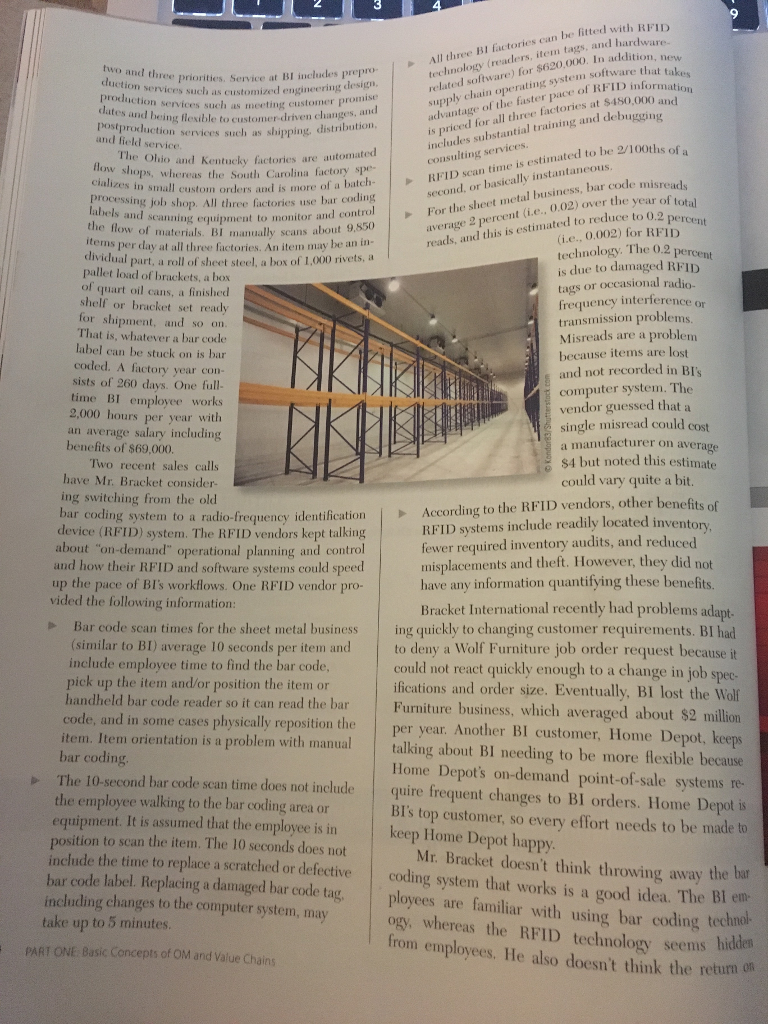
k
Case Questions
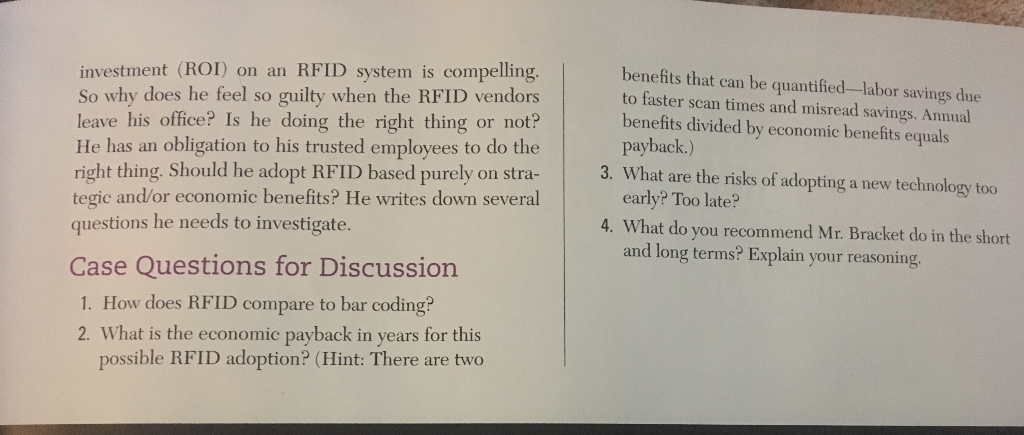
- How does RFID compare to Bar Coding?
- What is the economic payback in years for this possible RFID adoption?
- What are the risks of adopting a new technology too early? Too late?
- What do you recommend Mr. Bracket do in the short and long terms?
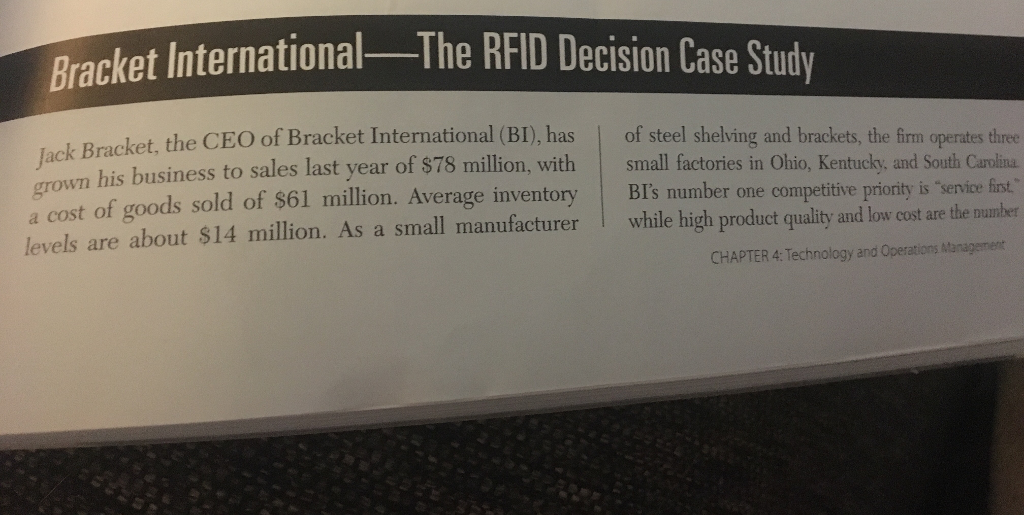
Bracket International The RFID Decision Case Stud Tork Bracket, the CEO of Bracket International (BI), has grown his business to sales last year of $78 million, with e cost of goods sold of $61 million. Average inventory Levels are about $14 million. As a small manufacturer of steel shelving and brackets, the firm operates three small factories in Ohio, Kentucky, and South Carolina BI's number one competitive priority is "service first while high product quality and low cost are the nunber CHAPTER 4: Technology and Operations Management two and three priorities duction services such as c hardware In addition, new All throny (reader $620,00 aware that takes of RFID information es at $480,000 and three priorities. Service at Bl includes prepro Services such as customized engineering design, chiction serviet t ing customer being flexible to customer driven changes, and ction services such as shipping, distribution, dates and being flexible postproduction services such as sh and field service meeting customer promise 2/100ths of a All three BI factories can be fitted with RFID technology (readers, item tags, and hardwa related software) for $620.000. In additi supply chain operating system software th advantage of the faster pace of RFID in is priced for all three factories at $4480.000 includes substantial training and debugun consulting services. RFID scan time is estimated to be 2/100th second, or basically instantaneous. For the sheet metal business, bar code mi sverige percent (ie., 0.02) over the year of reads, and this is estimated to reduce to 09, flow shops, whereas the ve year of total wce to 0.2 percent The Ohio and Kentucky factories are automated The Olun Shops, whereas the South Carolina factory spe- C's in small custom orders and is more of a batch- Processing job shop. All three factories use bar coding bels and scanning equipment to monitor and com low of materials. BT manually scans about 9,850 items per day at all three factories. An item may be an in- dividual part, a roll of sheet steel a box of 1,000 rivets, a pallet load of brackets, a box of quart oil cans, a finished shelf or bracket set ready for shipment, and so on. That is, whatever a bar code label can be stuck on is bar coded. A factory year con- sists of 260 days. One full- time BI employee works 2,000 hours per year with an average salary including benefits of $69,000. Two recent sales calls have Mr. Bracket consider- ing switching from the old bar coding system to a radio-frequency identification device (RFID) system. The RFID vendors kept talking about "on-demand" operational planning and control and how their RFID and software systems could speed up the pace of BI's workflows. One RFID vendor pro vided the following information: Bar code scan times for the sheet metal business (similar to BI) average 10 seconds per item and include employee time to find the bar code, pick up the item and/or position the item or handheld bar code reader so it can read the bar code, and in some cases physically reposition the item. Item orientation is a problem with manual bar coding The 10-second bar code scan time does not include the employee walking to the bar coding area or equipment. It is assumed that the emplovee is in position to scan the item. The 10 seconds does not include the time to replace a scratched or defective bar code label. Replacing a damaged bar code tag, including changes to the computer system, may take up to 5 minutes PART ONE Basic Concepts of OM and Value Chains (i.e., 0.002) for RFID technology. The 0.2 percent is due to damaged RFID tags or occasional radio- frequency interference or transmission problems. Misreads are a problem because items are lost and not recorded in BI's computer system. The vendor guessed that a single misread could cost a manufacturer on average $4 but noted this estimate could vary quite a bit According to the RFID vendors, other benefits of RFID systems include readily located inventory fewer required inventory audits, and reduced misplacements and theft. However, they did not have any information quantifying these benefits. Bracket International recently had problems adapt ing quickly to changing customer requirements. BI had to deny a Wolf Furniture job order request because it could not react quickly enough to a change in job spec- ifications and order size. Eventually, BI lost the Wolf Furniture business, which averaged about $2 million per year. Another Bl customer, Home Depot, keeps! talking about Bl needing to be more flexible because Home Depot's on-demand point-of-sale systems re- quire frequent changes to BI orders. Home Depot is! BI's top customer, so every effort needs to be made to keep Home Depot happy. Mr. Bracket doesn't think throwing away the bar coding system that works is a cood idea. The Blem ployees are familiar with using bar coding techno ogy, whereas the RFID technology seems hidden from employees. He also doesn't think the retur investment (ROI) on an RFID system is compelling. So why does he feel so guilty when the RFID vendors leave his office? Is he doing the right thing or not?! He has an obligation to his trusted employees to do the right thing. Should he adopt RFID based purely on stra- tegic and/or economic benefits? He writes down several questions he needs to investigate. Case Questions for Discussion 1. How does RFID compare to bar coding? 2. What is the economic payback in years for this possible RFID adoption? (Hint: There are two benefits that can be quantified-labor savings due to faster scan times and misread savings. Annual benefits divided by economic benefits equals payback.) 3. What are the risks of adopting a new technology too early? Too late? 4. What do you recommend Mr. Bracket do in the short and long terms? Explain your reasoning
Step by Step Solution
There are 3 Steps involved in it
1 Expert Approved Answer
Step: 1 Unlock

Question Has Been Solved by an Expert!
Get step-by-step solutions from verified subject matter experts
Step: 2 Unlock
Step: 3 Unlock
 Study Help