







Question: Develop and test two classes: an array-based stack ADT that implements the provided StackInterface.java an array-based queue ADT that implements the provided QueueInterface.java You must
Develop and test two classes:
an array-based stack ADT that implements the provided StackInterface.java
an array-based queue ADT that implements the provided QueueInterface.java
You must also develop a single test program that verifies all of the operations for each of the ADT classes.
Please include a toString( ) method in each ADT.
package stackInterface;
public interface StackInterface
void push(E element); // add an element to the stack - always at
the "top"
E pop(); // remove and return the top of the stack
E peek(); // return the top of the stack ... without removing
boolean isEmpty();
boolean isFull();
}
package queueInterface;
public interface QueueInterface
void enqueue(E element); // add an element to the queue - always at
the end of the queue
E dequeue(); // remove and return the front of the queue
boolean isEmpty();
boolean isFull();
}
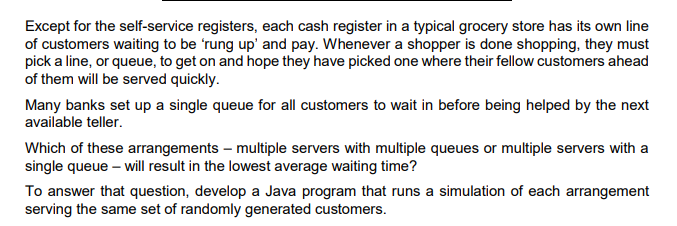
Except for the self-service registers, each cash register in a typical grocery store has its own line of customers waiting to be rung up' and pay. Whenever a shopper is done shopping, they must pick a line, or queue, to get on and hope they have picked one where their fellow customers ahead of them will be served quickly. Many banks set up a single queue for all customers to wait in before being helped by the next available teller. Which of these arrangements-multiple servers with multiple queues or multiple servers with a single queue - will result in the lowest average waiting time? To answer that question, develop a Java program that runs a simulation of each arrangement serving the same set of randomly generated customers
Step by Step Solution
There are 3 Steps involved in it

Get step-by-step solutions from verified subject matter experts
 Study Help