







Question: Develop the Year 1 financial forecast (income statement, balance sheet and statement of cash flows) for Bennis Co. Revenue is projected at $800,000, with a
Develop the Year 1 financial forecast (income statement, balance sheet and statement of cash flows) for Bennis Co. Revenue is projected at $800,000, with a gross margin of 34%. Operating expenses (including depreciation of $30,000) total 20% of revenue and taxes are estimated at 35% of pre-tax income.
Bennis wants to maintain a cash balance of 3% of their cost of goods sold. Accounts receivable are 10% of sales and inventory turnover is forecast at 9 times. Fixed assets of $500,000 will be needed to start the venture. Accounts payable days are forecast to be 30. If Bennis will be all-equity financed, calculate the required initial investment by the entrepreneur.
-
Hint 1: Since inventory turns over 9 times Inventory on the balance sheet will be 1/9th of COGS
-
Hint 2: Beginning cash is not 0. They did not tell you the initial owners investment. You can determine by adding the net cash outflow (- net cash flow) to ending cash. Remember that total liabilities and equity equals total assets and the ending owners equity will equal the beginning equity (beginning cash balance in this case) plus the net income.
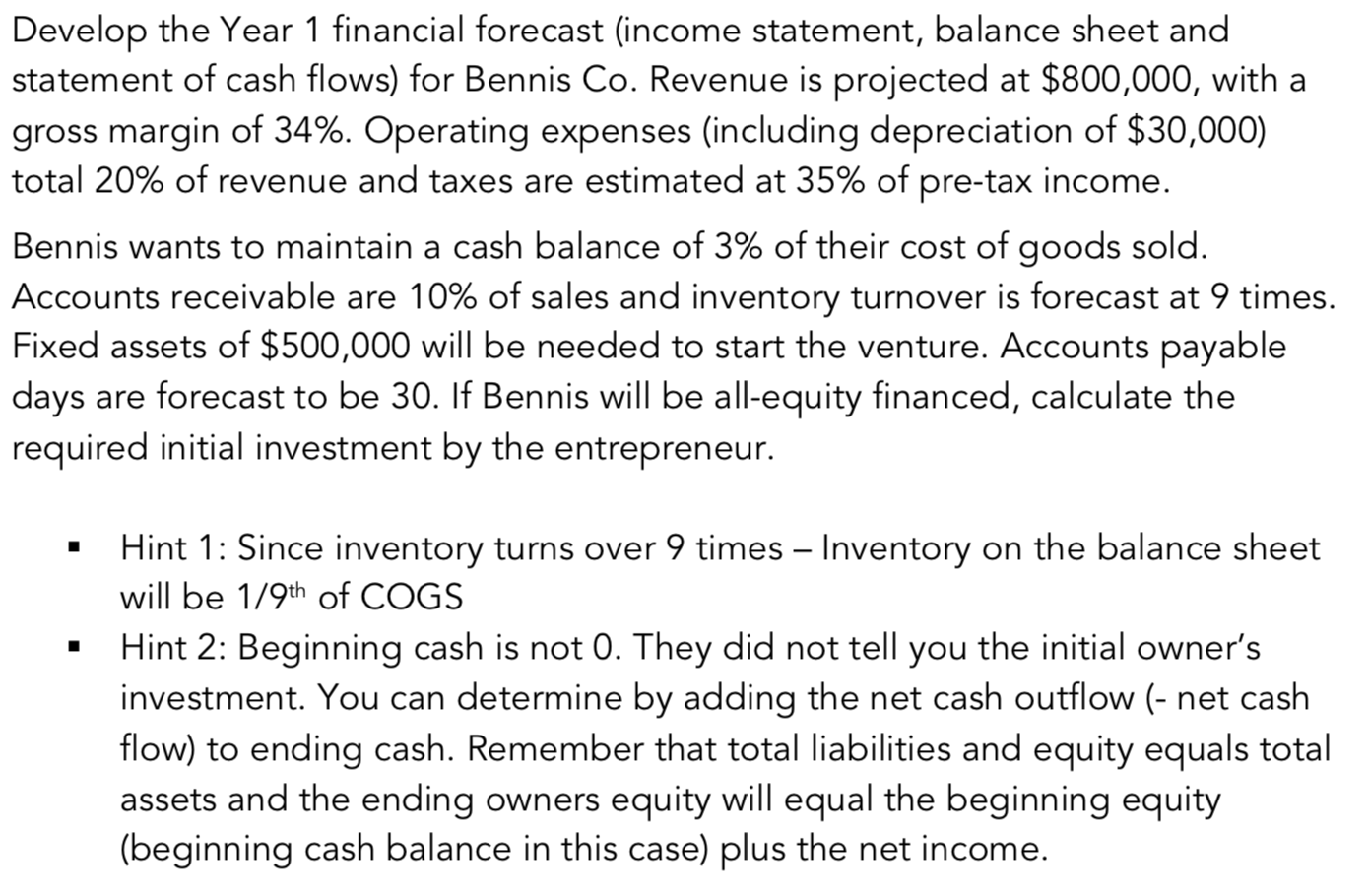
Develop the Year 1 financial forecast (income statement, balance sheet and statement of cash flows) for Bennis Co. Revenue is projected at $800,000, with a gross margin of 34%. Operating expenses (including depreciation of $30,000) total 20% of revenue and taxes are estimated at 35% of pre-tax income. Bennis wants to maintain a cash balance of 3% of their cost of goods sold. Accounts receivable are 10% of sales and inventory turnover is forecast at 9 times. Fixed assets of $500,000 will be needed to start the venture. Accounts payable days are forecast to be 30. If Bennis will be all-equity financed, calculate the required initial investment by the entrepreneur. Hint 1: Since inventory turns over 9 times Inventory on the balance sheet will be 1/9th of COGS Hint 2: Beginning cash is not 0. They did not tell you the initial owner's investment. You can determine by adding the net cash outflow (- net cash flow) to ending cash. Remember that total liabilities and equity equals total assets and the ending owners equity will equal the beginning equity (beginning cash balance in this case) plus the net income
Step by Step Solution
There are 3 Steps involved in it

Get step-by-step solutions from verified subject matter experts
 Study Help