







Question: Develop Value Stream Map to measure process performance Tasks: 1) Create a value stream map for the narrative found within the Assignment #1 folder a.
Develop Value Stream Map to measure process performance Tasks: 1) Create a value stream map for the narrative found within the Assignment #1 folder a. On a separate tab you are to show all rough work for how the data box values were calculated 2) Answer the following group of questions (Include these questions on a second tab within VISIO file, during conversion to PDF they will appear as an additional page): 1. What is the TAKT time for this manufacturing cell? 2. What is the total production Lead Time? 3. What is the total throughput and cycle times for this manufacturing cell? 4. What is the maximum manufacturing capacity per week? Are we able to meet customer requirements? If we are unable to meet demand, which process failed to meet requirements? 5. What is the process cycle efficiency (PCE)? 6. In under 250 words, clearly describe the purpose of VSM mapping and provide a brief explanation as to how it would help an organization control processes and capacity manufacturing. 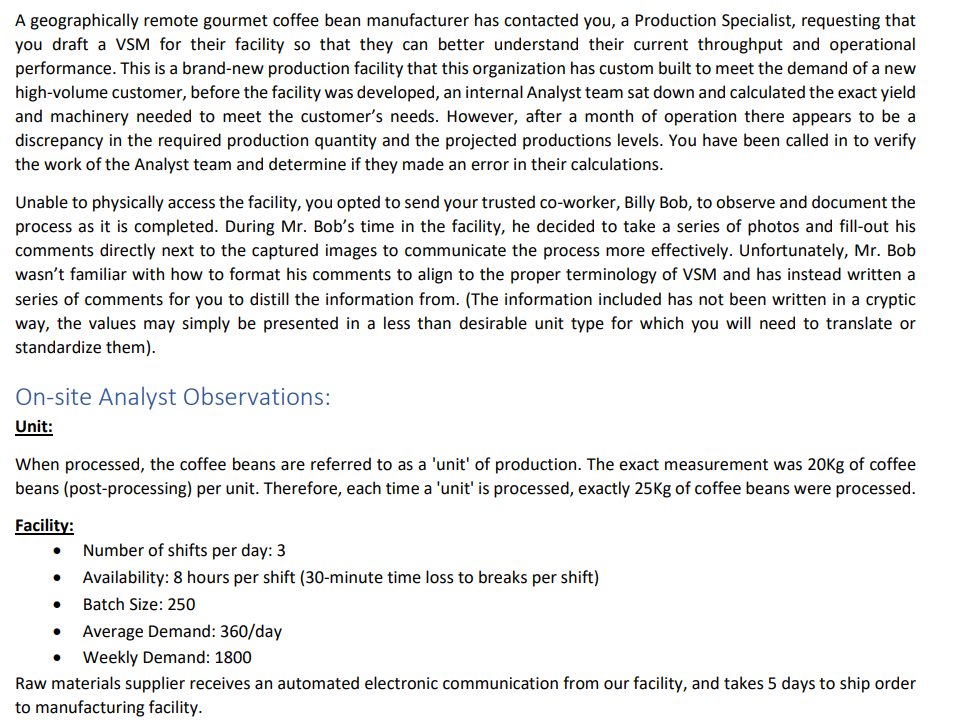
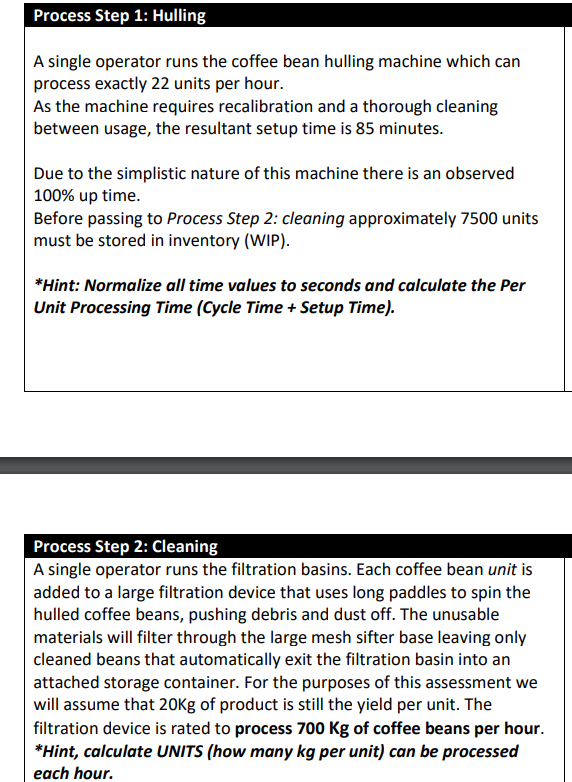
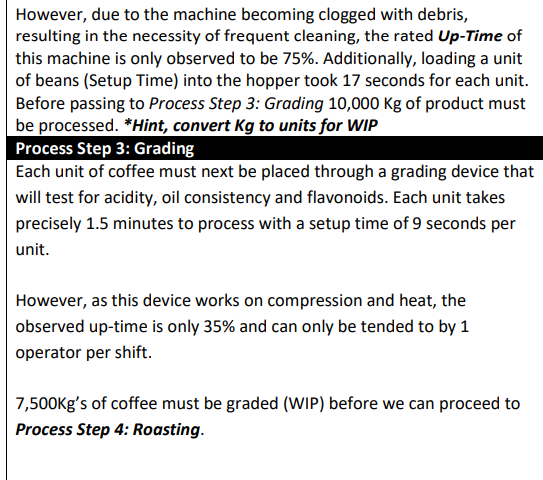
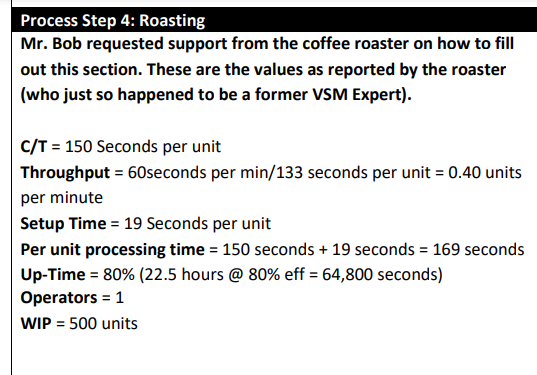
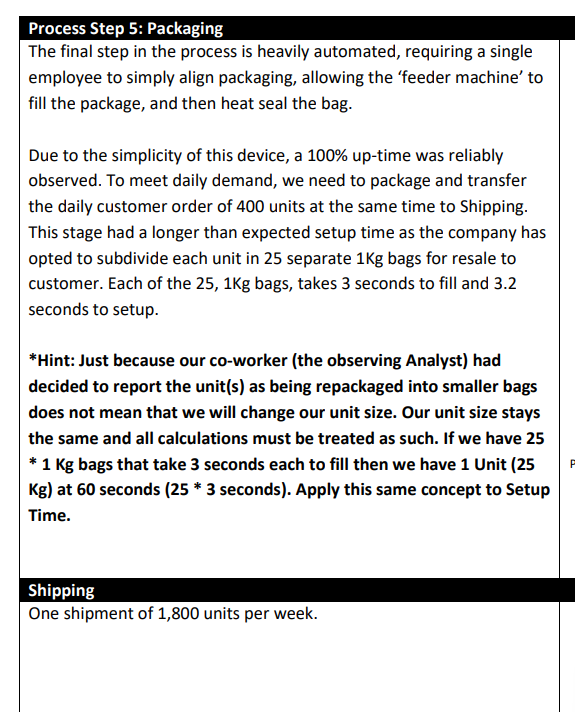
A geographically remote gourmet coffee bean manufacturer has contacted you, a Production Specialist, requesting that you draft a VSM for their facility so that they can better understand their current throughput and operational performance. This is a brand-new production facility that this organization has custom built to meet the demand of a new high-volume customer, before the facility was developed, an internal Analyst team sat down and calculated the exact yield and machinery needed to meet the customer's needs. However, after a month of operation there appears to be a discrepancy in the required production quantity and the projected productions levels. You have been called in to verify the work of the Analyst team and determine if they made an error in their calculations. Unable to physically access the facility, you opted to send your trusted co-worker, Billy Bob, to observe and document the process as it is completed. During Mr. Bob's time in the facility, he decided to take a series of photos and fill-out his comments directly next to the captured images to communicate the process more effectively. Unfortunately, Mr. Bob wasn't familiar with how to format his comments to align to the proper terminology of VSM and has instead written a series of comments for you to distill the information from. (The information included has not been written in a cryptic way, the values may simply be presented in a less than desirable unit type for which you will need to translate or standardize them). On-site Analyst Observations: Unit: When processed, the coffee beans are referred to as a 'unit' of production. The exact measurement was 20Kg of coffee beans (post-processing) per unit. Therefore, each time a 'unit' is processed, exactly 25Kg of coffee beans were processed. Facility: - Number of shifts per day: 3 - Availability: 8 hours per shift (30-minute time loss to breaks per shift) - Batch Size: 250 - Average Demand: 360/day - Weekly Demand: 1800 Raw materials supplier receives an automated electronic communication from our facility, and takes 5 days to ship order Process Step 1: Hulling A single operator runs the coffee bean hulling machine which can process exactly 22 units per hour. As the machine requires recalibration and a thorough cleaning between usage, the resultant setup time is 85 minutes. Due to the simplistic nature of this machine there is an observed 100% up time. Before passing to Process Step 2: cleaning approximately 7500 units must be stored in inventory (WIP). *Hint: Normalize all time values to seconds and calculate the Per Unit Processing Time (Cycle Time + Setup Time). Process Step 2: Cleaning A single operator runs the filtration basins. Each coffee bean unit is added to a large filtration device that uses long paddles to spin the hulled coffee beans, pushing debris and dust off. The unusable materials will filter through the large mesh sifter base leaving only cleaned beans that automatically exit the filtration basin into an attached storage container. For the purposes of this assessment we will assume that 20Kg of product is still the yield per unit. The filtration device is rated to process 700Kg of coffee beans per hour. *Hint, calculate UNITS (how many kg per unit) can be processed each hour. However, due to the machine becoming clogged with debris, resulting in the necessity of frequent cleaning, the rated Up-Time of this machine is only observed to be 75%. Additionally, loading a unit of beans (Setup Time) into the hopper took 17 seconds for each unit. Before passing to Process Step 3: Grading 10,000 Kg of product must be processed. *Hint, convert Kg to units for WIP Process Step 3: Grading Each unit of coffee must next be placed through a grading device that will test for acidity, oil consistency and flavonoids. Each unit takes precisely 1.5 minutes to process with a setup time of 9 seconds per unit. However, as this device works on compression and heat, the observed up-time is only 35% and can only be tended to by 1 operator per shift. 7,500Kg's of coffee must be graded (WIP) before we can proceed to Process Step 4: Roasting. Mr. Bob requested support from the coffee roaster on how to fill out this section. These are the values as reported by the roaster (who just so happened to be a former VSM Expert). C/T=150 Seconds per unit Throughput =60 seconds per min/133 seconds per unit =0.40 units per minute Setup Time =19 Seconds per unit Per unit processing time =150 seconds +19 seconds =169 seconds Up-Time =80% (22.5 hours @ 80\% eff = 64,800 seconds) Operators =1 WIP =500 units The final step in the process is heavily automated, requiring a single employee to simply align packaging, allowing the 'feeder machine' to fill the package, and then heat seal the bag. Due to the simplicity of this device, a 100% up-time was reliably observed. To meet daily demand, we need to package and transfer the daily customer order of 400 units at the same time to Shipping. This stage had a longer than expected setup time as the company has opted to subdivide each unit in 25 separate 1Kg bags for resale to customer. Each of the 25,1Kg bags, takes 3 seconds to fill and 3.2 seconds to setup. *Hint: Just because our co-worker (the observing Analyst) had decided to report the unit(s) as being repackaged into smaller bags does not mean that we will change our unit size. Our unit size stays the same and all calculations must be treated as such. If we have 25 * 1Kg bags that take 3 seconds each to fill then we have 1 Unit (25 Kg ) at 60 seconds ( 253 seconds). Apply this same concept to Setup Time. Shipping One shipment of 1,800 units per week
Step by Step Solution
There are 3 Steps involved in it

Get step-by-step solutions from verified subject matter experts
 Study Help