Question: Develop Your Skills ANALYSIS CASE CPA Go to the website ir.cedarfair.com and click on Investor Information to locate SEC Filings. Download Cedar Fair, L.P.'s annual
Develop Your Skills ANALYSIS CASE CPA Go to the website ir.cedarfair.com and click on "Investor Information" to locate "SEC Filings." Download Cedar Fair, L.P.'s annual report on Form 10-K filed with the SEC on 02/19/2021. Review the financial statements and the accompanying notes contained in this annual report, especially any that discuss the partnership form of organization. Assume that an investor is considering investing in this partnership and has downloaded this report for analysis. Required 1. Briefly describe Cedar Fair's business and major properties. 2. Summarize the major differences that exist between Cedar Fair's financial statements and those of a corporation. 3. Assume that the investor is not aware of the potential implications of investing in a partnership rather than a corporation. What information is available in Cedar Fair's annual report that relates to unique characteristics of investing in a partnership?
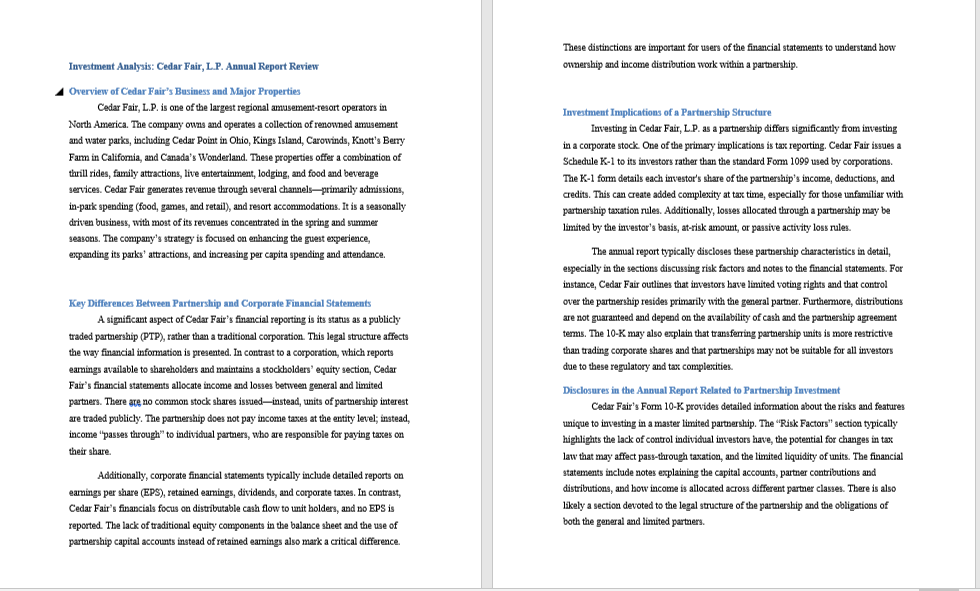
Investment Analysis: Cedar Fair, LP. Annual Report Review a Overview of Cedar Fair's Business and Major Properties. Cedar Fair, L.P, is one of the largest regional anvasement-reiart operators in. 'North America. The company own and operates a collection of renowned amusement and water parks, incheding Cedar Point in Ohio, Kings Island, Carowinds, Knott's Berry Farm in California, and Canada's Wonderland. These properties offer a combination of thrill rides, family attractions, live entertainment, lodging, and food and beverage services. Cedar Fair generates revere through several channelsprimarily: admissions, in-park: spending (food, games, and retail}, and resort accommodations. It is a seasonally driven buriness, with mort of its revenues concentrated in the xpring and summer searons, The company's strategy is focuied on enhancing the guest experience, ecpanding its parks' attractions, and increasing per capita apanding and attendance. Key Difference Between Partnership and Corporate Financial Statements A significant aspect of Cedar Fair's financial reporting is its tame as a pablicly traded partnership (PTP), rather than a traditional comporation. This legal structure affects the way financial information is presented. In comtaat to a corporation, which reports earnings available to shareholders and maintains a stockholders' equity section, Cedar Fair's financial statements allocate income and losves between general and limited partners. There gpa no common stock shares issuedinstead, waits of partnership interest are traded publich: The partnership does not pay income taxes at the entity level; instead, income \"passes through\" to individual partners, who are responsible for paying taxes on their share. Additionally, corporate financial statements typically inclode detailed reports an. earnings per share (EPS), retained earings, dividends, and corporate taxes, In contrast, (Cedar Fair's financials focus on distributable cash flow to unit holders, and no EPS is reported. The lack of traditional equity componente in the balance aheet and the use of partuerahip capital accounts instead of retained earnings also mark a critical difference. 'These distinctions are iniportant for wer of the financial statements to understand how ownership and income distribution work within a partnership, Tnvextment Implications of a Partnership Structure Tivesting in Cedar Fair, L.P. as a partnership differs significantly dram investing ina corporate stock. One ofthe primary implications is tax reporting. Cedar Fair issues a 'Schedule K-1 to its investors rather than the standard Form 1009 used by corporations, The K-1 form details each investor's share of the partmersiip's income, deductions, and credits, This can create added complexity at tax time, expecially for thoae unfamiliar with Partnership taxation rules. Additionally, losses allocated through a partnership may be 'limited by the investor's basis, at-risk amount, or passive activity loss rales. The antl report typically discloses these partnership characteristics in detail, especially in the sections discusaing riak factora and notes to the financial statements. For instance, Cedar Fair outlines that investors have limited voting rights and that control over the partnership resides primarily with the peneral partner. Furthemmore, distributions are mat guaranteed and depend on the availabiliry of cash and the partmership agreement terms. The 10-K may also explain that transferring partnership unite is more restrictive than trading corporate shares and that parmershipa may not be suitable for all investors due to these regulatory and tax complenities. Tiischoiures im the Annual Report Related to Partnership Investment Cedar Fair's Form 10-K provides detailed information about the risks and features 'unique to inverting in a master limited partnership, The \"Pusk Factors\" section typically highlights the lack of control individual investors have, the potential for changes in tax law that may affect pasi-throwsh taxation, and the limited liquidity of units. The financial 'Matements include notes explaining the capital accounta, parter contributions and distributions, and how income is allocated across different partner classes. There is also 'likely a section devoted to the legal seracture of the partnarahip and the obligations of 'both the general and limited parters
Step by Step Solution
There are 3 Steps involved in it
1 Expert Approved Answer
Step: 1 Unlock
Question Has Been Solved by an Expert!
Get step-by-step solutions from verified subject matter experts
Step: 2 Unlock
Step: 3 Unlock
Students Have Also Explored These Related Accounting Questions!









 Study Help