Question: (Developing an Effective Business Model) in the book of(Entrepreneurship: Successfully Launching New Ventures, 6e ) then answer the two questions: 1- What is the purpose
(Developing an Effective
Business Model) in the book
of(Entrepreneurship:
Successfully Launching New
Ventures, 6e ) then answer the
two questions:
1- What is the purpose of
business model?
2- Briefly describe the four
main components of a
Business Model Template.
Identify the subcomponents of
each of the four main
components of a business
model.
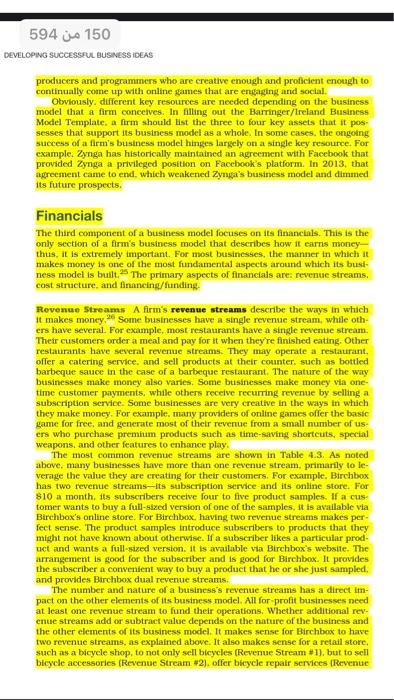
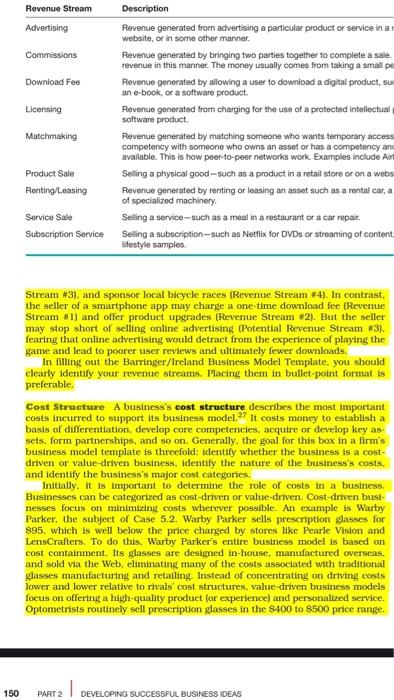
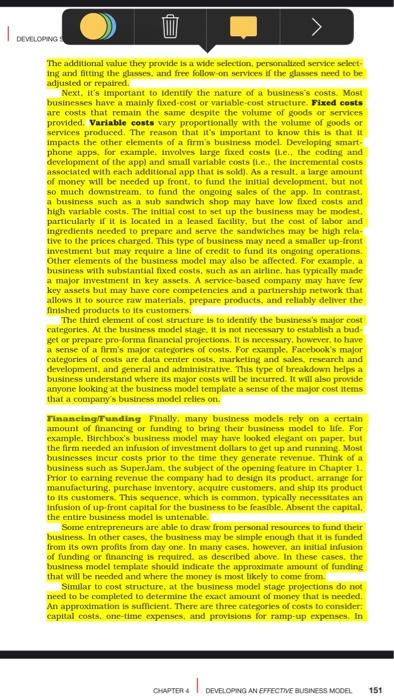
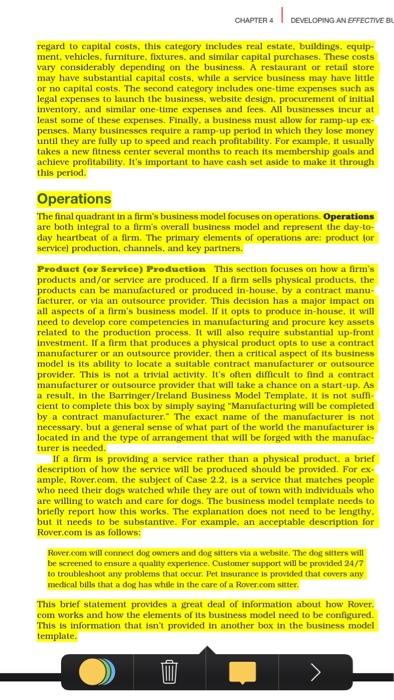
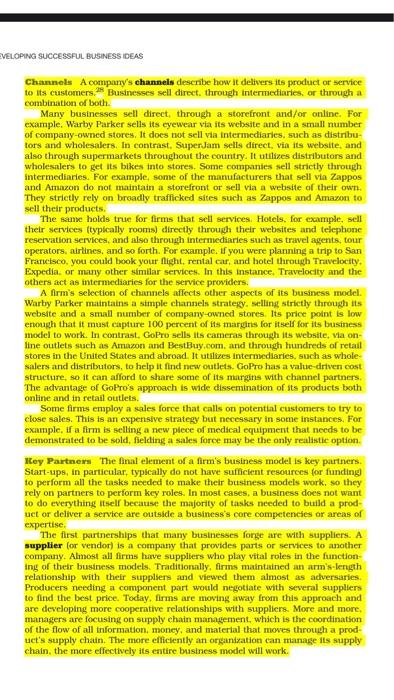
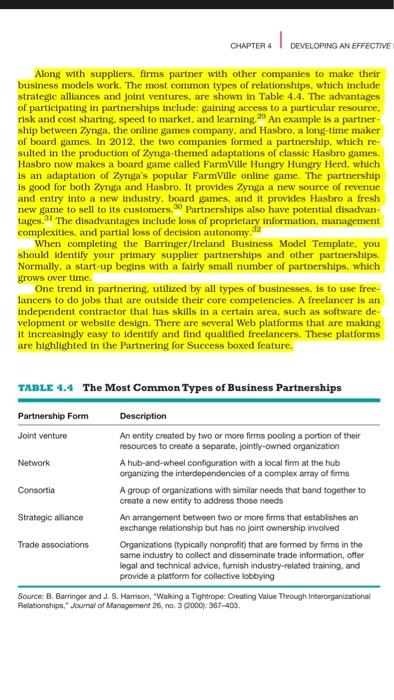
/13 594 CHAPTER & DEVELOPING AN EFFECTME BUSIN space, and makes money by seling premium accounts with more capacity. Dropbox could charge all of its users a monthly fee based on the amount of storage that they use, but that's not its business model. Its business model is based on the belief that by introducing users to its service through a free account, it will ultimately sign up more paid users. To further illustrate what a business model is, the Savvy Entrepreneurial Firm feature focuses on Quirky, an interesting company that helps bring peoples' inven- tions to life. The feature illustrates how Quirky creatos, delivers and captures value for its stakeholder he proper time to determine a company's business model is following the initial validation of the business idea and prior to fleshing out the opera nicely parallels the chapters in the book. Chapter 1 dealt with the decision to become an entrepreneur. Chapters 2-3 considered the initial validation of the business idea. This chapter deals with determining a business model, while Chapter 5-15 deal with the topics needed to implement a firm's business model and grow the firm. In this chapter we'll first discuss business models and their importance We then introduce and discuss a template for developing a business model. The template, called the Barringer/Ireland Business Model Template, consists of 4 categories and 12 items that make up a firm's business model. The tem- plate, which can be completed on an 8 by 11 sheet of paper or blown up and placed on the wall, provides a nice visual mechanism to think through and display the elements of a firm's business model. A critical factor is that similar to feasibility analysis, a firm's business mudel should not be completed in isolation. The founders of a firm should get out of the building and talk to potential customers as a firm's business model takes shape. This is a facet of developing an effective business model that we stress throughout the chapter. Business Models and Their Importance As stated above, a firm's business model is its plan or recipe for how it creates LEAR delivers, and captures value for its stakeholders. Glance ahead to Figure 4.2. 1. De the Barringer/Ireland Business Model Template. As you can see by looking at the template, a firm's business model represents the core aspects of its busi- im ness. It also describes how the core aspects fit together and support one an- other. For example, three important elements of a firm's business model are its target market. its basis for differentiation, and its key assets. In Her Campus's case, its target market is college-aged females. It differentiates itself by focus ing on six topics that college-aged females care about style, beauty, health love, life, and career), and its key assets include 4.000-plus college females volunteering in Her Campus chapters across the country writing articles that they believe other college females will be interested in. This example illustrates a nicely designed business model, at least as it pertains to the three elements mentioned above. Each element supports the others. It's also a business model that would be difficult to copy. It would take a tremendous effort on the part of a competitor to match Her Campus's network of 4.000-plus volunteers on col- lege campuses Preparation of the en model Fleshing out the perational the company rice Prope Deter Busin Business Model Business Mission A business's mission or mission statement describes Template why it exists and what is business model in apposed to accomplish 2014 carefully written and properly, statement can article and rem ness's overarching priorities and act as ancial and moral compass firm's mission is the first to that should be completed in the business model template. A well written mission statement is something that a business can controler back to as it makes important decisione in the elements of to business model At a 50,000 foot level, a ment indicate how a tim intenda to create value for stakeholders. For example.Zygamiston is connecting the world through is a product of otala wach FarmVille and Texas Holdem Poker, which can be played through its website and social networking platforms wichs Facebook and Google. Although Zynga's mostatement is short and to the plant provide direction for how the other elements of its business model had be configured. The trompt will focus on games as opposed to other bus purutits, and its antes will be social meaning that they will be designed to be played with other people. The training. Il parts of year's business model should up: porte basic parte de succes. De There are several of the warments. Abo msi Matement Deine ersten Describe what makes the company different Beriky and challenging but achievable Uma tone that represents the company culture and Componentheid of the made De best and the methm that the company Mis of Duterte important that are clearly articulate the pot that differentiates product or service from competitors. The akin to what some muhim to many's va pret company's basis of differentiation in what can compare company's products were is when a problem or tibes need When completing the bust for differentiation porn of the Bater Erlands Mad Templates to the action with three points. Also makeware that the value of the points is easy to see and understand eram Aww..comis pack on roll destod by aura llantate de traditional backpack when betarth grade daughter complained daily that her from can her backpack. The ZILICA has two distant of differentiation trees back pain by putting backpackers and sturdy for the a child to non. The company's website trequently features photos a kids sitting on the ZUCA at which are commight be hand for kids waiting for the school bus. These reports of differentiation that are easy to grasp and remember. They are the reason that we will choose LICA's product and solution or other Making certain that your posts of afferentie meer to benefits rather than feature is another pertam potember when determining firma of differentiations of allerent that fou em fer wuch as the technicalmente a product are less compelling than there that Fus om bewell, which is what producten de Fortal when Laura Udantroduced the ZUCA. she could have fossed on the features of the product and listed spot of ions for this pulled like a waarather than worn on the back.cludes wutly. and is wailable in colors. While features are the typically dont monet prodat. A better approach for all when to focus on the benefits of the product relies hack by putting back pakon eder, sturdy much for other an adult ched in sit on, and is the ideal balance between functional and food. This points fortes on benefits, telepathy the product willen hance their woorde Target Maut The identification of the target market in which the firm will compete is extremely important. As explained in Chapter 3. a target market is a place within a larg mooi that represent awer group women with similar interests. Most new buses do not start by sell ing to browarketsInstead, most start to identifying an emerunder vednictw within a large market Afirmatiget market should be made exploat on the basic model template. Her Camp target market is active rematestar gel market is online su Atarget marcante based on any relevant variable, as long as I dette for a firm the group of likeded comes that it will try to appeal to Forest Hayley and Katia 147 594 CHAPTER 4 DEVEL DEVELOPING AN EFFECTIVE BUSIN Beauchamp, the founders of Birchbox, wrote the following about their com- pany's target market: From the start we've always said that our target market isn't a specific demo graphic, but instead a psychographiewe believe that Birchbox appeals to women of all ages and backgrounds as long as they are excited to try new things and learn through discovery This type of awareness of a firm's intended market, and the people who are the most likely to respond positively to a firm's product or service, is helpful in build ing out all the elements of a firm's business model. For example, targeting women of all ages and backgrounds who are excited to try new things and learn through ciscovery requires a certain set of core competencies (we define core competen- cles in the next section. It requires identifying and hiring people who have the ability to build anticipation and can locate partners and suppliers that have ex- citing new products that appeal to all age groups. If Barra and Beauchamp had instead identified Birchbox's target market as females ages 16-31. and left the "try new things and learn through discovery part out, a different set of core com- petencies may have been needed for Birchbox's overall business model to work The same philosophy applies across the business model template. The target market a firm sclects affects everything it does, from the key assets it acquires to the financing or funding it will need to the partnerships it forms. Product/Marleet Scope The fourth clement of core strategy is product/ market scope. A company's product/market scope defines the products and markets on which it will concentrate. Most firms start narrow and pursue adja- cent product and market opportunities as the company grows and becomes finan- cially secure. As explained earlier, new firms typically do not have the resources to produce multiple products and pursue multiple markets simultaneously. An example is Dropbox, the online data storage company profiled in Case 2.1. When Dropbox was pitching its business idea, a challenge it had was that it was solving a problem that most people didn't know they had. There were ways for people to transfer files from one device to another, such as USB memory sticks, c-malling files to yoursell, and so forth. Dropbox's solution was much more elegant. Its service allows users to create a special folder on each of their devices, and sync and store data across devices. Dropbox completely solved the problem of working on a file on one device, such as an office com puter, and then not having it available on another device, such as a laptop at home. When Dropbox launched in 2008, it had a single product-Its online data storage service. The initial market it pursued was tech-savvy people in the Silicon Valley. Since then, Dropbox's market has expanded to all computer and Internet users: the firm now has 200 million customers. But for the first five years of its existence, it stuck to its initial product. preferring to continually im- prove the quality of its online data storage service rather than developing new services. It wasn't until 2013 that Dropbox added a second product through the acquisition of Mailbox, an e-mail processing service for mobile devices. Recently, the firm announced a third product, Carousel, which will be a digital gallery that will allow users to share their entire life's memories. So in terms of product/market scope. Dropbox has progressed as follows: Launch-Single product/Silicon Valley tech-savvy users 1-2 years into existence Single product/Growing number of Silicon Valley tech-savvy users and people they told about the service 3-4 years into existence-Single product/All computer and Internet users 25 years into existence-Two products/All computer and Internet users 6 years into existence Three products/All computer and Internet users DEVELOPING SUCCESSFUL BUSINESS IDEAS This example illustrates a well-thought-out and executed expansion of product/ market scope In completing the Barringer/Ireland Business Model Template, a company should be very clear about its initial product/market scope and project 3-5 years in the future in terms of anticipated expansion. A bullet-point format, as shown for Dropbox above is acceptable. Similar to all aspects of a company's business model its product/market scope will affect other elements of the model Resources The second component of a business model is resources. Resources are the Inputs a firm uses to produce, sell, distribute, and service a product or ser vice. At a basic level, a firm must have a sufficient amount of resources to enable its business model to work. For example, a firm may need a patent li.e. a key asset) to protect its basis of differentiation. Similarly, a business may need expertise in certain areas .c.. core competencies) to understand the needs of its target market. At a deeper level a firm's most important resources both tangible and intangible, must be both dimcult to imitate and hard to find a substitute for in order for the company's business model to be competitive over the long term. A tangible resource that fits this criterion is Her Campus's network of 4.000-plus volunteers. As mentioned earlier. It would take a tre- mendous effort for a competitor to amass a similar number of volunteers. In addition, there is no practical substitute for the work that 4,000-plus volun- teers can do. An example of an intangible resource that fits the criterion is Zappos's reputation for customer service. Zappos is consistently viewed very favorably for its ability to deliver a high level of customer service that is both difficult to imitate and hard to find a substitute for Resources are developed and accumulated over a period of time. 22 As a result, when completing the Barringer/Ireland Business Plan Template, the current resources a company possesses should be the resources that are noted, but aspirational resources should be kept in mind. For example.it took time for Her Campus to recruit 4.000-plus volunteers. The company may have had 100 volunteers if and when it completed its first business model template. As a result, the proper notation under the key Assets por tion of the Barringer/Ireland Business Model Template would have been 100 volunteers with the goal of adding 100 volunteers a month) or whatever the exact number might have been Core Competencies A core competency is a specific factor or capabil ity that supports a firm's business model and sets it apart from its rivals.28 A core competency can take on various forms, such as technical know-how, an efficient process, a trusting relationship with customers, expertise in product design, and so forth. It may also include factors such as passion for a business idea and a high level of employee morale. A firm's core competencies largely determine what it can do. For example, many firms that sell physical prod ucts do not do their own manufacturing because manufacturing is not a core competency. Instead, their core competencies may be in areas such as product design and marketing. The key idea is that to be competitive a business must be particularly good at certain things, and those certain things must be sup- portive of all clements of its business model. For example, Netflix is particu- larly good at supply chain management, which was essential during the years that Netflix's business model was geared primarily towards delivering DVDs to customers via the mail. Without a core competency in supply chain manage ment. Netix's entire business model would not have worked. Most start-ups will list two to three core competencies on the business model template. Consistent with the information provided above, a core compe tency is compelling if it not only supports a firm's initiatives, but is also difficult CHAPTER 4 1 DEVELOPING AN EFFECTIVE BUSINESS MODEL 147 stc ksa Is. Entreprene... sta to imitate and substitute. Few start-ups tuve core competencies in more than two to three arcas. For example. Her Campus has three core competencies: Creating content of interest to active college-aged females Recruiting and managing a volunteer network Connecting active college-aged females with major brands Similar to the Netflix and supply chain management example. Her Campus's entire business model would be untenable absent these three core competen- cies. In Her Campus's case, an added advantage is that its core competencies arc, at varying levels, difficult to imitate and hard to find substitutes for Key Assets Key assets are the assets that a firm owns that enable its business model to work. The assets can be physical, financial Intellectual or human. Physical assets include physical space, equipment, vehicles, and distribution networks. Intellectual assets include resources such as patents. trademarks, copyrights, and trade secrets, along with a company's brand and its reputation. Financial assets include cash lines of credit, and commitments from Investors. Human assets include a company's founder or founders, its key employees, and its advisors Firms vary regarding the key assets they prioritize and accumulate. All companies require financial assets to varying degrees. Retailers such as Whole Foods Markets and Amazon rely heavily on physical assets-Whole Foods because of its stores and Amazon because of its warehouses and distribu- tion network. Companies such as Uber rely almost exclusively on intellectual assets. Uber does not employ the drivers that provide its customers rides or own the cars they ride in. It simply provides a technology-based platform that connects people wanting rides with people willing to provide them. As a result Uber's key assets are an app. Its brand, and the relationships. It has with its customers, drivers, and the communities in which it operates. Many compa- nies rely heavily on human assets. The success of Zynga's business model for example, relies heavily on its ability to attract and retain a group of game 148 DEVELOPING SUCCESSFUL BUSINESS IDEAS PART 2 150 594 DEVELOPING SUCCESSFUL BUSINESS IDEAS producers and programmers who are creative enough and proficient enough to continually come up with online games that are engaging and social Obviously different key resources are needed depending on the business model that a firm conceives. In filling out the Barringer/Ireland Business Model Template, a firm should list the three to four key assets that it pos- sesses that support its business model as a whole. In some cases, the ongoing success of a firm's business model hinges largely on a single key resource. For example, Zynga has historically maintained an agreement with Facebook that provided Zynga a privileged position on Facebook's platform. In 2013, that agreement came to end, which weakened Zynga's business model and dimmed its future prospects. Financials The third component of a business model focuses on its financials. This is the only section of a firm's business model that describes how it earnis money, thus, it is extremely important. For most businesses, the manner in which it makes money is one of the most fundamental aspects around which its bust ness model is built. The primary aspects of financials are: revenue streams. cost structure, and financing/funding Revenue Streams Afirm's revenue streams describe the ways in which it makes money, 26 Some businesses have a single revenue stream, while oth- ers have several. For example, most restaurants have a single revenue stream, Their customers order a meal and pay for it when they're finished eating. Other restaurants have several revenue streams. They may operate a restaurant, offer a catering service and sell products at their counter, such as bottled barbeque sauce in the case of a barbeque restaurant. The nature of the way businesses make money also varies. Some businesses make money via one- time customer payments, while others receive recurring revenue by selling a subscription service. Some businesses are very creative in the ways in which they make money. For example, many providers of oniline games offer the basic game for free, and generate most of their revenue from a small number of us ers who purchase premium products such as time-saving shortcuts, special weapons, and other features to enhance play. The most common revenue streams are shown in Table 4.3. As noted above, many businesses have more than one revenue stream, primarily to le- verage the value they are creating for their customers. For example. Birchbox has two revenue streams--its subscription service and its online store. For $10 a month, its subscribers receive four to five product samples. If a cus: tomer wants to buy a full-sized version of one of the samples, it is available via Birchbox's online store. For Birchbox, having two revenue streams makes per fect sense. The product samples introduce subscribers to products that they might not have known about otherwise. If a subscriber likes a particular prod- ict and wants a full-sized version, it is available via Birchbox's website. The arrangement is good for the subscriber and is good for Birchbox. It provides the subscriber a convenient way to buy a product that he or she just sampled, and provides Birchbox dual revenue streams. The number and nature of a business's revenue streams has a direct im- pact on the other elements of its business model. All for profit businesses need at least one revenue stream to fund their operations. Whether additional rev. enue streams add or subtract value depends on the nature of the business and the other elements of its business model. It makes sense for Birchbox to have two revenue streams, as explained above. It also makes sense for a retail store, such as a bicycle shop, to not only sell bicycles (Revenue Stream #1), but to sell bicycle accessories (Revenue Stream #2). offer bicycle repair services (Revenue Revenue Stream Advertising Commissions Download Fee Licensing Description Revenue generated from advertising a particular product or service in a website, or in some other manner. Revenue generated by bringing two parties together to complete a sale. revenue in this manner. The money usually comes from taking a small pe Revenue generated by allowing a user to download a digital product, su an e-book. or a software product. Revenue generated from charging for the use of a protected intellectual software product Revenue generated by matching someone who wants temporary access competency with someone who owns an asset or has a competency an available. This is how peer-to-peer networks work. Examples include Air Seling a physical good-such as a product in a retail store or on a webs Revenue generated by renting or leasing an asset such as a rental car, a of specialized machinery Selling a service-such as a meal in a restaurant or a car repair, Selling a subscription such as Netflix for DVDs or streaming of content. lifestyle samples Matchmaking Product Sale Renting/Leasing Service Sale Subscription Service Stream #3). and sponsor local bicycle races (Revenue Stream #4). In contrast. the seller of a smartphone app may charge a one-time download fee (Revenue Stream #1) and offer product upgrades (Revenue Stream #2). But the seller may stop short of selling online advertising (Potential Revenue Stream #3). fearing that online advertising would detract from the experience of playing the game and lead to poorer user reviews and ultimately fewer downloads. In filling out the Barringer/Ireland Business Model Template, you should clearly identify your revenue streams. Placing them in bullet-point format is preferable. Cost Structure A business's cost structure describes the most important costs incurred to support its business model. It costs money to establish a basis of differentiation, develop core competencies, acquire or develop key as- sets. form partnerships, and so on. Generally, the goal for this box in a firm's business model template is threefold: identify whether the business is a cost- driven or value-driven business, Identify the nature of the business's costs, and identify the business's major cost categories Initially, it is important to determine the role of costs in a business Businesses can be categorized as cost-driven or value-driven. Cost-driven busi- nesses focus on minimizing costs wherever possible. An example is Warby Parker, the subject of Case 5.2. Warby Parker sells prescription glasses for 895. which is well below the price charged by stores like Pearle Vision and LensCrafters. To do this. Warby Parker's entire business model is based on cost containment. Its glasses are designed in-house, manufactured overseas. and sold via the Web, eliminating many of the costs associated with traditional glasses manufacturing and retailing. Instead of concentrating on driving costs lower and lower relative to rivals' cost structures, value-driven business models focus on offering a high-quality product (or experience) and personalized service, Optometrists routinely sell prescription glasses in the $400 to $500 price range, 150 PART 2 DEVELOPING SUCCESSFUL BUSINESS IDEAS DEVELONG E The additional value they provide is a wide selection, personalized service select ing and fitting the glasses, and free follow on services if the glasses need to be adjusted or repaired Next, it's important to identify the nature of a business's costs. Most businesses have a mainly fixed cost or variable-cost structure. Fixed costs are costs that remain the same despite the volume of goods or services provided. Variable costs vary proportionally with the volume of goods or services produced. The reason that it's important to know this is that it impacts the other elements of a firm's business model. Developing smart phone apps, for example, involves large fixed costs the the coding and development of the app and small variable costs (le, the incremental costs associated with each additional app that is sold). As a result, a large amount of money will be needed up front, to fund the initial development, but not so much downstream, to fund the ongoing sales of the app. In contrast, a business such as a sub sandwich shop may have low fixed costs and hich variable costs. The initial cost to set up the business may be modest. particularly if it is located in a leased facility, but the cost of labor and ingredients needed to prepare and serve the sandwiches may be high rela- tive to the prices charged. This type of business may need a smaller up-front investment but may require a line of credit to fund its ongoing operations Other elements of the business model may also be affected. For example, a business with substantial fixed costs, such as an airline, has typically made a major investment in key assets. A service-based company may have few key assets but may have core competencies and a partnership network that allows it to source raw materials, prepare products, and reliably deliver the finished products to its customers. The third element of cost structure is to identify the business's major cost categories. At the business model stage. It is not necessary to establish a bud- get or prepare pro forma financial projections. It is necessary, however, to have a sense of a firm's major categories of costs. For example. Facebook's major categories of costs are data center costs, marketing and sales, research and development, and general and administrative. This type of breakdown helps a business understand where its major costs will be incurred. It will also provide anyone looking at the business model template a sense of the major cost Items that a company's business model relies on Tinancing Funding Finally, many business models rely on a certain amount of financing or funding to bring their business model to life. For example. Birchbox's business model may have looked elegant on paper, but the firm needed an infusion of investment dollars to get up and running. Most businesses incur costs prior to the time they generate revenue. Think of a business such as SuperJam, the subject of the opening feature in Chapter 1 Prior to earning revenue the company had to design its product. arrange for manufacturing, purchase inventory, acquire customers, and ship its product to its customers. This sequence, which is common typically necessitates an Infusion of up front capital for the business to be feasible. Absent the capital the entire business model is untenable. Some entrepreneurs are able to draw from personal resources to fund their business. In other cases, the business may be simple enough that it is funded from its own profits from day one. In many cases, however, an initial infusion of funding or financing is required. as described above. In these cases, the business model template should indicate the approximate amount of funding that will be needed and where the money is most likely to come from. Similar to cost structure, at the business model stage projections do not need to be completed to determine the exact amount of money that is needed An approximation is sufficient. There are three categories of costs to consider capital costs, one-time expenses, and provisions for ramp-up expenses, in CHAPTER 4 1 DEVELOPING AN EFFECTIVE BUSINESS MODEL 151 CHAPTER 4 . DEVELOPING AN EFFECTIVE BL regard to capital costs, this category includes real estate, buildings, equip- ment, vehicles, furniture, fixtures, and similar capital purchases. These costs vary considerably depending on the business. A restaurant or retail store may have substantial capital costs, while a service business may have little or no capital costs. The second category includes one-time expenses such as legal expenses to launch the business, website design procurement of initial Inventory, and similar one-time expenses and fees. All businesses incur at least some of these expenses. Finally, a business must allow for ramp-up ex- penses. Many businesses require a ramp up period in which they lose money until they are fully up to speed and reach profitability. For example, it usually takes a new fitness center several months to reach its membership goals and achieve profitability. It's important to have cash set aside to make it through this period Operations The final quadrant in a firm's business model focuses on operations Operations are both integral to a firm's owerall business model and represent the day-to- day heartbeat of a firm. The primary elements of operations are product for service production channels, and key partners Product (or Service) Production This section focuses on how a firm's products and/or service are produced. If a firm sells physical products, the products can be manufactured or produced in-house by a contract manu- facturer, or via an outsource provider. This decision has a major impact on all aspects of a firm's business model. If it opts to produce in-house, it will need to develop core competencies in manufacturing and procure key assets related to the production process. It will also require substantial up-front Investment. If a firm that produces a physical product opts to use a contract manufacturer or an outsource provider, then a critical aspect of its business model is its ability to locate a suitable contract manufacturer or outsource provider. This is not a trivial activity. It's often difficult to find a contract manufacturer or outsource provider that will take a chance on a start-up. As a result, in the Barringer/Ireland Business Model Template. It is not suf- cient to complete this box by simply saying "Manufacturing will be completed by a contract manufacturer. The exact name of the manufacturer is not necessary, but a general sense of what part of the world the manufacturer is located in and the type of arrangement that will be forged with the manufac turer is needed. If a firm is providing a service rather than a physical product, a brief deseription of how the service will be produced should be provided. For ex- ample, Rover.com, the subject of Case 2.2. is a service that matches people who need their dogs watched while they are out of town with individuals who are willing to watch and care for dogs. The business model template needs to briefly report how this works. The explanation does not need to be lengthy. but it needs to be substantive. For example, an acceptable description for Rover.com is as follows: Rover.com will connect dog owners and dog sitters via a website. The dog sitters will be screened to ensure a quality experience. Customer support will be provided 24/7 to troubleshoot any problems that our Pet Insurance is provided that covers any medical bills that a dog has while in the care of a Rover.com sitter This brief statement provides a great deal of information about how Rover. com works and how the elements of its business model need to be configured. This is information that isn't provided in another box in the business model template. E VELOPING SUCCESSFUL BUSINESS IDEAS Channels A company's channels describe how it delivers its product or service to its customers. Businesses sell direct. through intermediaries, or through a combination of both Many businesses sell direct, through a storefront and/or online. For example, Warby Parker sells its eyewear via its website and in a small number of company-owned stores. It does not sell via intermediaries, such as distribu- tors and wholesalers. In contrast. Super Jam sells direct, via its website, and also through supermarkets throughout the country. It utilizes distributors and wholesalers to get its bikes into stores. Some companies sell strictly through intermediaries. For example, some of the manufacturers that sell via Zappos and Amazon do not maintain a storefront or sell via a website of their own They strictly rely on broadly trafficked sites such as Zappos and Amazon to sell their products. The same holds true for firms that sell services Hotels, for example, sell their services (typically rooms) directly through their websites and telephone reservation services, and also through intermediaries such as travel agents, tour operators, airlines, and so forth. For example. If you were planning a trip to San Francisco, you could book your night. rental car, and hotel through Travelocity. Expedia, or many other similar services. In this instance, Travelocity and the others act as intermediaries for the service providers. A firm's selection of channels affects other aspects of its business model Warty Parker maintains a simple channels strategy. selling strictly through its website and a small number of company-owned stores. Its price point is low enough that it must capture 100 percent of its margins for itself for its business model to work. In contrast. GoPro sells its cameras through its website, via on- line outlets such as Amazon and BestBuy.com, and through hundreds of retail stores in the United States and abroad. It utilizes intermediaries, such as whole salers and distributors, to help it find new outlets. GoPro has a value-driven cost structure, so it can afford to share some of its margins with channel partners The advantage of GoPro's approach is wide dissemination of its products both online and in retail outlets. Some firms employ a sales force that calls on potential customers to try to close sales. This is an expensive strategy but necessary in some instances. For example, if a firm is selling a new plece of medical equipment that needs to be demonstrated to be sold, fieldling a sales force may be the only realistic option Key Partner The final element of a firm's business model is key partners Start-ups, in particular, typically do not have sufficient resources for funding to perform all the tasks needed to make their business models work, so they rely on partners to perform key roles. In most cases, a business does not want to do everything itself because the majority of tasks needed to build a prod- uct or deliver a service are outside a business's core competencies or areas of expertise, The first partnerships that many businesses forge are with suppliers. A supplier (or vendor) is a company that provides parts or services to another company. Almost all firms have suppliers who play vital roles in the function ing of their business models. Traditionally, firms maintained an arm's-length relationship with their suppliers and viewed them almost as adversaries, Producers needing a component part would negotiate with several suppliers to find the best price. Today, firms are moving away from this approach and are developing more cooperative relationships with suppliers. More and more, managers are focusing on supply chain management, which is the coordination of the flow of all information, money, and material that moves through a prod- uct's supply chain. The more efficiently an organization can manage its supply chain, the more effectively its entire business model will work. CHAPTER 4 DEVE DEVELOPING AN EFFECTIVE Along with suppliers, firms partner with other companies to make their business models work. The most common types of relationships, which include strategic alliances and joint ventures, are shown in Table 4.4. The advantages of participating in partnerships include: gaining access to a particular resource. risk and cost sharing, speed to market, and learning. An example is a partner ship between Zynga, the online games company, and Hasbro, a long-time maker of board games. In 2012, the two companies formed a partnership, which re- sulted in the production of Zynga-themed adaptations of classic Hasbro games, Hasbro now makes a board game called FarmVille Hungry Hungry Herd, which Is an adaptation of Zynga's popular FarmVille online game. The partnership is good for both Zynga and Hasbro. It provides Zynga a new source of revenue and entry into a new industry, board games, and it provides Hasbro a fresh new game to sell to its customers. 30 Partnerships also have potential disadvan- tages. The disadvantages include loss of proprietary information management complexities, and partial loss of decision autonomy 32 When completing the Barringer/Ireland Business Model Template, you should identify your primary supplier partnerships and other partnerships. Normally, a start-up begins with a fairly small number of partnerships, which grows over time. One trend in partnering, utilized by all types of businesses. is to use free- lancers to do jobs that are outside their core competencies. A freelancer is an independent contractor that has skills in a certain area, such as software de- velopment or website design. There are several Web platforms that are making it increasingly easy to identify and find qualified freelancers. These platforms are highlighted in the Partnering for Success boxed feature. TABLE 4.4 The Most Common Types of Business Partnerships Partnership Form Description Joint venture An entity created by two or more firms pooling a portion of their resources to create a separate, jointly-owned organization Network A hub-and-wheel configuration with a local firm at the hub organizing the interdependencies of a complex array of firms Consortia A group of organizations with similar needs that band together to create a new entity to address those needs Strategic alliance An arrangement between two or more firms that establishes an exchange relationship but has no joint ownership involved Trade associations Organizations (typically nonprofit) that are formed by firms in the same industry to collect and disseminate trade information, offer legal and technical advice, furnish industry-related training, and provide a platform for collective lobbying Source: B. Barringer and J. S. Harrison, "Walking a Tightrope: Creating Value Through Interorganisational Relationships." Journal of Management 26, no. 3 (2000357-403









 Study Help