







Question: Developing Diagnostic and Analytical Skills Case Application 8-A: THE UNDERRATED CHECKLIST: FIVE STEPS TO SAVE LIVES The idea of having to go through a checklist
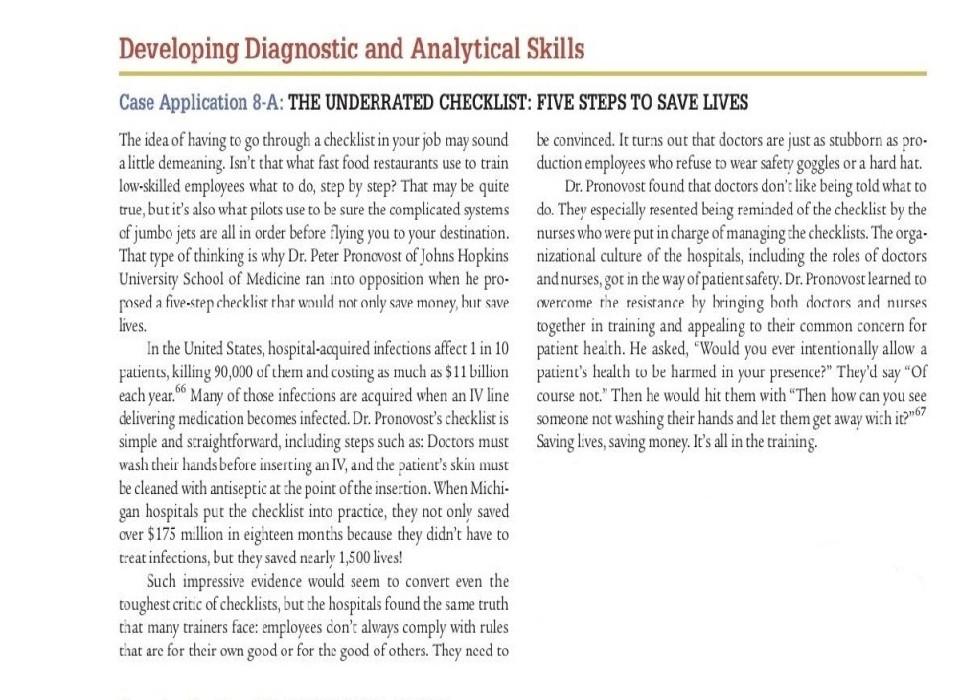

Developing Diagnostic and Analytical Skills Case Application 8-A: THE UNDERRATED CHECKLIST: FIVE STEPS TO SAVE LIVES The idea of having to go through a checklist in your job may sound be convinced. It turns out that doctors are just as stubborn as pro- a little demeaning. Isn't that what fast food restaurants use to train duction employees who refuse to wear safety goggles or a hard hat. low-skilled employees what to do, step by step? That may be quite Dr. Pronovost found that doctors don't like being told what to true, but it's also what pilots use to be sure the complicated systems do. They especially resented being reminded of the checklist by the of jumbo jets are all in order before flying you to your destination. nurses who were put in charge of managing the checklists. The orga- That type of thinking is why Dr. Peter Pronovost of Johns Hopkins nizational culture of the hospitals, including the roles of doctors University School of Medicine ran into opposition when he pro- and nurses, gor in the way of patient safety. Dr. Pronovost learned to posed a five-step checklist that would not only save money, hur save wercome the resistance by bringing both doctors and nurses lives. together in training and appealing to their common concern for In the United States, hospital-acquired infections affect 1 in 10 patient health. He asked, "Would you ever intentionally allow a patients, killing 90,000 u them and costing as much as $11 billion patient's health to be harmed in your presence?" They'd say "of each year. Many of those infections are acquired when an IV line course not." Then he would hit them with "Then how can you see delivering medication becomes infected. Dr. Pronovost's checklist is someone not washing their hands and let them get away with it?"67 simple and straightforward, including steps such as: Doctors must Saving lives, saving money. It's all in the training. wash their hands before inserting an IV, and the patient's skin must be cleaned with antiseptic at the point of the insertion. When Michi- gan hospitals put the checklist into practice, they not only saved over $175 million in eighteen months because they didn't have to treat infections, but they saved nearly 1,500 lives! Such impressive evidence would seem to convert even the toughest critic of checklists, but the hospitals found the same truth that many trainers face: employees con't always comply with rules that are for their own good or for the good of others. They need to 2. What method should hospitals use to evaluate IV checklist training
Step by Step Solution
There are 3 Steps involved in it
1 Expert Approved Answer
Step: 1 Unlock

Question Has Been Solved by an Expert!
Get step-by-step solutions from verified subject matter experts
Step: 2 Unlock
Step: 3 Unlock
 Study Help