





Question: DF 7. IN MATH 112 Discussion Forum 7 MATH 112 In the Textbook or ALEKS read Section 2.8 (objectives 1, 2) To Perform Operations on
DF 7. IN MATH 112 Discussion Forum 7 MATH 112 InDF 7. IN MATH 112 Discussion Forum 7 MATH 112 In
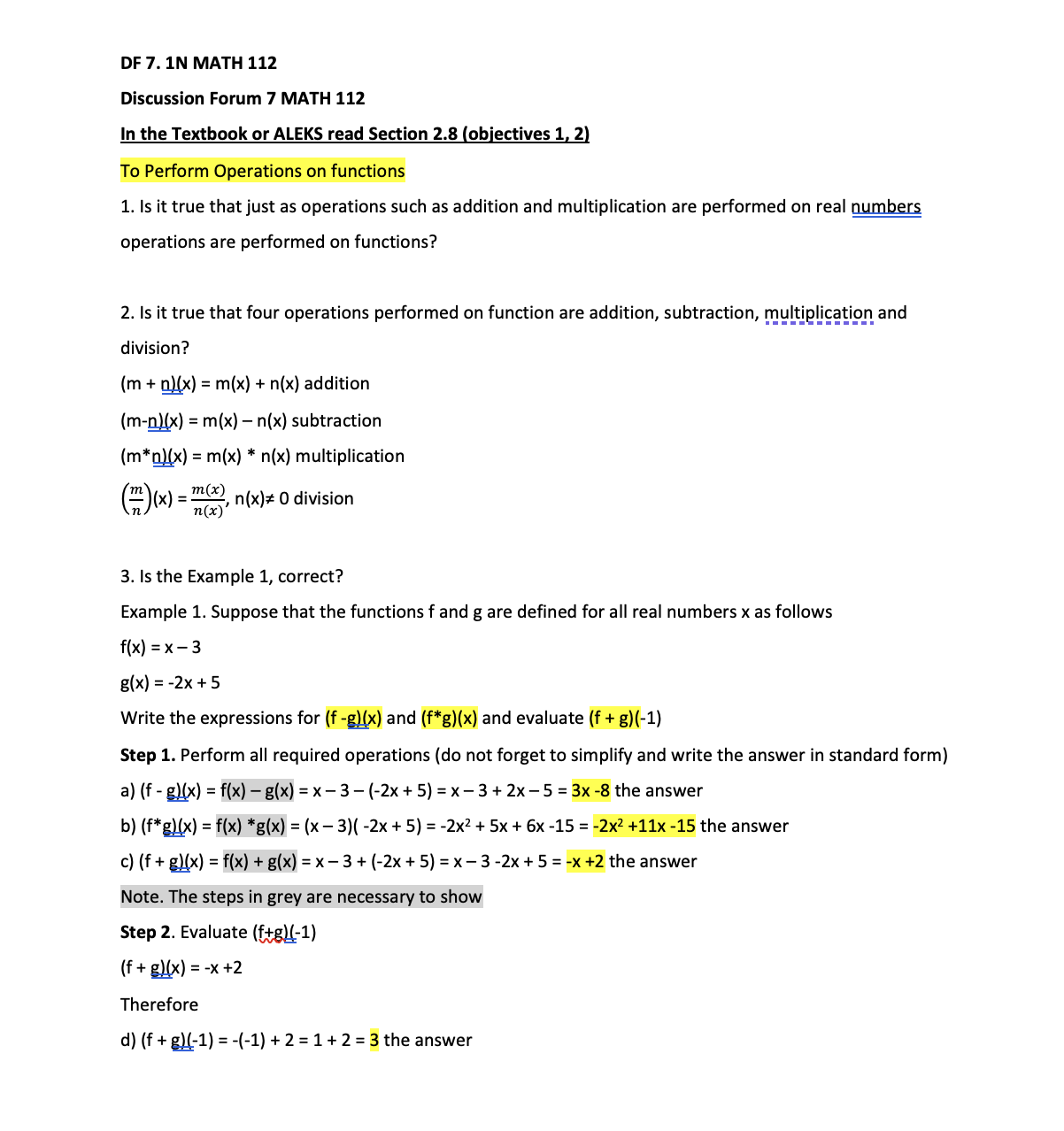
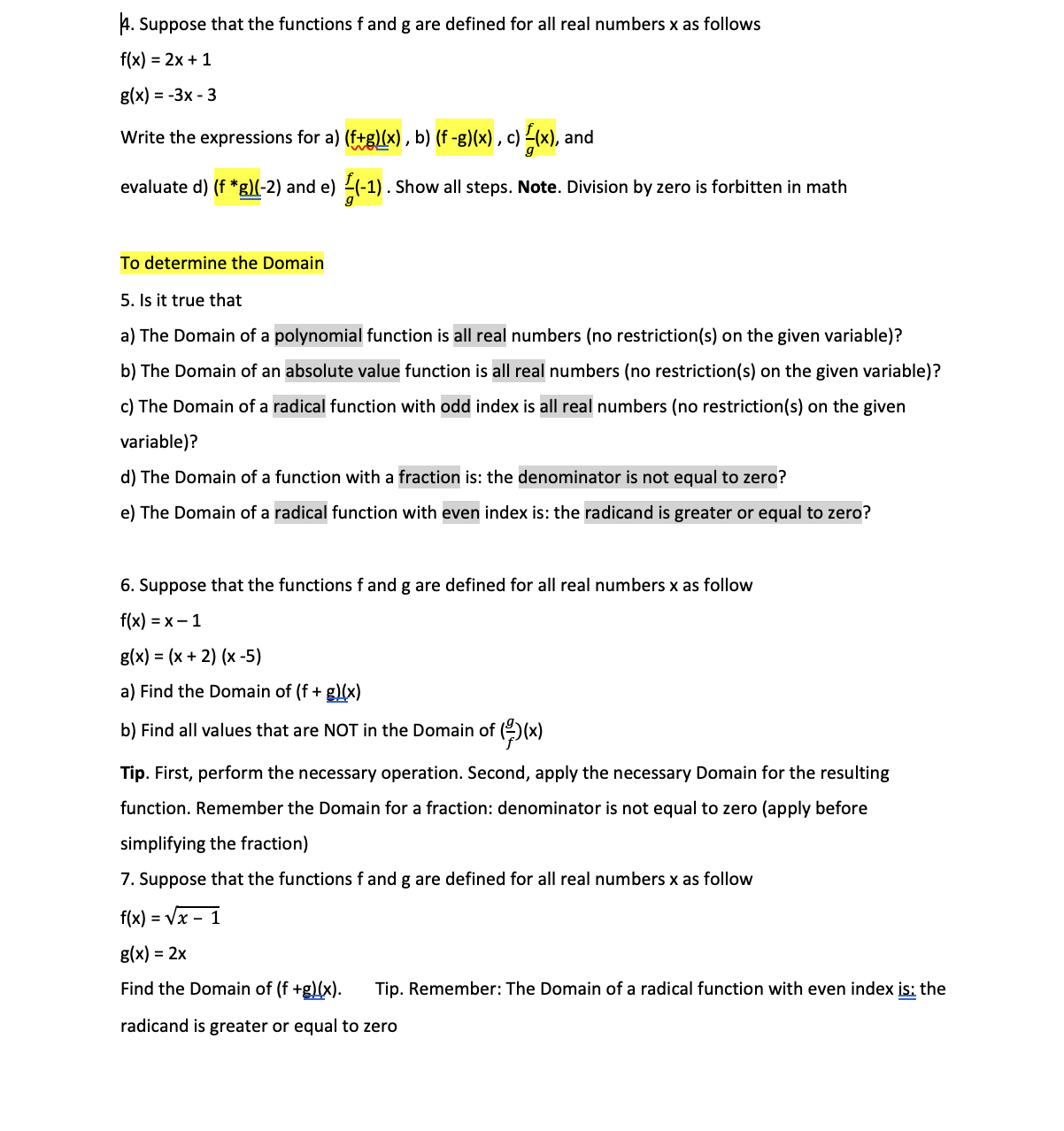
DF 7. IN MATH 112 Discussion Forum 7 MATH 112 In the Textbook or ALEKS read Section 2.8 (objectives 1, 2) To Perform Operations on functions 1. Is it true that just as operations such as addition and multiplication are performed on real numbers operations are performed on functions? 2. Is it true that four operations performed on function are addition, subtraction, multiplication and division? (m + n)(x) = m(x) + n(x) addition (m-n)(x) = m(x) - n(x) subtraction (m*n)(x) = m(x) * n(x) multiplication (m) (x) = m(2) n(x), n(x)= 0 division 3. Is the Example 1, correct? Example 1. Suppose that the functions f and g are defined for all real numbers x as follows f(x) = x - 3 g(x) = -2x +5 Write the expressions for (f -@)(x) and (f*g)(x) and evaluate (f + g)(-1) Step 1. Perform all required operations (do not forget to simplify and write the answer in standard form) a) (f - g)(x) = f(x) - g(x) = x- 3-(-2x + 5) = x -3 + 2x -5 = 3x -8 the answer b) (f*)(x) = f(x) *g(x) = (x-3)(-2x+5) =-2x2 + 5x + 6x -15 = -2x2 +11x -15 the answer c) (f + )(x) = f(x) + g(x) =x-3+(-2x + 5) = x-3-2x +5 = -x +2 the answer Note. The steps in grey are necessary to show Step 2. Evaluate (f+g)(-1) (f + ) (x) = -x+2 Therefore d) (f + @)(-1) = -(-1) + 2 = 1+ 2 = 3 the answerI4. Suppose that the functions f and g are defined for all real numbers x as follows f(x] = 2x + 1 g(x) = -3x - 3 Write the expressions for a] (f+g!!x] , h} (f -g](x) , c1500, and evaluate d) (f *g_]_(-2] and e) 3-1) . Show all steps. Note. Division by zero is forbitten in math To determine the Domain 5. Is it true that a] The Domain of a polynomial function is all real numbers (no restriction(s} on the given variable}? b] The Domain of an absolute value function is all real numbers (no restriction(s] on the given variable}? c} The Domain of a radical function with odd index is all real numbers (no restriction(s} on the given variable}? d] The Domain of a function with a fraction is: the denominator is not equal to zero? e] The Domain of a radical function with even index is: the radicand is greater or equal to zero? 5. Suppose that the functions f and g are defined for all real numbers 3: as follow f(x] = x 1 300 = (X + 2} (X -5} a] Find the Domain of (f + in\") b] Find all values that are NOT in the Domain of ($00 Tip. First, perform the necessary operation. Second, apply the necessary Domain for the resulting function. Remember the Domain for a fraction: denominator is not equal to zero (apply before simplifying the fraction) 7. Suppose that the functions f and g are defined for all real numbers 3: as follow f(x] = m g(x) = 2): Find the Domain of (f ux]. Tip. Remember: The Domain of a radical function with even index gthe radicand is greater or equal to zero

Step by Step Solution

There are 3 Steps involved in it

1 Expert Approved Answer
Step: 1 Unlock blur-text-image
Question Has Been Solved by an Expert!

Get step-by-step solutions from verified subject matter experts

Step: 2 Unlock
Step: 3 Unlock

Students Have Also Explored These Related Mathematics Questions!