







Question: DFS is a graph search algorithm that starts from a node (a root node) and explores as far as possible along each branch before backtracking
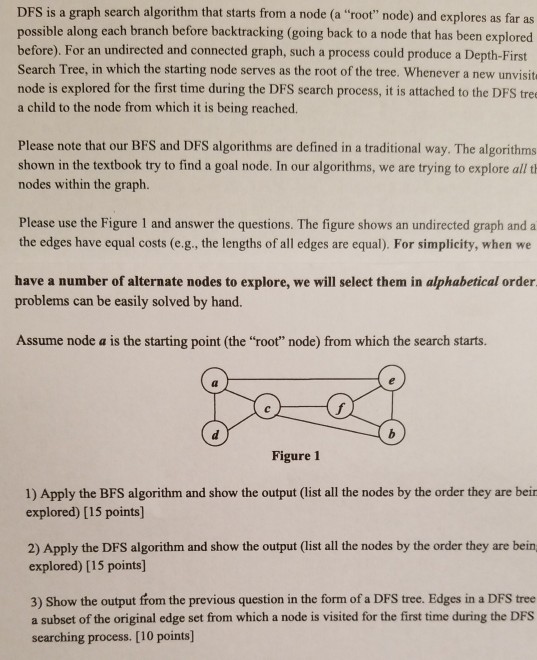
DFS is a graph search algorithm that starts from a node (a "root" node) and explores as far as possible along each branch before backtracking (going back to a node that has been explored before). For an undirected and connected graph, such a process could produce a Depth-First Search Tree, in which the starting node serves as the root of the tree. Whenever a new unvisite node is explored for the first time during the DFS search process, it is attached to the DFS tree a child to the node from which it is being reached. Please note that our BFS and DFS algorithms are defined in a traditional way. The algorithms shown in the textbook try to find a goal node. In our algorithms, we are trying to explore all t nodes within the graph. Please use the Figure 1 and answer the questions. The figure shows an undirected graph and a the edges have equal costs (e.g., the lengths of all edges are equal). For simplicity, when we have a number of alternate nodes to explore, we will select them in alphabetical order problems can be easily solved by hand. Assume node a is the starting point (the "root" node) from which the search starts Figure 1 1) Apply the BFS algorithm and show the output (list all the nodes by the order they are beir explored) [15 points] 2) Apply the DFS algorithm and show the output (list all the nodes by the order they are bein explored) [15 points] 3) Show the output from the previous question in the form of a DFS tree. Edges in a DFS tree a subset of the original edge set from which a node is visited for the first time during the DFS searching process. [10 points]
Step by Step Solution
There are 3 Steps involved in it

Get step-by-step solutions from verified subject matter experts
 Study Help