


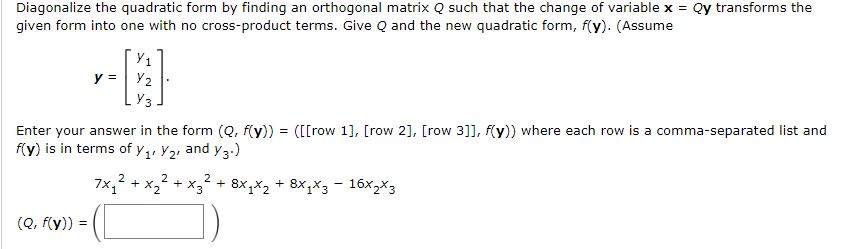
Question: Diagonalize the quadratic form by finding an orthogonal matrix Q such that the change of variable x = Qy transforms the given form into one
Diagonalize the quadratic form by finding anDiagonalize the quadratic form by finding anDiagonalize the quadratic form by finding an
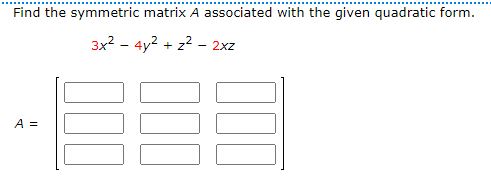
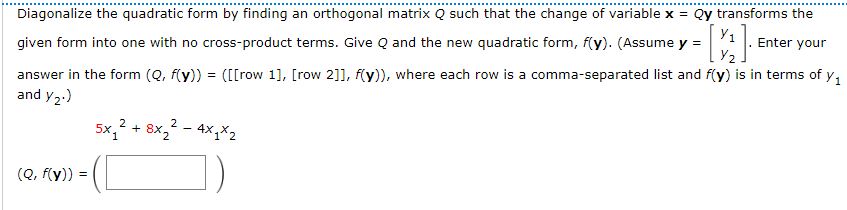
Diagonalize the quadratic form by finding an orthogonal matrix Q such that the change of variable x = Qy transforms the given form into one with no cross-product terms. Give Q and the new quadratic form, f(y). (Assume y = Y2 Enter your answer in the form (Q, A(y)) = ([[row 1], [row 2], [row 3]], A(y)) where each row is a comma-separated list and f(y) is in terms of y, , V2, and y3.) 7X 1 2+ x 7 - 2+ X3 2 + 8x,X, + 8X,X3 - 16X,X3 (Q, f(y) ) =\fDiagonalize the quadratic form by finding an orthogonal matrix Q such that the change of variable x = 011 transforms the Y1 Y2 answer in the form (Q, FWD = [[[rew 1], [row 2]], yjj, where each row is a commaseparated list and ffy) is in terms of y1 and V2.) given form into one with no crass-product terms. Give Q and the new quadratic form, y}. {Assume y = |: ]. Enter your 2 2 _ 5x1 + 8X2 4xlxz {Q,m=(E )
Step by Step Solution

There are 3 Steps involved in it

1 Expert Approved Answer
Step: 1 Unlock blur-text-image

Question Has Been Solved by an Expert!

Get step-by-step solutions from verified subject matter experts

Step: 2 Unlock
Step: 3 Unlock

Students Have Also Explored These Related Mathematics Questions!