







Question: did part a and got D2= 0.2822. need help with b ans c 8. Please either type your answers and equations or attach an image
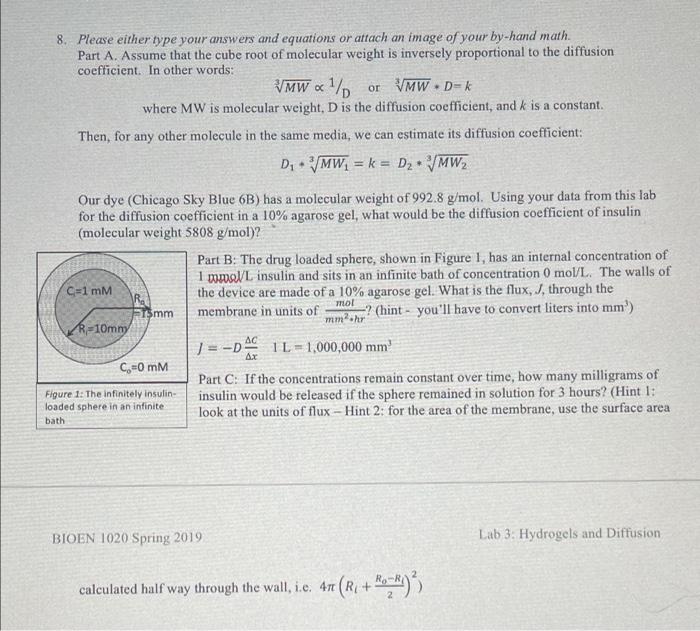
8. Please either type your answers and equations or attach an image of your by-hand math. Part A. Assume that the cube root of molecular weight is inversely proportional to the diffusion coefficient. In other words: VMW 1/1 or VMW.D-k where MW is molecular weight, D is the diffusion coefficient, and k is a constant. Then, for any other molecule in the same media, we can estimate its diffusion coefficient: D, VMW, = k = D. . VMW, mol Our dye (Chicago Sky Blue 6B) has a molecular weight of 992.8 g/mol. Using your data from this lab for the diffusion coefficient in a 10% agarose gel, what would be the diffusion coefficient of insulin (molecular weight 5808 g/mol)? Part B: The drug loaded sphere, shown in Figure 1, has an internal concentration of 1 mall insulin and sits in an infinite bath of concentration 0 mol/L. The walls of C=1 mM the device are made of a 10% agarose gel. What is the flux, J, through the 75mm membrane in units of mm.hr F? (hint - you'll have to convert liters into mm') R-10mm DC 1L = 1,000,000 mm C =0 mm Part 2: If the concentrations remain constant over time, how many milligrams of Figure 1: The infinitely insulin insulin would be released if the sphere remained in solution for 3 hours? (Hint 1: loaded sphere in an infinite look at the units of flux - Hint 2: for the area of the membrane, use the surface area 1=-DAC Ax bath BIOEN 1020 Spring 2019 Lab 3. Hydrogels and Diffusion calculated half way through the wall, i.e. 47 (R1+ Kg78)
Step by Step Solution
There are 3 Steps involved in it

Get step-by-step solutions from verified subject matter experts
 Study Help