







Question: Dido's Problem The classic isoperimetric problem is based on a passage from Virgil's Aeneid which requires finding the shape containing the maximum area for given
Dido's Problem
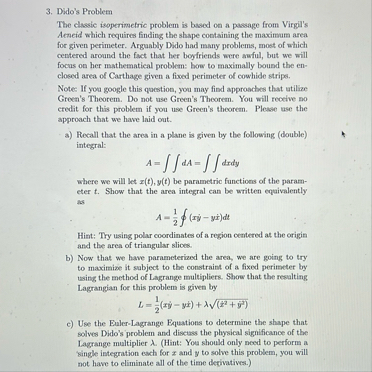
The classic isoperimetric problem is based on a passage from Virgil's Aeneid which requires finding the shape containing the maximum area for given perimeter. Arguably Dido had many problems, most of which centered around the fact that her boyfriends were awful, but we will focus on her mathematical problem: how to maximally bound the enclosed area of Carthage given a fixed perimeter of cowhide strips.
Notes If you google this question, you may find approaches that utilize Green's Theorem. Do not use Green's Theorem. You will receive no credit for this problem if you use Green's theorem. Plesse use the approach that we have laid out.
a Recall that the area in a plane is given by the following double integral:
where we will let be parametric functions of the parameter Show that the area integral can be written equivalently
Hint: Try using polar coordinates of a region centered at the origin and the area of triangular slices.
b Now that we have parameterized the area, we are going to try to maximize it subject to the constraint of a fixed perimeter by using the method of Lagrange multipliers. Show that the resulting Lagrangian for this problem is given by
c Use the EulerLagrange Equations to determine the shape that solves Dido's problem and discuss the physical significance of the Lagrange multiplier Hint: You should only need to perform a single integration each for and to solve this problem, you will not have to eliminate all of the time derivatives.
Step by Step Solution
There are 3 Steps involved in it
1 Expert Approved Answer
Step: 1 Unlock

Question Has Been Solved by an Expert!
Get step-by-step solutions from verified subject matter experts
Step: 2 Unlock
Step: 3 Unlock
 Study Help