







Question: Different techniques for analyzing project risk require different input variables and assumptions. Suppose you are using the sensitivity analysis technique to evaluate project risk. You
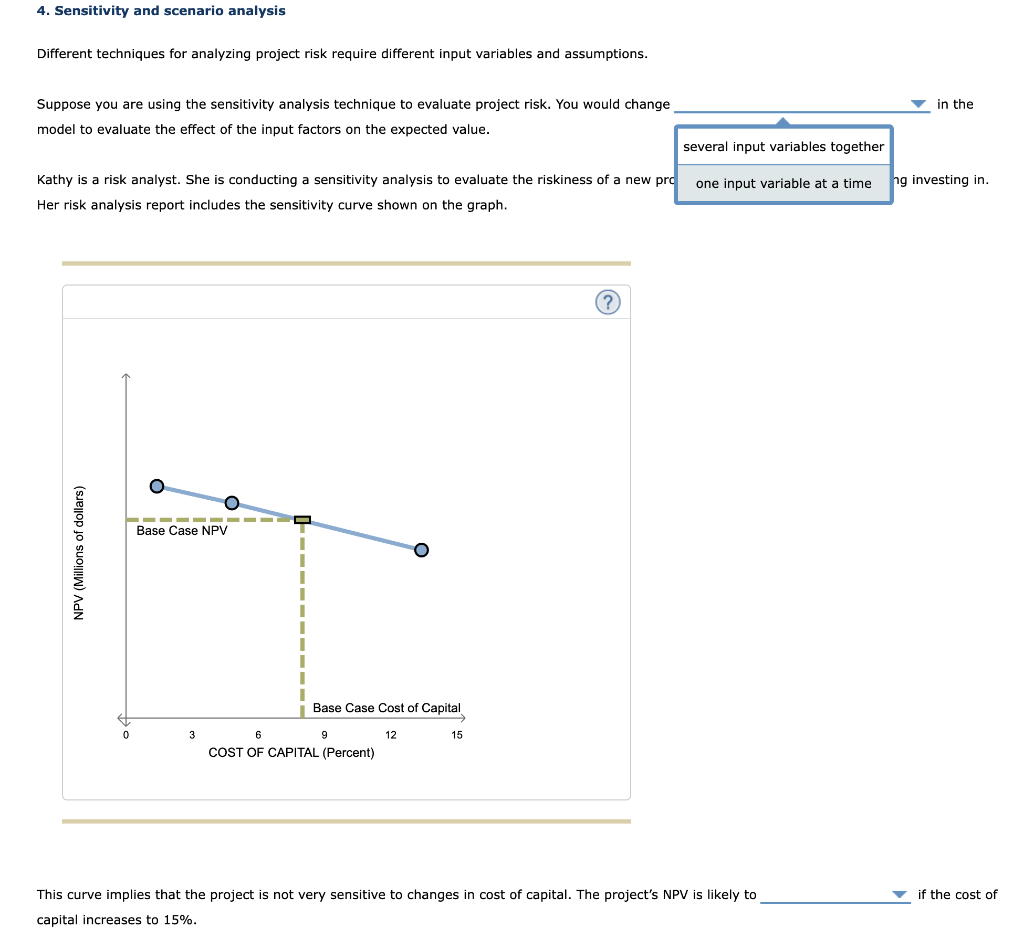
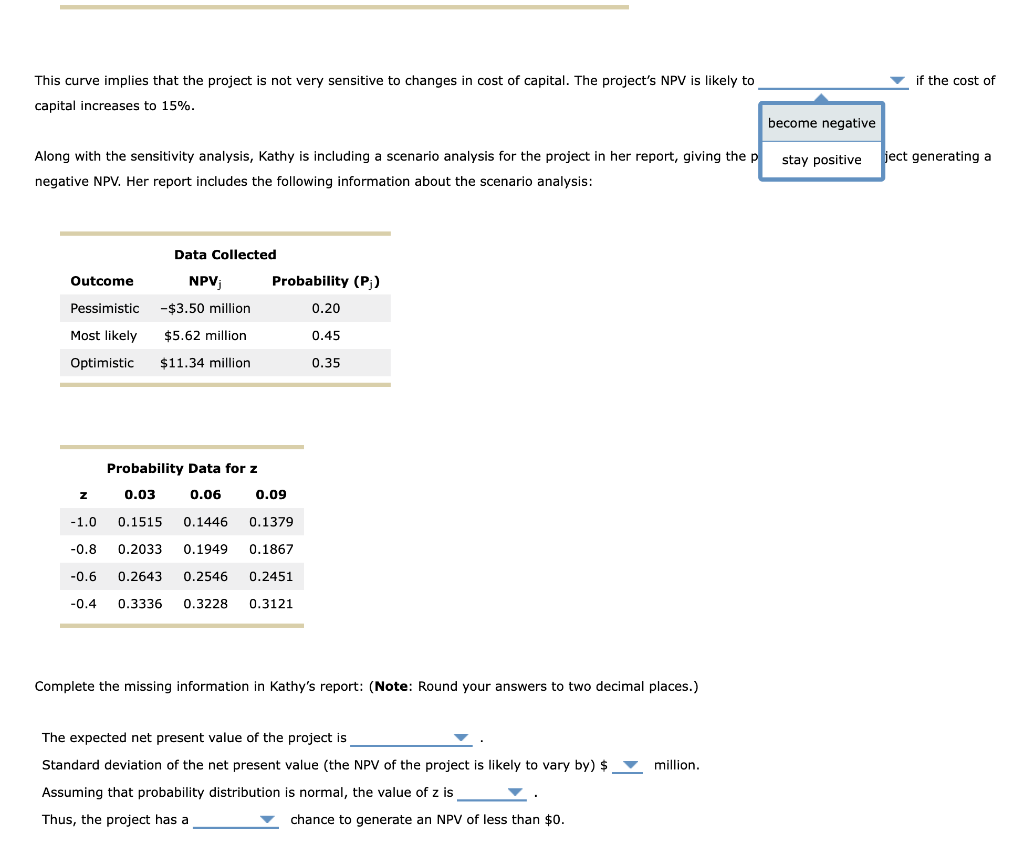
Different techniques for analyzing project risk require different input variables and assumptions. Suppose you are using the sensitivity analysis technique to evaluate project risk. You would change in the model to evaluate the effect of the input factors on the expected value. Kathy is a risk analyst. She is conducting a sensitivity analysis to evaluate the riskiness of a new pre 19 investing in. Her risk analysis report includes the sensitivity curve shown on the graph. This curve implies that the project is not very sensitive to changes in cost of capital. The project's NPV is likely to if the cost of capital increases to 15%. This curve implies that the project is not very sensitive to changes in cost of capital. The project's NPV is likely to . capital increases to 15%. Along with the sensitivity analysis, Kathy is including a scenario analysis for the project in her report, giving the p ect generating a negative NPV. Her report includes the following information about the scenario analysis: Complete the missing information in Kathy's report: (Note: Round your answers to two decimal places.) The expected net present value of the project is Standard deviation of the net present value (the NPV of the project is likely to vary by) $ million. Assuming that probability distribution is normal, the value of z is Thus, the project has a chance to generate an NPV of less than $0. Different techniques for analyzing project risk require different input variables and assumptions. Suppose you are using the sensitivity analysis technique to evaluate project risk. You would change in the model to evaluate the effect of the input factors on the expected value. Kathy is a risk analyst. She is conducting a sensitivity analysis to evaluate the riskiness of a new pre 19 investing in. Her risk analysis report includes the sensitivity curve shown on the graph. This curve implies that the project is not very sensitive to changes in cost of capital. The project's NPV is likely to if the cost of capital increases to 15%. This curve implies that the project is not very sensitive to changes in cost of capital. The project's NPV is likely to . capital increases to 15%. Along with the sensitivity analysis, Kathy is including a scenario analysis for the project in her report, giving the p ect generating a negative NPV. Her report includes the following information about the scenario analysis: Complete the missing information in Kathy's report: (Note: Round your answers to two decimal places.) The expected net present value of the project is Standard deviation of the net present value (the NPV of the project is likely to vary by) $ million. Assuming that probability distribution is normal, the value of z is Thus, the project has a chance to generate an NPV of less than $0
Step by Step Solution
There are 3 Steps involved in it

Get step-by-step solutions from verified subject matter experts
 Study Help