



Question: Different trade orders such as market orders, limit orders, and stop-loss orders are created to give investors the liberty to manage their securities based on
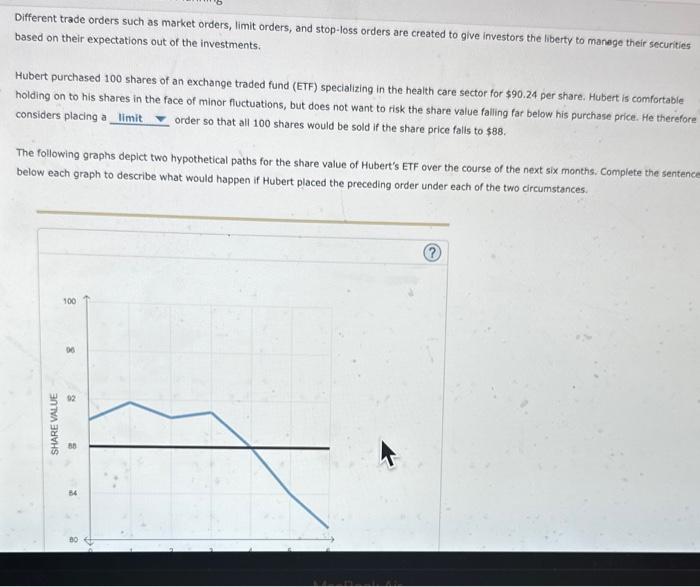
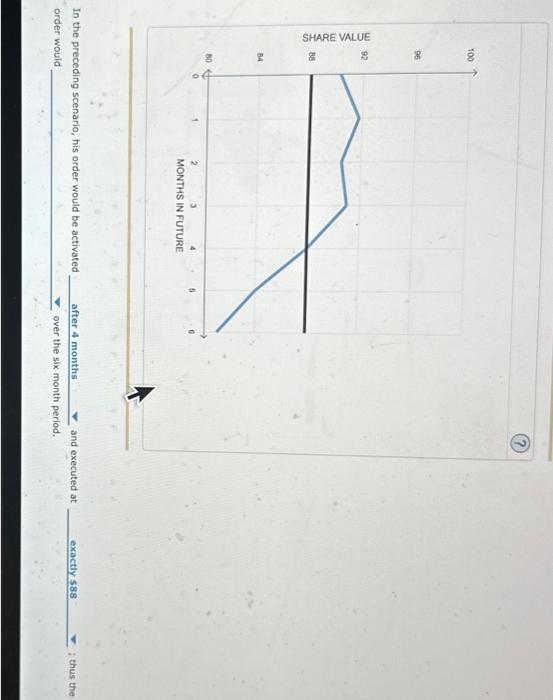
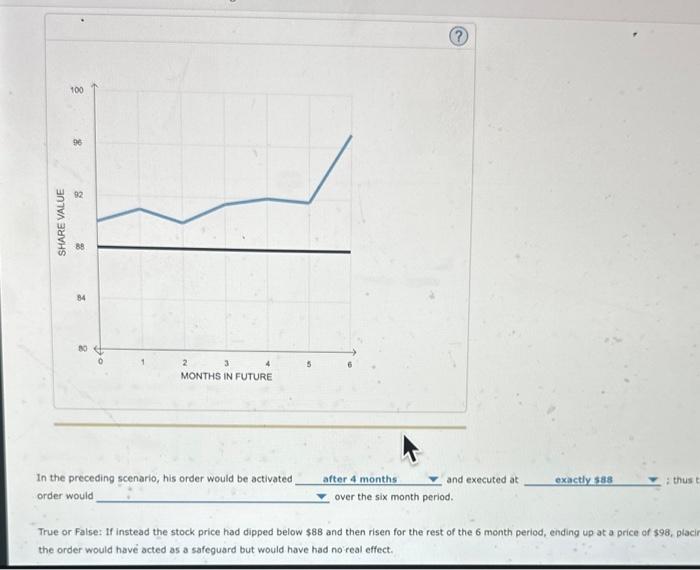
Different trade orders such as market orders, limit orders, and stop-loss orders are created to give investors the liberty to manage their securities based on their expectations out of the investments. Hubert purchased 100 shares of an exchange traded fund (ETF) specializing in the health care sector for $90.24 per share. Hubert is comfortable holding on to his shares in the face of minor fluctuations, but does not want to risk the share value falling far below his purchase price. He therefore considers placing a limit order so that all 100 shares would be sold if the share price falls to $88. The following graphs depict two hypothetical paths for the share value of Hubert's ETF over the course of the next six months. Complete the sentence below each graph to describe what would happen if Hubert placed the preceding order under each of the two circumstances. SHARE VALUE 100 06 90 2 84 SHARE VALUE 84 88 96 100 2 MONTHS IN FUTURE In the preceding scenario, his order would be activated after 4 months and executed at exactly $88 thus the order would over the six month period. SHARE VALUE 100 92 88 84 8 2 3 4 MONTHS IN FUTURE In the preceding scenario, his order would be activated, order would after 4 months and executed at over the six month period. exactly $88 thus t True or False: If instead the stock price had dipped below $88 and then risen for the rest of the 6 month period, ending up at a price of $98, placin the order would have acted as a safeguard but would have had no real effect
Step by Step Solution
There are 3 Steps involved in it

Get step-by-step solutions from verified subject matter experts