


Question: DIFFERENTIAL EQUATION: APPLICATION OF FIRST-ORDER DIFFERENTIAL EQUATIONS Show straightforward, complete, and neat solutions. Box final answer. B. Radioactive Decay 1. 2. 3| 4. A certain
DIFFERENTIAL EQUATION: APPLICATION OF FIRST-ORDER DIFFERENTIAL EQUATIONS

Show straightforward, complete, and neat solutions. Box final answer.

DIFFERENTIAL EQUATION: APPLICATION OF FIRST-ORDER
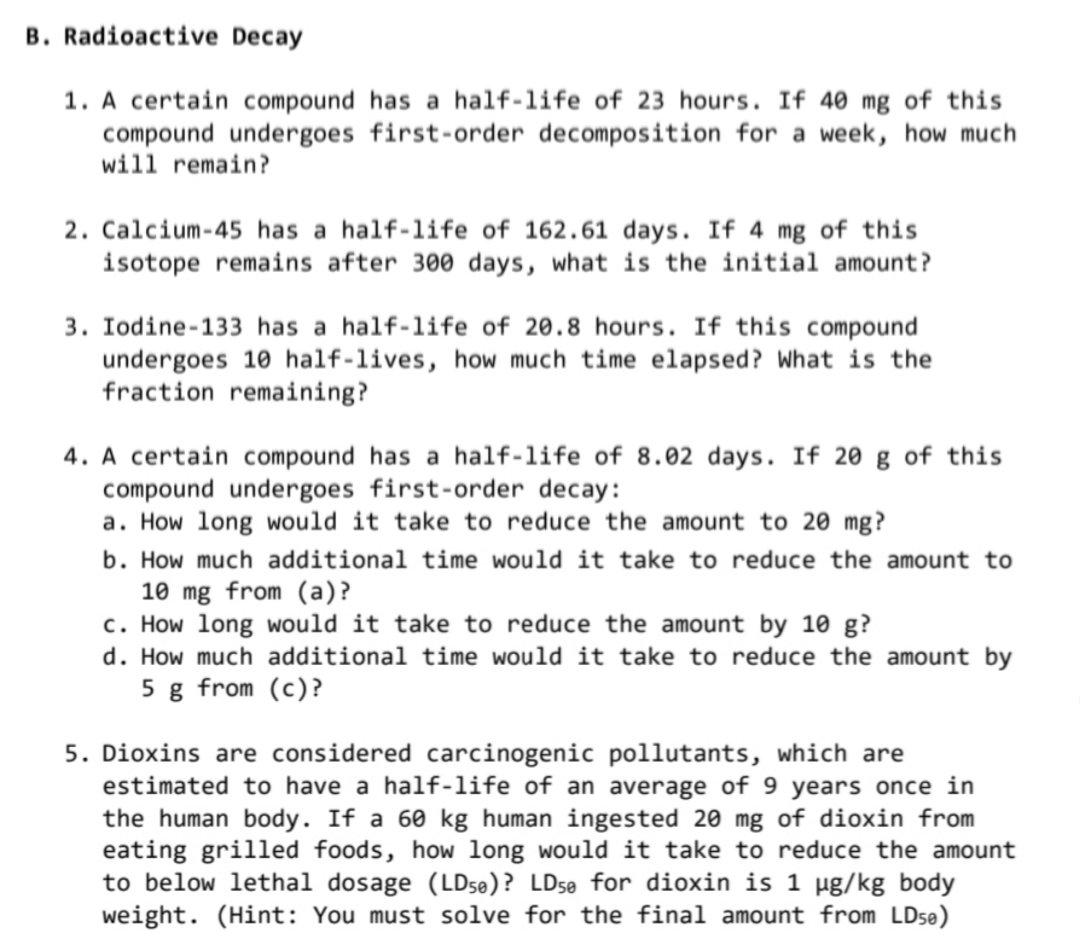
B. Radioactive Decay 1. 2. 3| 4. A certain compound has a half-life of 23 hours. If 49 mg of this compound undergoes first-order decomposition for a week, how much will remain? Calcium-45 has a half-life of 162.61 days. If 4 mg of this isotope remains after 360 days, what is the initial amount? Iodine-133 has a half-life of 20.8 hours. If this compound undergoes 16 half-lives, how much time elapsed? what is the fraction remaining? A certain compound has a half-life of 8.82 days. If 26 g of this compound undergoes first-order decay: a. How long would it take to reduce the amount to 26 mg? b. How much additional time would it take to reduce the amount to 10 mg from (a)? . How long would it take to reduce the amount by 16 g? d. How much additional time would it take to reduce the amount by 5 g from (c)? n . Dioxins are considered carcinogenic pollutants, which are estimated to have a half-life of an average of 9 years once in the human body. If a 60 kg human ingested 20 mg of dioxin from eating grilled foods, how long would it take to reduce the amount to below lethal dosage (LDm)? LDm for dioxin is 1 pg/kg body weight. (Hint: You must solve for the final amount from LDm

Step by Step Solution

There are 3 Steps involved in it

1 Expert Approved Answer
Step: 1 Unlock blur-text-image

Question Has Been Solved by an Expert!

Get step-by-step solutions from verified subject matter experts

Step: 2 Unlock
Step: 3 Unlock

Students Have Also Explored These Related Mathematics Questions!