



Question: DIFFERENTIAL EQUATION MATH Will rate for good work! Very appreciate! The extra credit project is to teach me about an differential equation that pops up
DIFFERENTIAL EQUATION MATH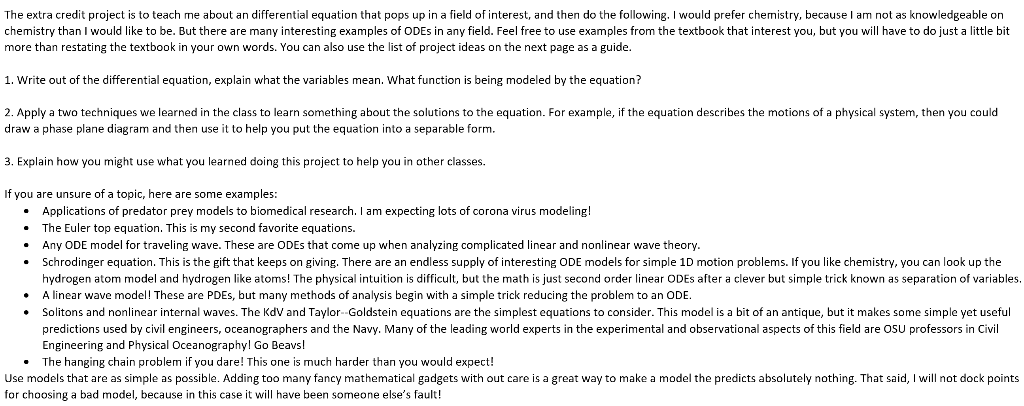 Will rate for good work! Very appreciate!
The extra credit project is to teach me about an differential equation that pops up in a field of interest, and then do the following. I would prefer chemistry, because I am not as knowledgeable on chemistry than I would like to be. But there are many interesting examples of ODEs in any field. Feel free to use examples from the textbook that interest you, but you will have to do just a little bit more than restating the textbook in your own words. You can also use the list of project ideas on the next page as a guide. 1. Write out of the differential equation, explain what the variables mean. What function is being modeled by the equation? 2. Apply a two techniques we learned in the class to learn something about the solutions to the equation. For example, if the equation describes the motions of a physical system, then you could draw a phase plane diagram and then use it to help you put the equation into a separable form. 3. Explain how you might use what you learned doing this project to help you in other classes. If you are unsure of a topic, here are some examples: Applications f predator prey models to biomedical research. I am expecting lots of corona virus modeling! The Euler top equation. This is my second favorite equations. Any ODE model for traveling wave. These are ODEs that come up when analyzing complicated linear and nonlinear wave theory. Schrodinger equation. This is the gift that keeps on giving. There are an endless supply of interesting ODE models for simple 10 motion problems. If you like chemistry, you can look up the hydrogen atom model and hydrogen like atoms! The physical intuition is difficult, but the math is just second order linear ODEs after a clever but simple trick known as separation of variables. A linear wave model! These are PDEs, but many methods of analysis begin with a simple trick reducing the problem to an ODE. Solitons and nonlinear internal waves. The KdV and Taylor-Goldstein equations are the simplest equations to consider. This model is a bit of an antique, but it makes some simple yet useful predictions used civil engineers, oceanographers and the Navy. Many of the leading world experts in the experimental and observational aspects of this field are OSU professors in Civil Engineering and Physical Oceanography! Go Beavs! The hanging chain problem if you dare! This one is much harder than you would expect! Use models that are as simple as possible. Adding too many fancy mathematical gadgets with out care is a great way to make model the predicts absolutely nothing. That said, I will not dock points for choosing a bad model, because in this case it will have been someone else's fault! The extra credit project is to teach me about an differential equation that pops up in a field of interest, and then do the following. I would prefer chemistry, because I am not as knowledgeable on chemistry than I would like to be. But there are many interesting examples of ODEs in any field. Feel free to use examples from the textbook that interest you, but you will have to do just a little bit more than restating the textbook in your own words. You can also use the list of project ideas on the next page as a guide. 1. Write out of the differential equation, explain what the variables mean. What function is being modeled by the equation? 2. Apply a two techniques we learned in the class to learn something about the solutions to the equation. For example, if the equation describes the motions of a physical system, then you could draw a phase plane diagram and then use it to help you put the equation into a separable form. 3. Explain how you might use what you learned doing this project to help you in other classes. If you are unsure of a topic, here are some examples: Applications f predator prey models to biomedical research. I am expecting lots of corona virus modeling! The Euler top equation. This is my second favorite equations. Any ODE model for traveling wave. These are ODEs that come up when analyzing complicated linear and nonlinear wave theory. Schrodinger equation. This is the gift that keeps on giving. There are an endless supply of interesting ODE models for simple 10 motion problems. If you like chemistry, you can look up the hydrogen atom model and hydrogen like atoms! The physical intuition is difficult, but the math is just second order linear ODEs after a clever but simple trick known as separation of variables. A linear wave model! These are PDEs, but many methods of analysis begin with a simple trick reducing the problem to an ODE. Solitons and nonlinear internal waves. The KdV and Taylor-Goldstein equations are the simplest equations to consider. This model is a bit of an antique, but it makes some simple yet useful predictions used civil engineers, oceanographers and the Navy. Many of the leading world experts in the experimental and observational aspects of this field are OSU professors in Civil Engineering and Physical Oceanography! Go Beavs! The hanging chain problem if you dare! This one is much harder than you would expect! Use models that are as simple as possible. Adding too many fancy mathematical gadgets with out care is a great way to make model the predicts absolutely nothing. That said, I will not dock points for choosing a bad model, because in this case it will have been someone else's fault
Step by Step Solution
There are 3 Steps involved in it

Get step-by-step solutions from verified subject matter experts