







Question: Differential Equations Consider the matrix 0 A = NO O A (a) Let x = [x1, X2, 23] , we want to find a set
Differential Equations
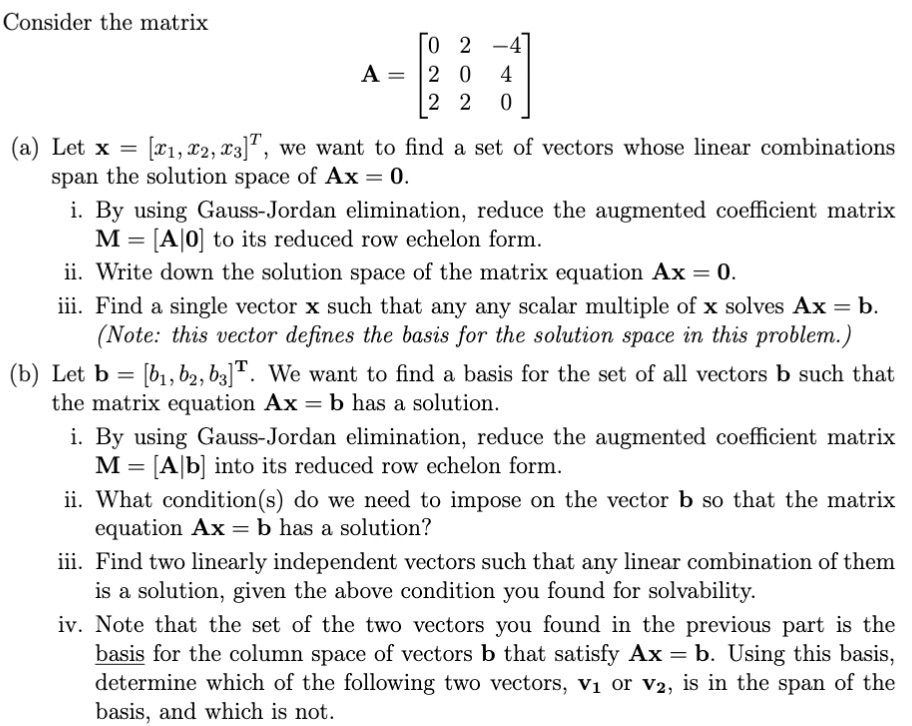
Consider the matrix 0 A = NO O A (a) Let x = [x1, X2, 23] , we want to find a set of vectors whose linear combinations span the solution space of Ax = 0. i. By using Gauss-Jordan elimination, reduce the augmented coefficient matrix M = [A|0] to its reduced row echelon form. ii. Write down the solution space of the matrix equation Ax = 0. iii. Find a single vector x such that any any scalar multiple of x solves Ax = b. (Note: this vector defines the basis for the solution space in this problem.) (b) Let b = [61, b2, bg]. We want to find a basis for the set of all vectors b such that the matrix equation Ax = b has a solution. i. By using Gauss-Jordan elimination, reduce the augmented coefficient matrix M = [A b] into its reduced row echelon form. ii. What condition(s) do we need to impose on the vector b so that the matrix equation Ax = b has a solution? iii. Find two linearly independent vectors such that any linear combination of them is a solution, given the above condition you found for solvability. iv. Note that the set of the two vectors you found in the previous part is the basis for the column space of vectors b that satisfy Ax = b. Using this basis, determine which of the following two vectors, v1 or v2, is in the span of the basis, and which is not
Step by Step Solution
There are 3 Steps involved in it

Get step-by-step solutions from verified subject matter experts
 Study Help