







Question: Diffraction grating Understanding a particular spectrum is important in many areas of science, including physics and chemistry, where it can be used to identify a
Diffraction grating
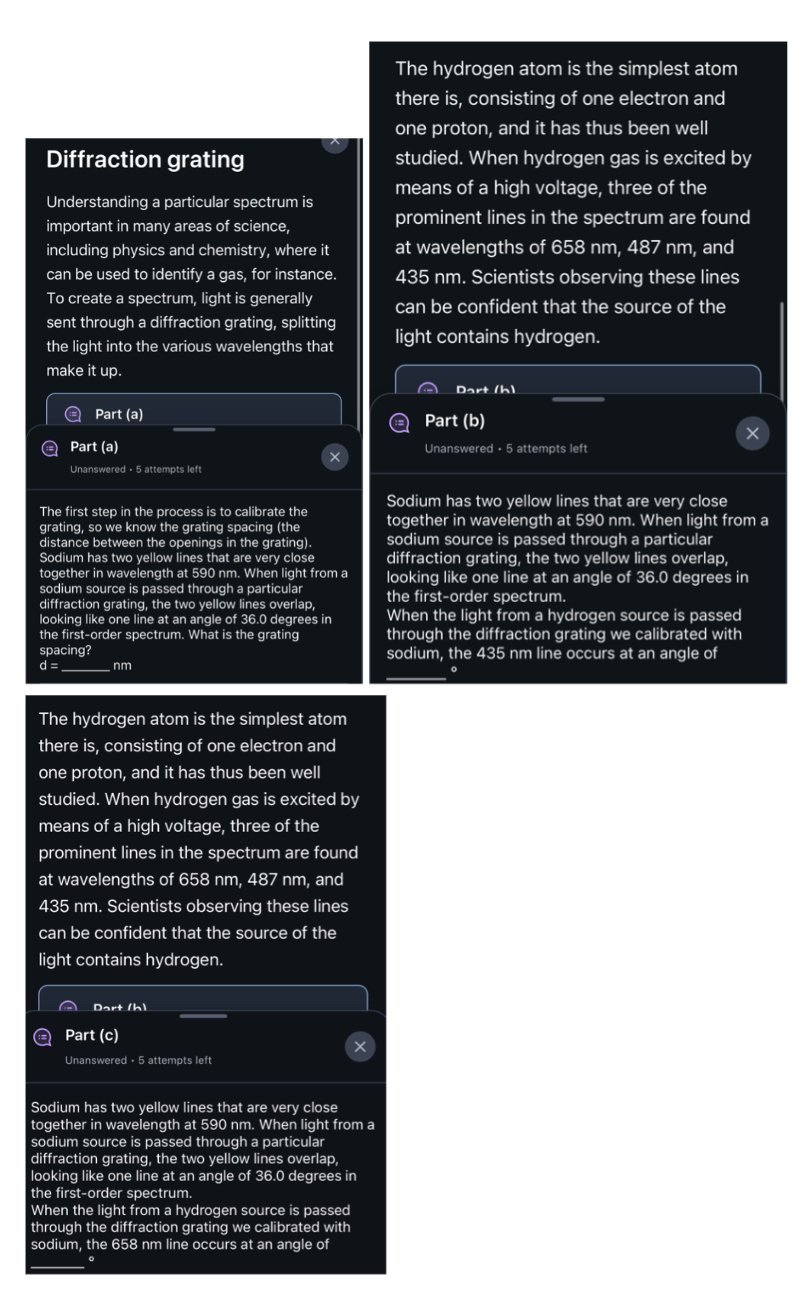
Understanding a particular spectrum is important in many areas of science, including physics and chemistry, where it can be used to identify a gas, for instance. To create a spectrum, light is generally sent through a diffraction grating, splitting the light into the various wavelengths that make it up
Part a
Part a
Unanswered attempts left
The first step in the process is to calibrate the grating, so we know the grating spacing the distance between the openings in the grating Sodium has two yellow lines that are very close together in wavelength at nm When light from a sodium source is passed through a particular diffraction grating, the two yellow lines overlap, looking like one line at an angle of degrees in the firstorder spectrum. What is the grating spacing?
nm
The hydrogen atom is the simplest atom there is consisting of one electron and one proton, and it has thus been well studied. When hydrogen gas is excited by means of a high voltage, three of the prominent lines in the spectrum are found at wavelengths of and nm Scientists observing these lines can be confident that the source of the light contains hydrogen.
Part c
Unanswered attempts left
Sodium has two yellow lines that are very close together in wavelength at nm When light from a sodium source is passed through a particular diffraction grating, the two yellow lines overlap, looking like one line at an angle of degrees in the firstorder spectrum.
When the light from a hydrogen source is passed through the diffraction grating we calibrated with sodium, the nm line occurs at an angle of
The hydrogen atom is the simplest atom there is consisting of one electron and one proton, and it has thus been well studied. When hydrogen gas is excited by means of a high voltage, three of the prominent lines in the spectrum are found at wavelengths of and nm Scientists observing these lines can be confident that the source of the light contains hydrogen.
a Part b
Unanswered attempts left
Sodium has two yellow lines that are very close together in wavelength at nm When light from a sodium source is passed through a particular diffraction grating, the two yellow lines overlap, looking like one line at an angle of degrees in the firstorder spectrum.
When the light from a hydrogen source is passed through the diffraction grating we calibrated with sodium, the nm line occurs at an angle of
Step by Step Solution
There are 3 Steps involved in it
1 Expert Approved Answer
Step: 1 Unlock

Question Has Been Solved by an Expert!
Get step-by-step solutions from verified subject matter experts
Step: 2 Unlock
Step: 3 Unlock
 Study Help