







Question: digital signal processing below is question 2 as it is refrenced thanks 3. If the input to the filter in question 2 is x(n) =
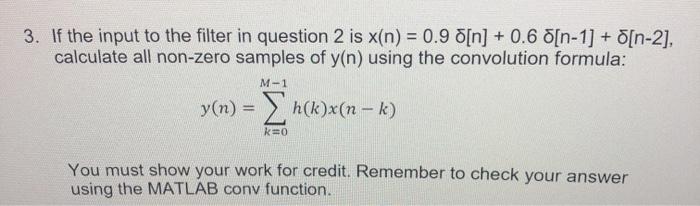
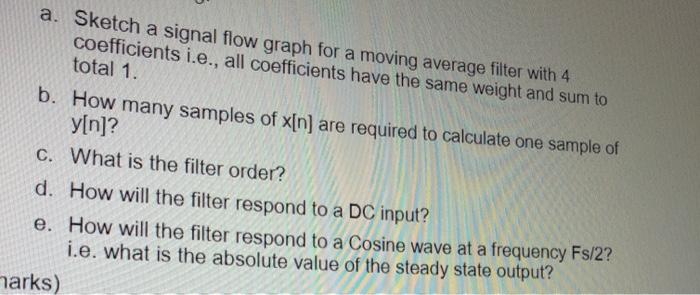
3. If the input to the filter in question 2 is x(n) = 0.9 5[n] + 0.6 [n-1] + [n-2], calculate all non-zero samples of y(n) using the convolution formula: M-1 y(n) = n(k)x(n 1) k=0 You must show your work for credit. Remember to check your answer using the MATLAB conv function. a. Sketch a signal flow graph for a moving average filter with 4 coefficients i.e., all coefficients have the same weight and sum to total 1. b. How many samples of x[n) are required to calculate one sample of y[n]? C. What is the filter order? d. How will the filter respond to a DC input? e. How will the filter respond to a Cosine wave at a frequency Fs/2? i.e. what is the absolute value of the steady state output? marks) 3. If the input to the filter in question 2 is x(n) = 0.9 5[n] + 0.6 [n-1] + [n-2], calculate all non-zero samples of y(n) using the convolution formula: M-1 y(n) = n(k)x(n 1) k=0 You must show your work for credit. Remember to check your answer using the MATLAB conv function. a. Sketch a signal flow graph for a moving average filter with 4 coefficients i.e., all coefficients have the same weight and sum to total 1. b. How many samples of x[n) are required to calculate one sample of y[n]? C. What is the filter order? d. How will the filter respond to a DC input? e. How will the filter respond to a Cosine wave at a frequency Fs/2? i.e. what is the absolute value of the steady state output? marks)
Step by Step Solution
There are 3 Steps involved in it

Get step-by-step solutions from verified subject matter experts
 Study Help