



Question: Dilemma BACKGROUND Sarah's project had now become more complex than she had anticipated. Sarah's company had a philosophy that the project manager would be assigned
Dilemma
BACKGROUND
Sarah's project had now become more complex than she had anticipated. Sarah's
company had a philosophy that the project manager would be assigned during
proposal preparation, assist in the preparation of the proposal, and take on the
role of the project manager after contract award, assuming the company would be
awarded the contract.
Usually, contract goahead would take place within a week or two after con
tract award. That made project staffing relatively easy for most of the project man
agers. It also allowed the company to include in the proposal a detailed schedule
based on resources that would be assigned upon contract award and goahead.
During proposal preparation, the functional managers would anticipate who
would be available for assignment to this project over the next few weeks. The
functional managers could then estimate with reasonable accuracy the duration
and effort required based on the grade level of the resources to be assigned. Since
the goahead date was usually within two weeks of contract award and the con
tract award was usually within a week or so after proposal submittal, the schedule
that appeared in the proposal was usually the same schedule for the actual project
with very few changes. This entire process was based on the actual availability of
resources rather than the functional managers assuming unlimited resources and
using various estimating techniques.
Although this approach worked well on most projects, Sarah's new project
had a goahead date of three months after contract award. For the functional man
agers, this created a problem estimating the effort and duration. Estimating now
had to be made based on the assumption of unlimited availability rather than the
availability of limited resources. Functional managers were unsure as to who
would be available three or four months from now, yet some type of schedule had
to appear in the proposal.
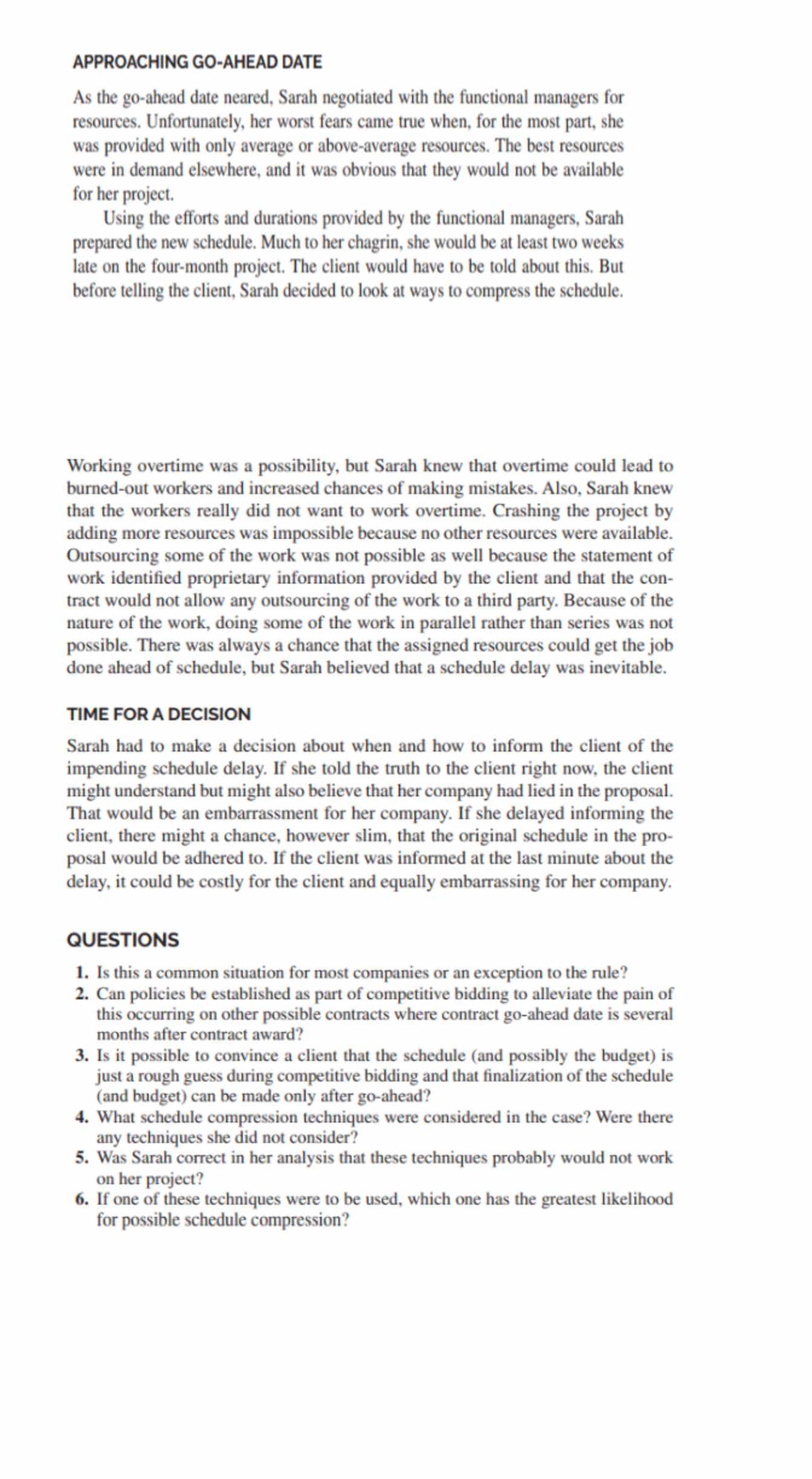
Sarah knew the risks. When the estimates were being prepared for her pro
posal, the functional managers assumed that the average worker in the department
would be available and assigned to the project after goahead. The effort and dura
tion estimates were then made based on the average employee. If after goahead,
aboveaverage employees would be assigned to Sarah's project, she could pos
sibly see the schedule accelerated but had to make sure that cost overruns did not
happen because the fully loaded salary of the workers might be higher that what
was estimated in the proposal. If belowaverage workers are assigned, a schedule
slippage might occur, and Sarah would have to look at possible schedule compres
sion techniques, hopefully without incurring added costs.
AWARD OF CONTRACT
Sarah's company was awarded the contract. Sarah had silently hoped that the
company would not get the contract, but it did. As expected, the goahead date
was three months from now. This created a problem for Sarah because she was
unsure as to when to begin the preparation of the detailed schedule. The functional
managers told her that they could not commit to an effort and duration based on
actual limited resource availability until somewhere around two to three weeks
prior to the actual goahead date. The resources were already spread thin across
several projects, and many of the projects were having trouble. Sarah was afraid
that the worstcase scenario would come true and that the actual completion date
would be longer than what was in the proposal. Sarah was certainly not happy
about explaining this to the client should it be necessary to do so
Step by Step Solution
There are 3 Steps involved in it
1 Expert Approved Answer
Step: 1 Unlock

Question Has Been Solved by an Expert!
Get step-by-step solutions from verified subject matter experts
Step: 2 Unlock
Step: 3 Unlock