







Question: Direct, sequential, and reciprocal allocation Ming Company has two service departments (S1 and S2) and two production departments (P1 and P2). Last year, directly identified
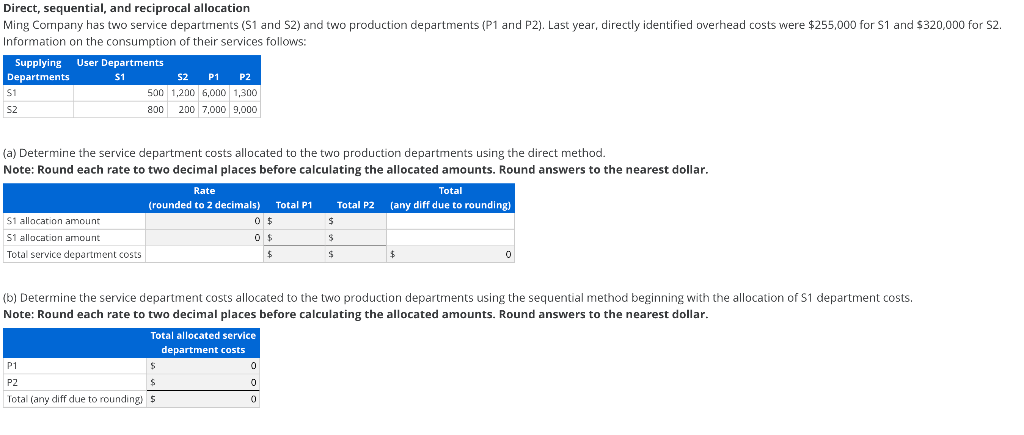
Direct, sequential, and reciprocal allocation Ming Company has two service departments (S1 and S2) and two production departments (P1 and P2). Last year, directly identified overhead costs were $255,000 for S1 and $320,000 for S2. Information on the consumption of their services follows:
| Supplying | User Departments | |||
|---|---|---|---|---|
| Departments | S1 | S2 | P1 | P2 |
| S1 | 500 | 1,200 | 6,000 | 1,300 |
| S2 | 800 | 200 | 7,000 | 9,000 |
(a) Determine the service department costs allocated to the two production departments using the direct method. Note: Round each rate to two decimal places before calculating the allocated amounts. Round answers to the nearest dollar.
| Rate | Total | |||
|---|---|---|---|---|
| (rounded to 2 decimals) | Total P1 | Total P2 | (any diff due to rounding) | |
| S1 allocation amount | Answer in % | Answer in $ | Answer in $ | |
| S1 allocation amount | Answer in % | Answer in $ | Answer in $ | |
| Total service department costs | Answer in $ | Answer in $ | Answer in $ |
(b) Determine the service department costs allocated to the two production departments using the sequential method beginning with the allocation of S1 department costs. Note: Round each rate to two decimal places before calculating the allocated amounts. Round answers to the nearest dollar.
| Total allocated service | |
|---|---|
| department costs | |
| P1 | Answer in $ |
| P2 | Answer in $ |
| Total (any diff due to rounding) | Answer in $ |
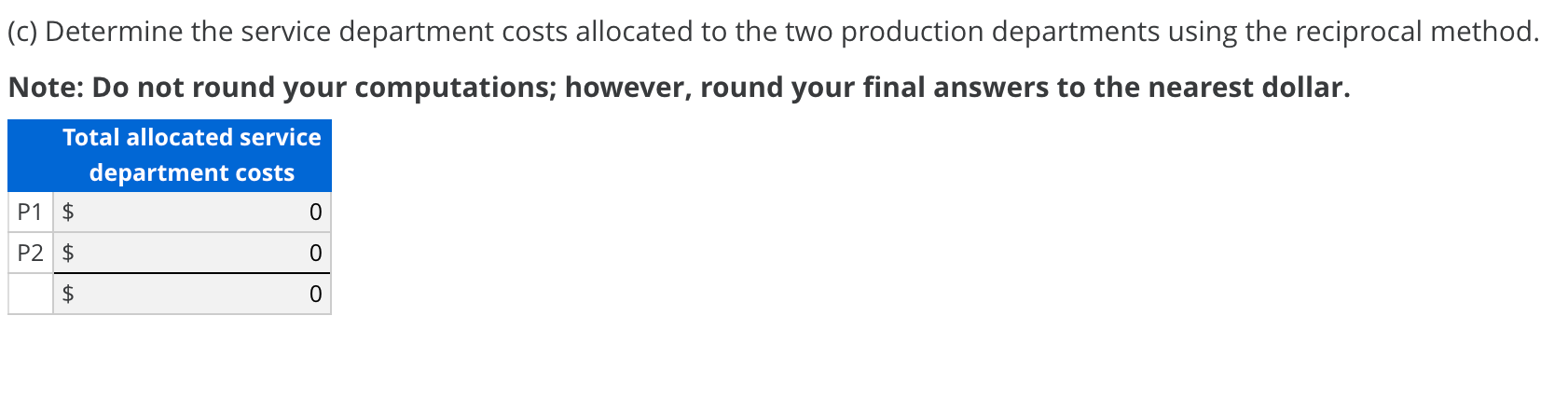
(c) Determine the service department costs allocated to the two production departments using the reciprocal method.
Note: Do not round your computations; however, round your final answers to the nearest dollar.
| Total allocated service | |
|---|---|
| department costs | |
| P1 | Answer in $ |
| P2 | Answer in $ |
| Answer in $ |
Direct, sequential, and reciprocal allocation Ming Company has two service departments (51 and 52) and two production departments (P1 and P2). Last year, directly identified overhead costs were $255,000 for S1 and $320,000 for $2. Information on the consumption of their services follows: Supplying User Departments Departments S1 S2 P1 PZ 500 1,200 6,000 1,300 S2 800 200 7,000 9,000 S1 (a) Determine the service department costs allocated to the two production departments using the direct method. Note: Round each rate to two decimal places before calculating the allocated amounts. Round answers to the nearest dollar. Rate Total (rounded to 2 decimals) Total P1 Total P2 (any diff due to rounding) S1 allocation amount S1 allocation amount Total service department costs $ (b) Determine the service department costs allocated to the two production departments using the sequential method beginning with the allocation of S1 department costs. Note: Round each rate to two decimal places before calculating the allocated amounts. Round answers to the nearest dollar. Total allocated service department costs P1 0 PZ Total (any diff due to rounding) $ 0 (c) Determine the service department costs allocated to the two production departments using the reciprocal method. Note: Do not round your computations; however, round your final answers to the nearest dollar. Total allocated service department costs P1 $ 0 P2 $ 0 $ 0
Step by Step Solution
There are 3 Steps involved in it

Get step-by-step solutions from verified subject matter experts
 Study Help