







Question: Directions In this performance Assessment you will write a Research Paper which you will have chosen from a problem in your text. You will begin


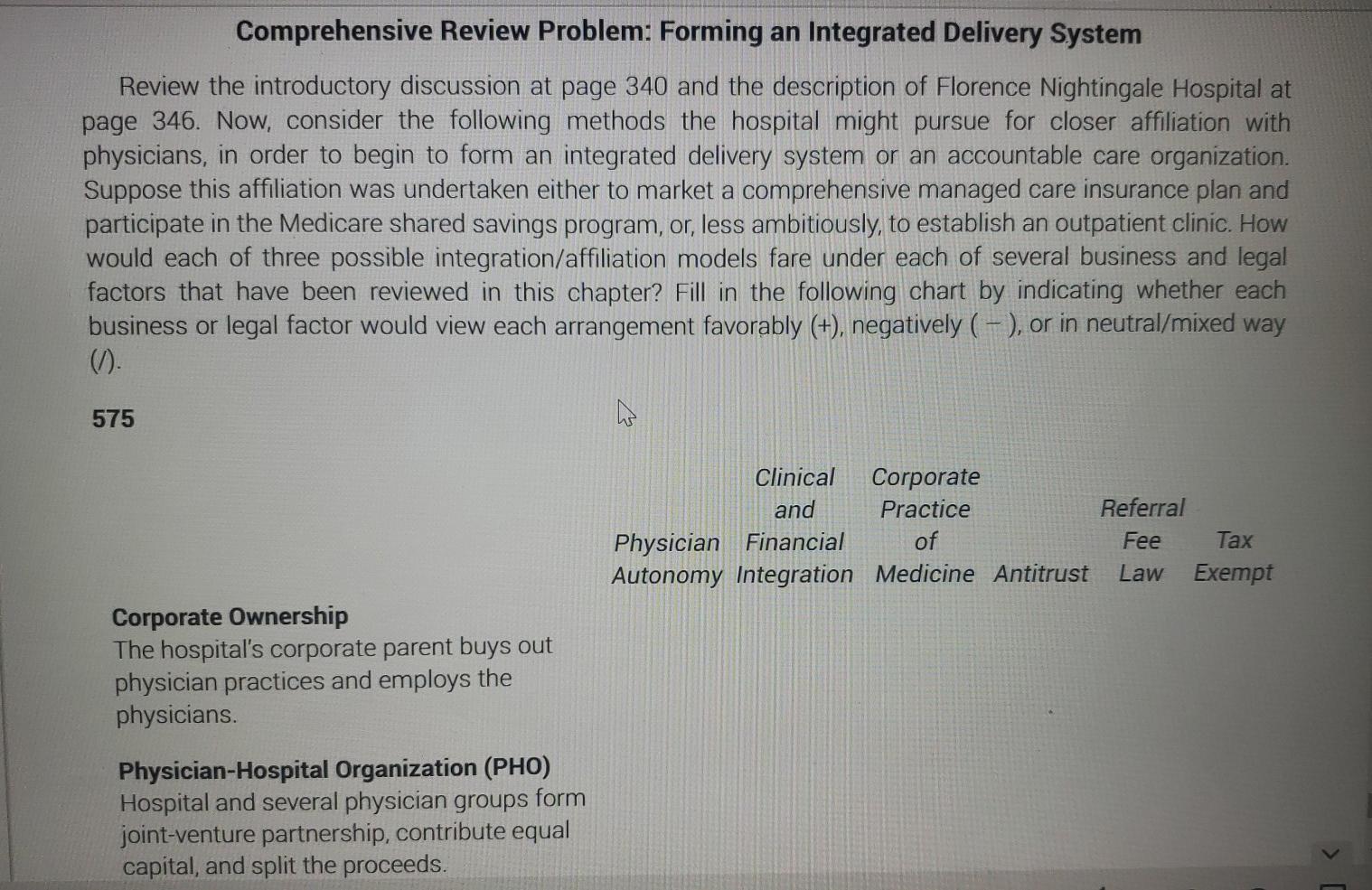
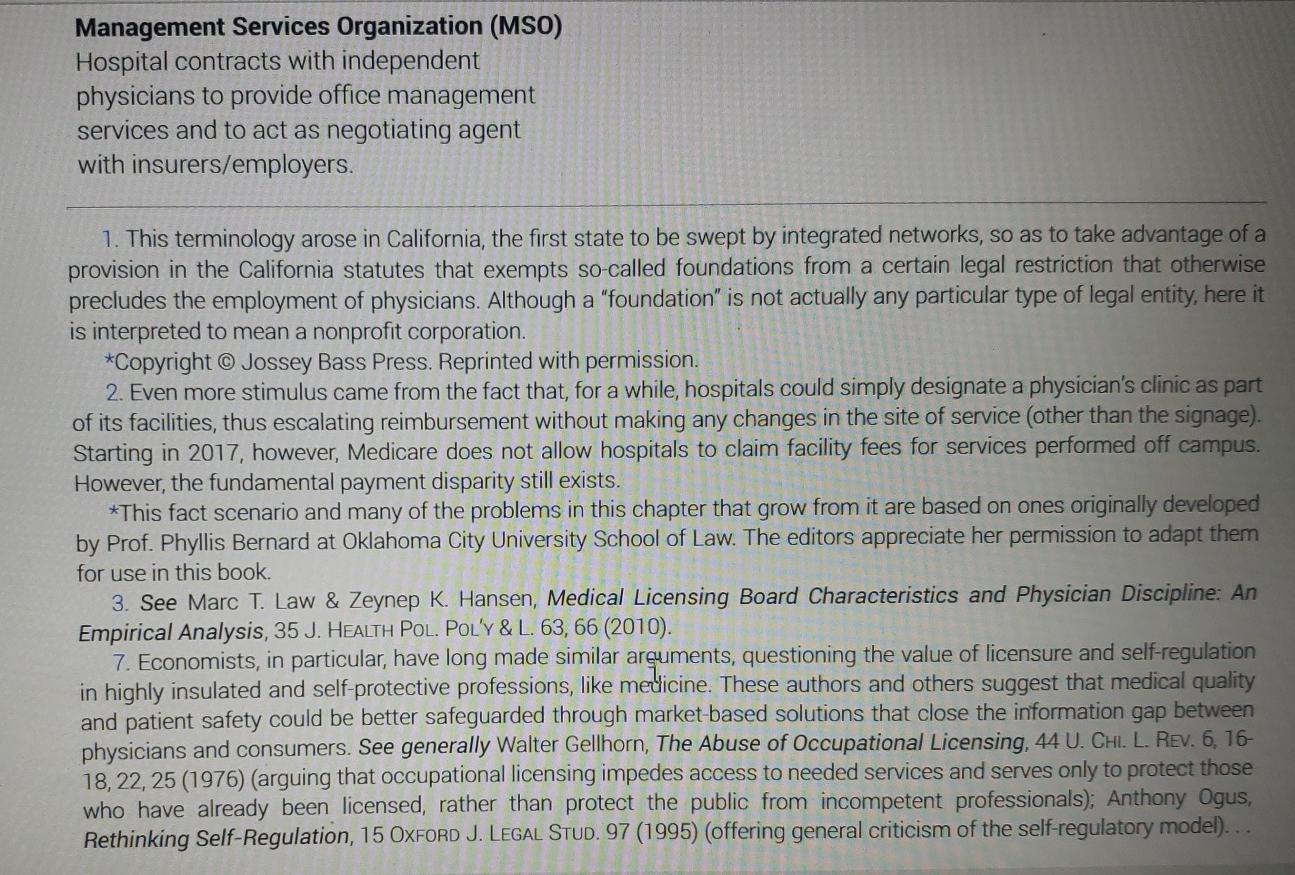
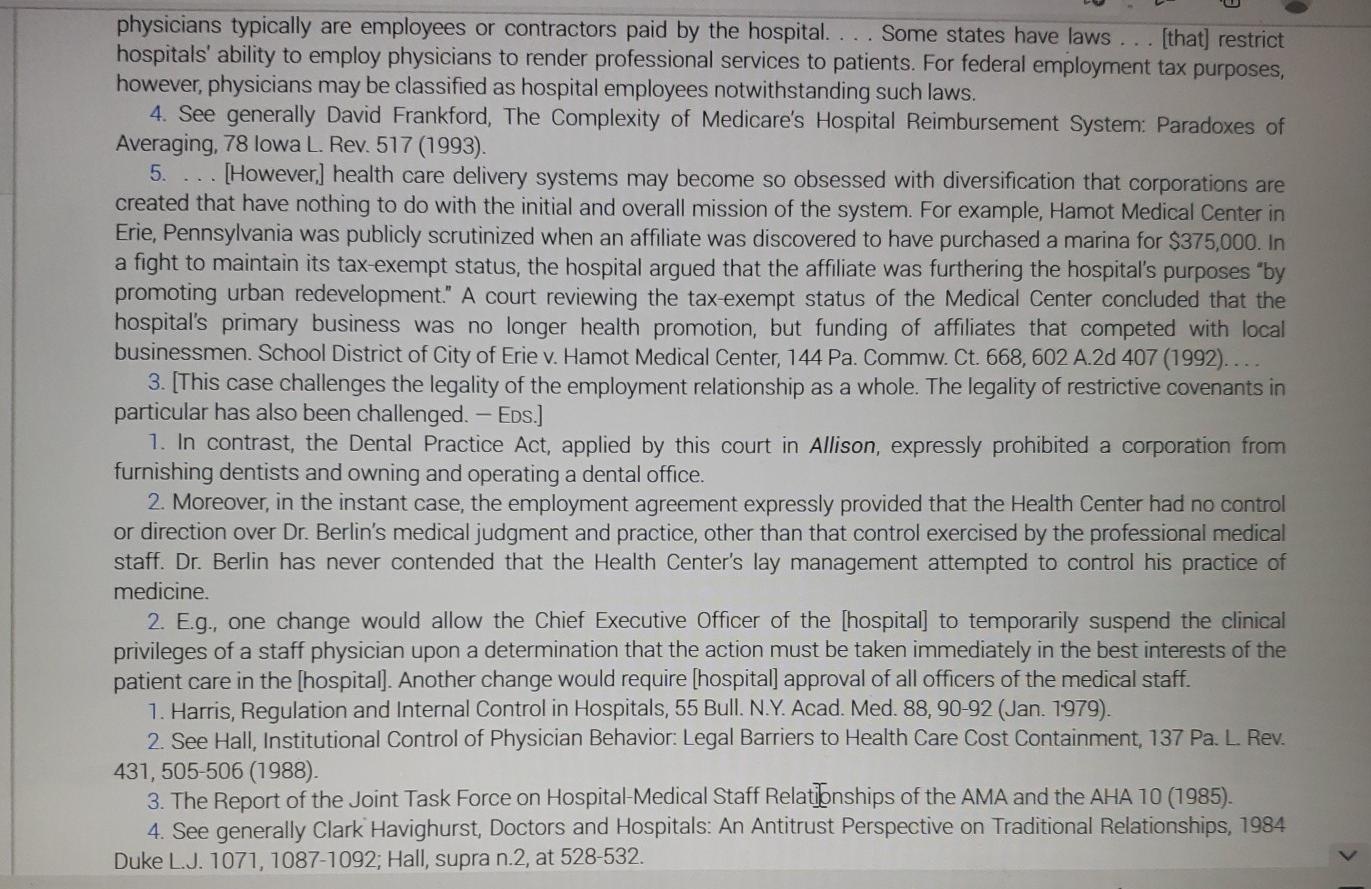
Directions In this performance Assessment you will write a Research Paper which you will have chosen from a problem in your text. You will begin by completing the Comprehensive Review Problem beginning on page 580 of the text. Make sure to include in your paper the results of the table on page 581. After you complete the chart, present your work in a paper of 5 to 7 pages and address what the stakes are for each major player in the Problem: the hospital, the PHO, and the MSO. In other words, you are explaining why you scored each factor the way you did on the chart. Cite your sources using correct American Psychological Association Style. For information on citations check these handouts from the APA Style tab on the library website. Review the Research Paper Writing Content Rubric under the Content Map. A sample paper is available on the Research and Writing website as well as the library website. There is a tutorial that will give you an overview of the parts and formatting of an APA paper here. Submit this assignment to the dropbox "Research Paper." This assignment is worth 180 points and will be graded according to the Research Paper Writing Content Rubric under the Content Map. Hi paper: Forming an Integrated Delivery System. Once you complete the chart, you will write a 5-7 page paper discussing the perspective/stakes for each player listed in the problem: Corporate Ownership, Physician-Hospital Owned (PHO) or Management Services Organization (MSO). In the 5-7 page paper, you will discuss and explain the reasoning behind the scoring in your chart . I hope +hic 1 Comprehensive Review Problem: Forming an Integrated Delivery System Review the introductory discussion at page 340 and the description of Florence Nightingale Hospital at page 346. Now, consider the following methods the hospital might pursue for closer affiliation with physicians, in order to begin to form an integrated delivery system or an accountable care organization. Suppose this affiliation was undertaken either to market a comprehensive managed care insurance plan and participate in the Medicare shared savings program, or, less ambitiously, to establish an outpatient clinic. How would each of three possible integration/affiliation models fare under each of several business and legal factors that have been reviewed in this chapter? Fill in the following chart by indicating whether each business or legal factor would view each arrangement favorably (+), negatively ( - ), or in neutral/mixed way 575 N. Clinical Corporate and Practice Referral Physician Financial of Fee Tax Autonomy Integration Medicine Antitrust Law Exempt Corporate Ownership The hospital's corporate parent buys out physician practices and employs the physicians. Physician-Hospital Organization (PHO) Hospital and several physician groups form joint-venture partnership, contribute equal capital, and split the proceeds. 1. The hospital association in New York once claimed that its members were subject to 174 regulatory bodies, and another survey found that hospitals have to submit themselves to over 50 different inspections and reports each year, often requiring into similar matters. B. Gray, The Profit Motive and Patient Care 112 (1991). [The American Hospital Association claims that, for every hour of patient care, hospitals engage in 30 to 60 minutes of paperwork. Patients or Paperwork? The Regulatory Burden Facing America's Hospitals (2001). See also John Braithwaite & Valerie Braithwaite, The Politics of Legalism: Rules Versus Standards in Nursing Home Regulation, 4 Soc. Leg. Stud. 307, 320 (1995) ("the people who inspect U.S. nursing homes are checking compliance with over a thousand regulations"); Christopher J. Conover, Health Care Regulation: A $169 Billion Hidden Tax (Cato Institute, 2004) (finding that health care regulation costs twice as much as its benefits are worth). See generally Robert I. Field, Health Care Regulation in America: Complexity, Confrontation and Compromise (2007).] 17. The district court granted summary judgment on the procedural due process claim for the reason that, in its opinion, the procedures used adequately safeguarded the Patients' interests, [a]pplying the tests of Mathews v. Eldridge, 424 U.S. 319 (1976). Without disagreeing with the district court's reasoning, we note that our analysis makes it unnecessary to reach the issues addressed by the court below.. 27. The legislative history reveals that Congress intended to support the efforts of the various professional accrediting organizations sponsored by the medical and hospital associations. 29. Our resolution of this issue renders somewhat academic the Patients' contention that it was improper for JCAH to "subdelegate" the responsibility for evaluating psychiatric hospitals to the various accreditation councils. Since we have found that no real authority was actually vested in JCAH, it follows that there could be no improper "subdelegation of authority to divisions of the Commission. ... *The editors are grateful to Prof. Phyllis Bernard for permission to use this problem, which she devised. 3. [This is a suit in which a private "bounty hunting" party or "whistleblower" (referred to as the "relator") sues on behalf of the federal government to recoup falsely paid amounts. If successful, the court can award the relator up to 30 percent of the recovery. If the government chooses to intervene, it then conducts the litigation, but the relator still receives 15-25 percent of the recovery. See Section E for further discussion. I 4. [Before joining the faculty of the University of the Pacific McGeorge School of Law, Prof. Parento was head of the Office of Health Policy in Kentucky, where she oversaw Kentucky's certificate of need program.] 5. Nicholas Bagley, Medicine as a Public Calling, 114 Mich. L. Rev. 57, 88 (2015). 6. John D. Blum, Finding a New Regulatory Pathway for the Old Labyrinth of Health Planning, 19 ANNALS OF HEALTH L. 213,216 (2010) 2. The articles also contain a "parity clause" which provides that the corporation may generally "do all acts and things which may be necessary, proper, useful or advantageous to the full carrying out of the purposes of this corporation."... *Excerpted with permission of the publisher. Copyright 1992, Massachusetts Medical Society. **The author is a respected journalist and social critic. 2. Other pertinent parts of Revenue Ruling 56-185 state: "It is normal for hospitals to charge those able to pay for services rendered in order to meet the operating expenses of the institution without denying medical care or treatment to others unable to pay.... It may furnish services at reduced rates which are below cost, and thereby render charity in that manner.... It must not, however, refuse to accept patients in need of hospital care who cannot pay for such services." 16. The Restatement (Second) of Trusts $368 (1959) states: "Charitable purposes include: (a) the relief of poverty, (b) the advancement of education; (c) the advancement of religion; (d) the promotion of health; (e) governmental or municipal purposes; (f) other purposes the accomplishment of which is beneficial to the community." 1. The disparity between the amount of free or discounted care dispensed and the amount of property tax that would be saved through receipt of a charitable exemption is in no way unique to the case before us here. Excluding bad debt, "the amount of uncompensated care provided by as many as three-quarters of nonprofit hospitals is less than their tax benefits." J. Colombo, Federal & State Tax Exemption Policy, Medical Debt & Healthcare for the Poor, 51 St. Louis L.J. 433, 433 n.2 (2007). 7. Paul Starr, The Social Transformation of American Medicine 150 (1982). "Voluntary" hospitals, like public hospitals (which evolved from almshouses for the dependent poor), performed a "welfare" function rather than a medical or curing function: The poor were housed in large wards, largely cared for themselves, and often were not expected to recover. See id. at 145, 149, 160. Early voluntary hospitals had paternalistic, communal social structures in which patients entered at the sufferance of their benefactors, "had the moral status of children," and received more moralistic and religious help than medical treatment. Id. at 149, 158. 4. The court also reasoned that extending free services and discounted membership to subscribers was not the same as serving the community at large, even though membership was open to the community at large. 8. When considering hospital-physician relationships, the Service should be aware that many ... "hospital based" physicians, notably radiologists, anesthesiologists, pathologists, medical residents, and some emergency room physicians typically are employees or contractors paid by the hospital.. Some states have laws ... [that] restrict physicians typically are employees or contractors paid by the hospital. . ... Some states have laws ... [that] restrict hospitals' ability to employ physicians to render professional services to patients. For federal employment tax purposes, however, physicians may be classified as hospital employees notwithstanding such laws. 4. See generally David Frankford, The Complexity of Medicare's Hospital Reimbursement System: Paradoxes of Averaging, 78 lowa L. Rev. 517 (1993). 5. ... [However) health care delivery systems may become so obsessed with diversification that corporations are created that have nothing to do with the initial and overall mission of the system. For example, Hamot Medical Center in Erie, Pennsylvania was publicly scrutinized when an affiliate was discovered to have purchased a marina for $375,000. In a fight to maintain its tax-exempt status, the hospital argued that the affiliate was furthering the hospital's purposes "by promoting urban redevelopment." A court reviewing the tax-exempt status of the Medical Center concluded that the hospital's primary business was no longer health promotion, but funding of affiliates that competed with local businessmen. School District of City of Erie v. Hamot Medical Center, 144 Pa. Commw. Ct. 668, 602 A.2d 407 (1992).... 3. [This case challenges the legality of the employment relationship as a whole. The legality of restrictive covenants in particular has also been challenged. - Eds.) 1. In contrast, the Dental Practice Act, applied by this court in Allison, expressly prohibited a corporation from furnishing dentists and owning and operating a dental office. 2. Moreover, in the instant case, the employment agreement expressly provided that the Health Center had no control or direction over Dr. Berlin's medical judgment and practice, other than that control exercised by the professional medical staff. Dr. Berlin has never contended that the Health Center's lay management attempted to control his practice of medicine. 2. E.g., one change would allow the Chief Executive Officer of the hospital] to temporarily suspend the clinical privileges of a staff physician upon a determination that the action must be taken immediately in the best interests of the patient care in the [hospital). Another change would require [hospital] approval of all officers of the medical staff. 1. Harris, Regulation and Internal Control in Hospitals, 55 Bull. N.Y. Acad. Med. 88, 90-92 (Jan. 1979). 2. See Hall, Institutional Control of Physician Behavior. Legal Barriers to Health Care Cost Containment, 137 Pa. L Rev. 431,505-506 (1988) 3. The Report of the Joint Task Force on Hospital-Medical Staff Relationships of the AMA and the AHA 10 (1985). 4. See generally Clark Havighurst, Doctors and Hospitals: An Antitrust Perspective on Traditional Relationships, 1984 Duke L.J. 1071, 1087-1092; Hall, supra n.2, at 528-532
Step by Step Solution
There are 3 Steps involved in it
1 Expert Approved Answer
Step: 1 Unlock

Question Has Been Solved by an Expert!
Get step-by-step solutions from verified subject matter experts
Step: 2 Unlock
Step: 3 Unlock
 Study Help