







Question: DIRECTIONS: Please write complete, concise responses to the following problems. Show all relevant work on any calculations and be sure to explain what you are
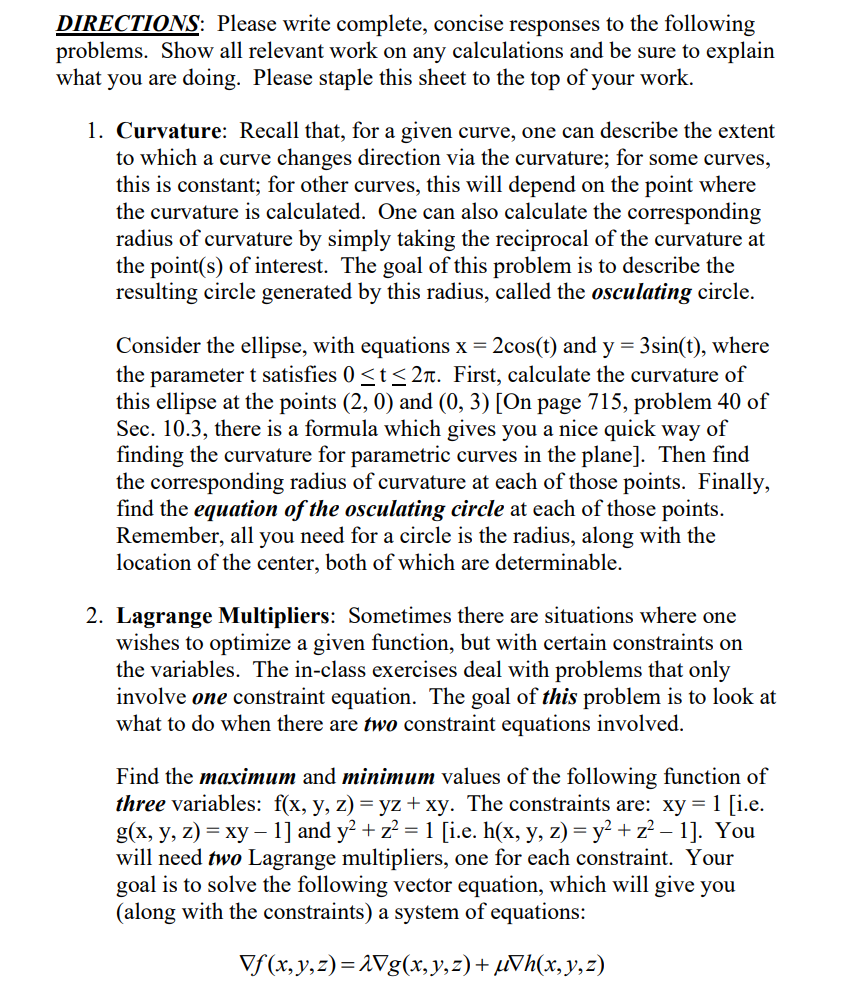
DIRECTIONS: Please write complete, concise responses to the following problems. Show all relevant work on any calculations and be sure to explain what you are doing. Please staple this sheet to the top of your work. 1. Curvature: Recall that, for a given curve, one can describe the extent to which a curve changes direction via the curvature; for some curves, this is constant; for other curves, this will depend on the point where the curvature is calculated. One can also calculate the corresponding radius of curvature by simply taking the reciprocal of the curvature at the point(s) of interest. The goal of this problem is to describe the resulting circle generated by this radius, called the escalating circle. Consider the ellipse, with equations 2: = 2cos(t} and y = 3sin(t), where the parameter t satisfies 0 5t 5 21:. First, calculate the curvature of this ellipse at the points (2, O) and (0, 3) [On page 715, problem 40 of Sec. [0.3, there is a formula which gives you a nice quick way of nding the curvature for parametric curves in the plane]. Then find the corresponding radius of curvature at each of those points. Finally, nd the equation cfthe nscuim'ing circle at each of those points. Remember, all you need for a circle is the radius, along with the location of the center, both of which are determinable. 2. Lagrange Multipliers: Sometimes there are situations where one wishes to optimize a given function, but with certain constraints on the variables. The in-class exercises deal with problems that only involve one constraint equation. The goal of this problem is to look at what to do when there are two constraint equations involved. Find the maximum and minimum values of the following mction of three variables: f(x, y, z} = yz + Ky. The constraints are: xy = 1 [i.e. g(x, y, z) = xy 1] and y2 + 22 =1 [i.e.h(x, y, z) = y2 + 22 1]. You will need two Lagrange multipliers, one for each constraint. Your goal is to solve the following vector equation, which will give you (along with the constraints) a system of equations: Vf(x,y,2) = Waxy. 2) + WMxJJ)
Step by Step Solution
There are 3 Steps involved in it

Get step-by-step solutions from verified subject matter experts
 Study Help