







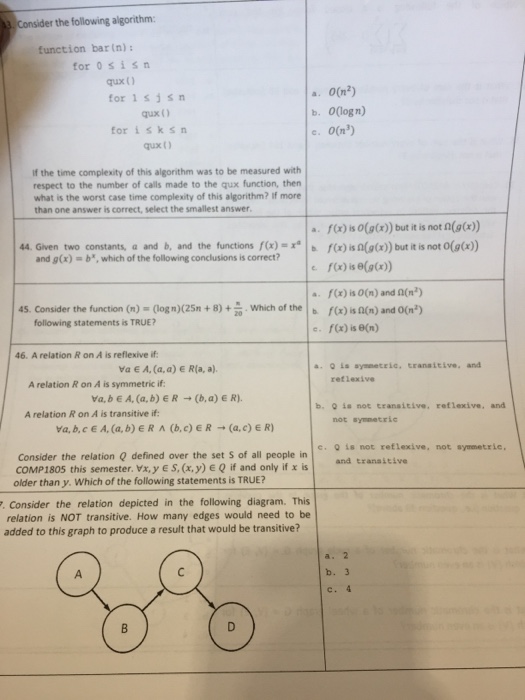
Question: Discrete math er the following algorithm: function bar (n) for 0 s is n qux a. 0(n2) for 1 s j s n b. 000g
 Discrete math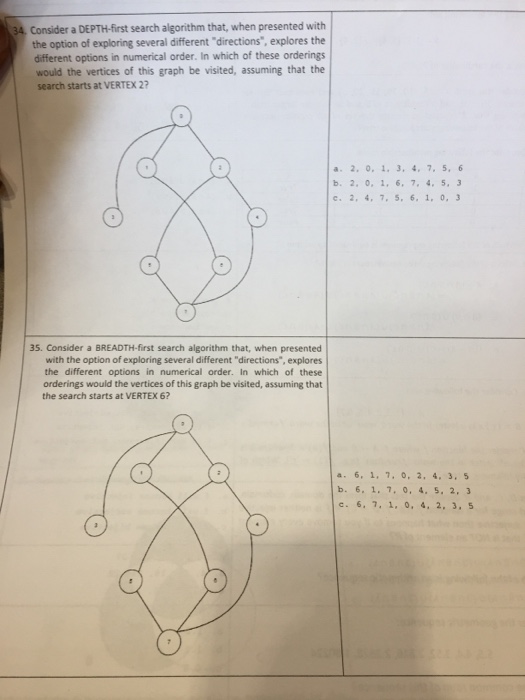
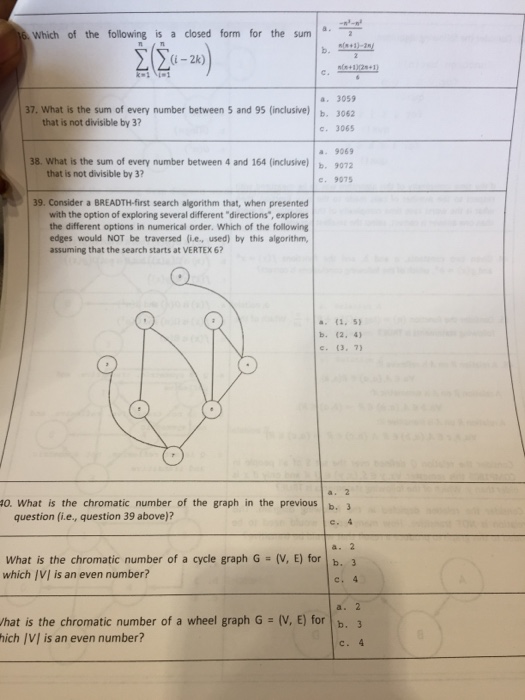
er the following algorithm: function bar (n) for 0 s is n qux a. 0(n2) for 1 s j s n b. 000g n) qux for i s k s n c. 0 (n') qux If the time complexity of this algorithm was to be measured with respect to the number of calls made to the qux function, then what is the worst case time complexity of this algorithm? If more than one answer is correct, select the smallest answer a. f() is o(g(x)) but it is not n(g(x)) 44. Given two constants, a and b, and the functions f(x) x" b fu)isin(g(x)) but it is not olg(x)) and g(x) b', which of the following conclusions is correct? a. f(e) is 0(n) and n(n?) 4s. Consider the function (n) (og n)(25n 8) Which of the b f(x)isn(n) and o(nz) following statements is TRUE? f(x) is e(n) 46. A relation R on A is reflexive a. Q is symmetric, transitive and Va e A, (a, a) E R(a, a). reflexive A relation R on A is symmetric if: Va, b EA, (a, b) ER (b, a) E R). is not transitive reflexive A relation R on A is transitive if: va, b, c E A. (a, b) E RA (b, c) E R (a, c) E R) c Q is not reflexive not symmetric Consider the relation 0 defined over the set s of all people in and transitive COMP1805 this semester. vx, y E S, (x, y) E Q if and only if x is older than y. Which of the following statements is TRUE? Consider the relation depicted in the following diagram. This relation is NOT transitive. How many edges would need to be added to this graph to produce a result that would be transitive? b. 3 c. 4
Step by Step Solution
There are 3 Steps involved in it

Get step-by-step solutions from verified subject matter experts
 Study Help