







Question: Discrete Math: Polynomials question. Please help and I will rate kindly. In class, we learned that n+ 2k packets are required to protect against general
Discrete Math: Polynomials question. Please help and I will rate kindly. 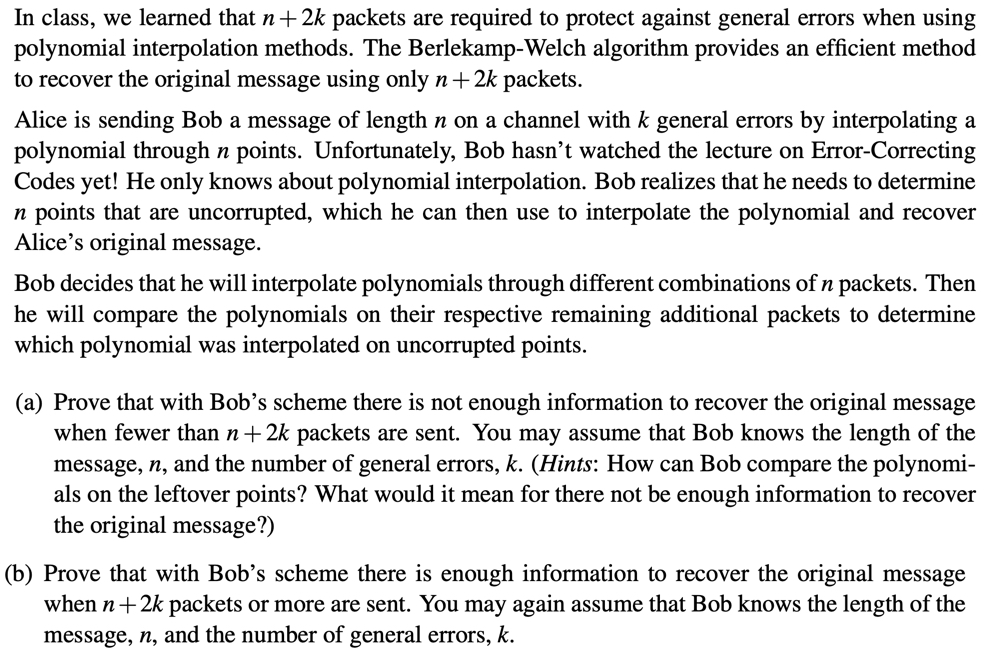
In class, we learned that n+ 2k packets are required to protect against general errors when using polynomial interpolation methods. The Berlekamp-Welch algorithm provides an efficient method to recover the original message using only n+2k packets. Alice is sending Bob a message of length n on a channel with k general errors by interpolating a polynomial through n points. Unfortunately, Bob hasn't watched the lecture on Error-Correcting Codes yet! He only knows about polynomial interpolation. Bob realizes that he needs to determine n points that are uncorrupted, which he can then use to interpolate the polynomial and recover Alice's original message. Bob decides that he will interpolate polynomials through different combinations of n packets. Then he will compare the polynomials on their respective remaining additional packets to determine which polynomial was interpolated on uncorrupted points. (a) Prove that with Bob's scheme there is not enough information to recover the original message when fewer than n+2k packets are sent. You may assume that Bob knows the length of the message, n, and the number of general errors, k. (Hints: How can Bob compare the polynomi- als on the leftover points? What would it mean for there not be enough information to recover the original message?) (b) Prove that with Bob's scheme there is enough information to recover the original message when n+2k packets or more are sent. You may again assume that Bob knows the length of the message, n, and the number of general errors, k. In class, we learned that n+ 2k packets are required to protect against general errors when using polynomial interpolation methods. The Berlekamp-Welch algorithm provides an efficient method to recover the original message using only n+2k packets. Alice is sending Bob a message of length n on a channel with k general errors by interpolating a polynomial through n points. Unfortunately, Bob hasn't watched the lecture on Error-Correcting Codes yet! He only knows about polynomial interpolation. Bob realizes that he needs to determine n points that are uncorrupted, which he can then use to interpolate the polynomial and recover Alice's original message. Bob decides that he will interpolate polynomials through different combinations of n packets. Then he will compare the polynomials on their respective remaining additional packets to determine which polynomial was interpolated on uncorrupted points. (a) Prove that with Bob's scheme there is not enough information to recover the original message when fewer than n+2k packets are sent. You may assume that Bob knows the length of the message, n, and the number of general errors, k. (Hints: How can Bob compare the polynomi- als on the leftover points? What would it mean for there not be enough information to recover the original message?) (b) Prove that with Bob's scheme there is enough information to recover the original message when n+2k packets or more are sent. You may again assume that Bob knows the length of the message, n, and the number of general errors, k
Step by Step Solution
There are 3 Steps involved in it

Get step-by-step solutions from verified subject matter experts
 Study Help