





Question: Discrete Math - Proof by Induction (7 steps) Binary establishes that any nonnegative integer m can be represented in binary. Now you'll show that this

Discrete Math - Proof by Induction (7 steps)
Discrete Math - Proof by Induction (7 steps)
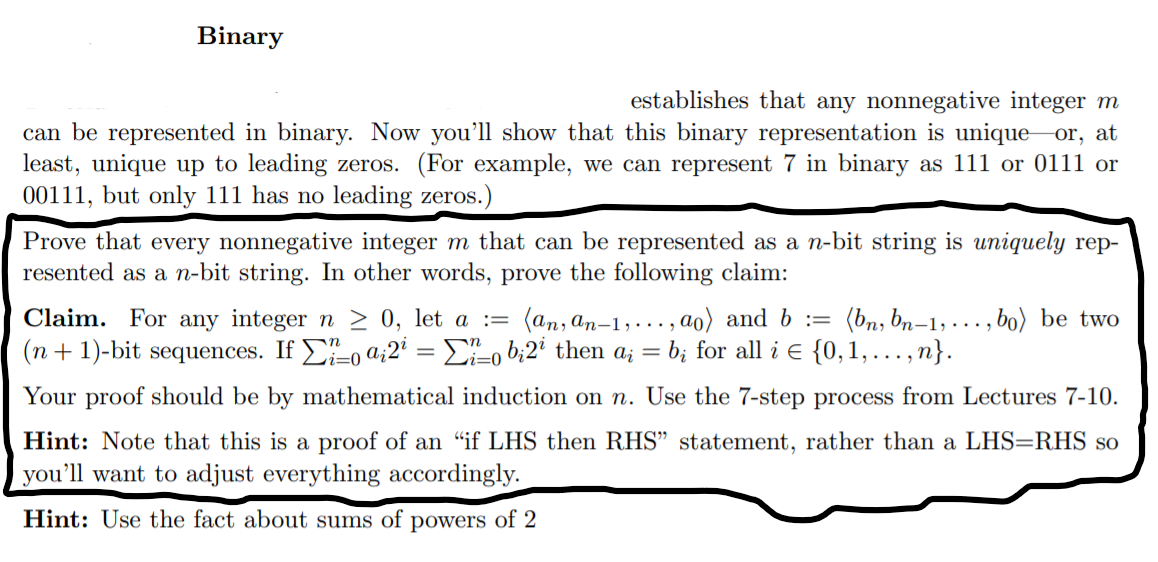
Binary establishes that any nonnegative integer m can be represented in binary. Now you'll show that this binary representation is uniqueor, at least, unique up to leading zeros. (For example, we can represent 7 in binary as 111 or 0111 or 00111, but only 111 has no leading zeros.) Prove that every n0nnegative integer m that can be represented as a 71-bit string is uniquely rep- resented as a n-bit string. In other words, prove the following claim: Claim. For any integer n 2 0, let a := (an,an_1,...,ao) and b := (bn,bn_1,...,bo) be two (11 + 1)bit sequences. If 22;) 042'- = 223:0 5323' then (13' = bi for all i 6 {0,1, . . . ,n}. Your proof should be by mathematical induction on 71. Use the 7-step process from Lectures 7-10. Hint: Note that this is a proof of an \"if LHS then RHS\" statement, rather than a LHS=RHS so you'll want to adjust everything accordingly. Hint: Use the fact about sums of powers of 2

Step by Step Solution

There are 3 Steps involved in it

1 Expert Approved Answer
Step: 1 Unlock blur-text-image

Question Has Been Solved by an Expert!

Get step-by-step solutions from verified subject matter experts

Step: 2 Unlock
Step: 3 Unlock

Students Have Also Explored These Related Mathematics Questions!